

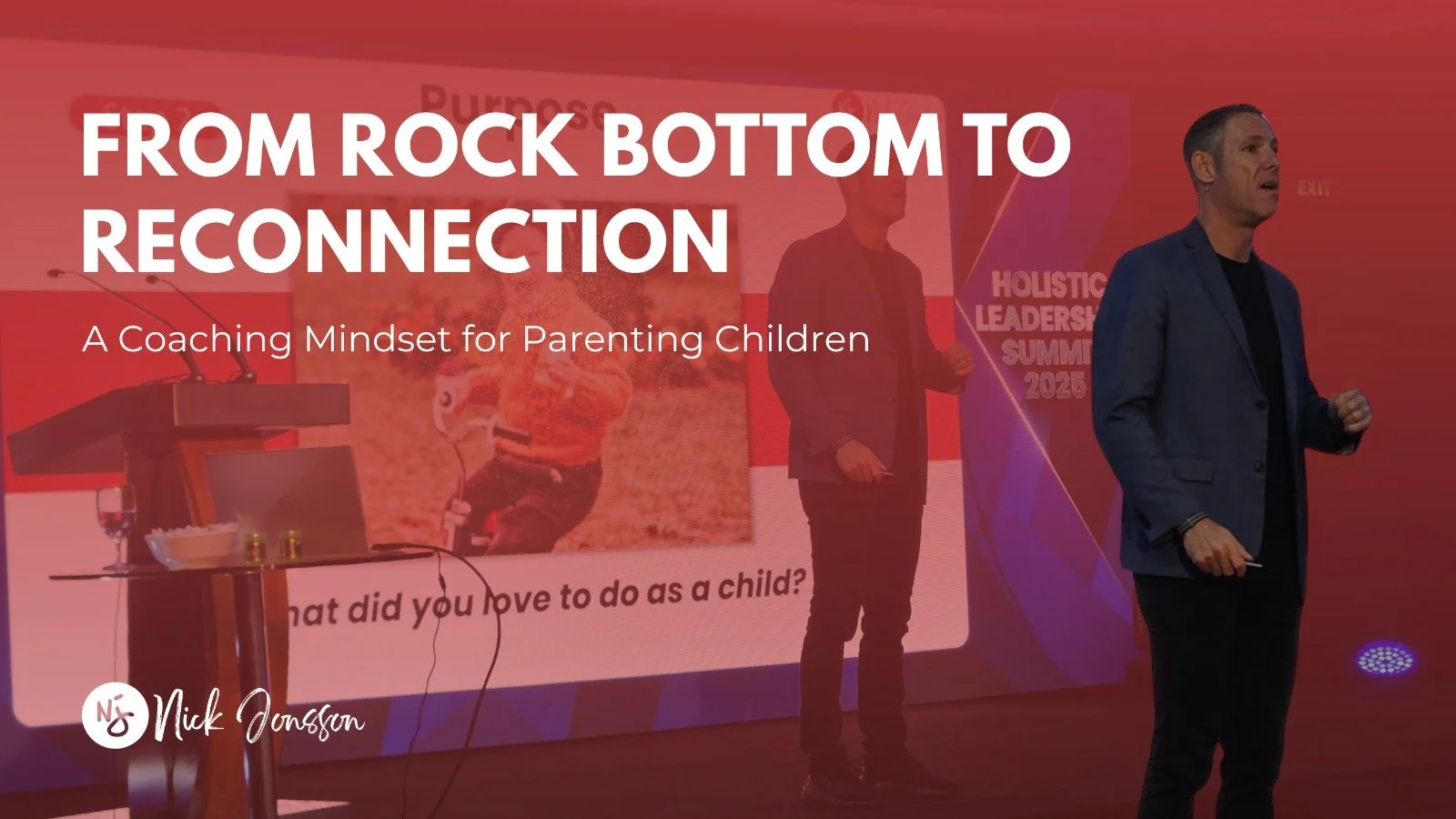
From Rock Bottom to Reconnection - A Coaching Mindset for Parenting Children
Private Parenting Community
Virtual | Two Regions, Two Time Zones | 3–4 December 2025
Some keynotes teach.
This one reconnected.
Delivered across two time zones on 3 and 4 December, From Rock Bottom to Reconnection was built for leaders who can run businesses, lead teams, and create performance — and yet still recognise a quieter truth:
It’s possible to succeed professionally… while slowly losing connection at home.
A client who invited Nick to speak later described it as “worthy of a call” — and that phrase became a theme echoed by participants across both sessions.
The strongest feedback wasn’t about polish. It was about presence.
It was “powerful.”
“Authentic.”
“Tangible.”
And unexpectedly, deeply human.
The Opening: Why This Conversation Matters
Nick began by acknowledging what many leaders feel but rarely say out loud.
Yes — on the screen were credentials and professional roles: coaching, psychological safety, sober coaching, ongoing psychotherapy & counselling training, mental health advocacy and suicide prevention work.
But the talk was never about certifications.
It was about a hard-earned discovery:
Titles, achievements, and money don’t repair disconnection.
What helps is something else entirely: human connection, psychological safety, vulnerability, and presence.
Over the years, Nick has helped leaders build those qualities in teams and cultures. But the real transformation, he shared, is when we bring those same leadership qualities into our families — because leadership isn’t only tested in boardrooms.
It’s tested at home.
And this session wasn’t about how we perform as leaders.
It was about how we reconnect as parents.
The Real Issue Leaders Talk About in Quiet Moments
After showing the breadth of organisations and media where Nick’s work has appeared, the message turned more personal.
In meeting rooms, leaders discuss success.
Outside them — the conversations change.
They become about: lost trust, a child pulling away, emotional distance, and silence.
Nick paused on that word because he knows it intimately.
Not conflict. Not shouting.
Silence.
And silence has a particular kind of pain.
It becomes the moment a parent realises: “My leadership skills are working everywhere… except where it matters most.”
The Premise: You Already Have the Skills
Nick didn’t position parents as “behind” or “broken.”
He positioned them as already skilled — just not always applying those skills at home with the same intention.
Business leaders already know how to:
build trust
mentor and develop people
listen and coach
create clarity
set direction and accountability
So this isn’t about learning something entirely new.
It’s about transferring what you already know into the relationships you value most.
This is where the session’s structure came in: four shifts that many high-achieving leaders miss — yet they are the ones that transform relationships at home.
And then Nick made it personal.
He shared that he didn’t learn this from a book.
He learned it the hard way — through years of disconnection with his son.
The Story: A Leader Without Connection
Nick described a season where his son didn’t want to speak with him. No fight. No dramatic scenes. Just emotional distance.
That silence triggered the questions many parents fear:
What kind of father am I?
How did I get this so wrong?
Why can I lead a business… but not repair this relationship?
It created guilt, shame, and powerlessness — and it exposed a painful truth:
Leadership means very little if you fail at connection where it matters most.
From there, Nick took the audience back through the story that shaped his lens — not for drama, but for meaning.
Early Identity: Work Hard, Don’t Talk About Emotions
Nick shared his working-class Swedish upbringing where emotions weren’t the language — work was.
If you wanted more money, you worked harder, longer, and more.
He did. He chased overtime. He chased intensity. He chased achievement.
And then life interrupted.
A motorcycle accident ended his ability to continue his old trade. With it, identity collapsed.
That moment forced him into growth. He returned to study as an adult, improved grades, and realised the future might be bigger than the past — but he needed English.
Australia became the leap.
The Winning Mindset: Excellence… and Anxiety
In Australia, a “winning mindset” was introduced as a way to approach education and life with excellence.
It worked — scholarship, achievement, a new sense of possibility.
But it also birthed something Nick later came to recognise in himself: the anxious overachiever.
Not simply driven by vision — but driven by fear of slipping.
That mindset carried into work.
The Climb: Success That Quietly Costs Something
Nick described the rapid corporate climb: titles, promotions, leadership responsibility, recognition.
He built a family. A home. The visible markers of success.
And then came the “arrived” moment — the senior title, the perks, the outer success — alongside an inner shift that surprised him:
More pressure. More isolation. More loneliness.
And less psychological safety.
Even with people he once had informal relationships with, he didn’t feel safe saying: “I’m struggling.”
He pushed harder, tried to work through it, and eventually resigned from the dream job — not because he wasn’t capable, but because he was breaking internally.
From there, the personal unraveling accelerated: leaving job, marriage, and becoming separated from his son.
The Drift: When a Person Becomes a Performance
Nick spoke about a long, gradual decline rather than one dramatic event.
He described a season of “smiling on the outside” while suffering inside — the kind of experience many leaders recognise but don’t name.
In that period, unhealthy coping patterns grew. He became more isolated. And his body began to signal what the mind was suppressing.
Eventually, he reached a point where he realised: something has to change.
Instead of presenting a sensational version of that moment, Nick framed it as a turning point of surrender — the beginning of recovery and reconnection.
The Turning Point: The First Step Is Surrender
This is where Nick introduced the framework that later became his core model: The Five Steps to Holistic Leadership.
He explained that recovery didn’t begin with more discipline, more achievement, or stronger willpower.
It began with surrender — letting go of the mask, the pretending, the lone-wolf leadership identity — and asking for help.
For Nick, that meant reaching out, opening up honestly, and stepping into genuine human connection.
“A problem shared is a problem halved,” he said — not as a slogan, but as something lived.
The Five Steps to Holistic Leadership
Nick framed Holistic Leadership as leading as a whole person, not just as a high performer.
He described the imbalance many leaders fall into: pouring intensity into professional responsibilities, while neglecting health, wellbeing, resilience, and relationships — until something breaks.
Then he walked the audience through the five steps:
Step 1: Surrender
The moment we stop managing everything alone and finally ask for help.
Step 2: Purpose
The question that follows recovery: “What am I rebuilding for?”
Purpose becomes service, direction, and meaning — not image.
Step 3: Connection
This was the heart of the session. Connection as the bridge between purpose and relationships — and as the foundation for parenting.
Step 4: Goals
Not only business goals — but goals that protect what matters most: health and relationships.
Step 5: Discipline
The consistency that keeps it alive — protecting what matters with time, presence, and accountability.
Nick made it clear the session would focus primarily on Connection and Goals, because that’s where real transformation becomes visible in family life.
Connection Starts With Self, Not Control
Nick described connection as something that begins internally: removing the mask, ending the double life, choosing authenticity.
He shared how real connection requires emotional safety — the kind you find in honest communities and support systems where performance isn’t required.
He emphasised that connection isn’t willpower.
It’s what replaces isolation.
And once we reconnect with ourselves, we become far more capable of reconnecting with others — including our children.
Relationship Fitness and the Cost of Disconnection
Nick brought in the idea that relationships are not “soft.”
They are health-related. They are performance-related. They are life-related.
The message was not “be perfect.”
It was: treat connection like something you train — like fitness.
Because leadership at home is not about strategy decks.
It’s about emotional availability.
“Keep Our Side of the Street Clean”
Nick then introduced a principle that became one of the most practical parts of the talk:
We can’t control our child’s response.
We can control our consistency, our calm, our emotional safety, and our willingness to show up.
That is leadership at its most human level.
The Reconnection With Percy: “Go Into His World”
The story then returned to Nick and his son — not as a motivational ending, but as a practical blueprint.
Nick shared that he sought professional guidance and received a simple instruction that changed everything:
Don’t ask him to come into your world.
Go into his.
That meant learning what his son cared about, referencing his world with specificity, and helping him feel seen.
When travel plans were disrupted, the principle remained: enter the child’s world.
Nick learned the game his son loved, showed up consistently week after week, protected the time, and built connection through presence rather than pressure.
And when they met again, he joined his son in the activities his son chose — reinforcing the same message:
Children don’t need perfect parents.
They need present parents.
Coaching Mindset in Parenting: The Shift That Changes Everything
From the reconnection story, Nick moved into the teaching:
Coaching is not giving people answers.
Coaching is helping people with their thinking — through listening, powerful questions, feedback, encouragement, and ownership.
And then he asked the parenting question:
How do we shift from telling and directing… to thinking together?
Nick shared his own evolution from directive parenting (fixing, explaining, advising) to coaching parenting (curiosity, questions, reflection, listening).
Not to remove structure — children still need boundaries and leadership — but to understand when to direct and when to coach.
That balance is where parenting and leadership truly meet.
Real Client Stories: Connection as the Compass
Nick then reinforced the model with real, anonymised examples from coaching work, showing that connection is not a philosophy — it’s a practice.
He shared stories of parents facing complex challenges who chose to stay emotionally available, calm, and present — becoming a safe base rather than an extra source of fear or control.
The point wasn’t the details.
The point was the compass:
When connection becomes the priority, healing becomes possible — and ownership can emerge.
Goals: Why Leaders Need Personal KPIs Too
From Connection, Nick transitioned to Goals.
Leaders measure what matters in business.
But many don’t measure what matters in life.
Nick asked participants to consider whether they set personal goals with the same clarity and accountability they apply professionally — because unwritten goals don’t guide action.
They become wishes.
He used a metaphor of driving at night without headlights: movement without clarity.
And he introduced the tool built to solve that: The Limitless Life Assessment.
The Limitless Life Assessment: Measuring the Whole Life
Nick introduced the Wheel of Life framework with eight areas — not as “work-life balance,” but as wholeness.
He emphasised that over-investing in one area eventually distorts the entire wheel.
He walked the group through each area (Business & Career, Finances, Health, Family & Friends, Romance, Personal Growth & Spirituality, Fun & Recreation, Physical Environment), inviting participants to notice where they were thriving — and where they were quietly neglecting something important.
Because the hidden insight is this:
We don’t parent from business success.
We parent from who we are — our health, our emotional availability, our relationships, our alignment.
Modelling: Children Copy Behaviour, Not Advice
Nick then grounded the Goals discussion in modelling.
He shared how the most influential parenting isn’t lecturing.
It’s living.
Living healthy sleep habits.
Living discipline and training.
Living growth through learning and study.
Not to impress a child — but to embody the values we hope they absorb.
This became one of the most practical parenting takeaways:
If you want your child to value wellbeing, growth, and discipline — show it.
The Close: What Leaders Took Away
Nick closed by returning to the purpose of the talk:
This isn’t about being a perfect parent.
It’s about four quiet shifts:
moving from instruction to ownership, bringing intention home, seeing family as foundational, and showing up consistently.
It’s about Holistic Leadership not as an idea — but as a life path: surrender, purpose, connection, goals, discipline.
And it’s about what becomes possible when we rebuild connection, not only with our children, but with ourselves, partners, and families.
Participant Feedback
Across both time zones, the feedback was consistent:
“Very powerful how authentic it was to listen from a father’s perspective.”
“Very well presented, interesting, tangible takeaways… and it felt worthy of a call.”
“Great presentation. Appreciated the visual on the red to green parenting coaching.”
“This event was fantastic — a perspective that the Parenting Community has not taken before.”
A client representative later summarised the impact in a way that captured the spirit of the session: it created a rare, authentic space where leaders could reflect honestly on their relationships — and leave with practical steps that actually work.
Bring This Keynote to Your Chapter or Community
From Rock Bottom to Reconnection: A Coaching Mindset for Parenting Children is available as a virtual keynote, in-person keynote, or extended workshop format.
If your community wants something story-driven, psychologically safe, and practical — designed to create real reflection and real change — this session can be tailored to your chapter’s theme and audience.
Enquiries: nick@nickjonsson.com
Website: www.nickjonsson.com
Or follow Nick on LinkedIn for weekly insights on coaching, leadership, wellbeing, and performance.