Building High Performing Teams Through Psychological Safety at InterContinental Maldives by Nick Jonsson and Dona Amelia

Building High-Performing Teams Through Psychological Safety & Holistic Leadership
InterContinental Maldives Maamunagau Resort
Facilitated by Nick Jonsson & Dona Amelia
Building Exceptional Guest Experiences Through Exceptional Team Experiences
In luxury hospitality, guests remember how they were made to feel.
Behind every memorable guest experience is a team that communicates effectively, supports one another, adapts under pressure, and consistently delivers excellence.
Yet even the most talented teams struggle when people are afraid to speak up, admit mistakes, ask for help, challenge assumptions, or share new ideas.
High-performing teams are not built solely through technical expertise, operational excellence, or service standards.
They are built through trust.
They are built through connection.
They are built through Psychological Safety.
Building High-Performing Teams Through Psychological Safety & Holistic Leadership is a transformational leadership and team development experience designed specifically for hospitality professionals who want to create stronger cultures, healthier teams, and sustainable high performance.
This highly interactive workshop combines the latest research on Team Psychological Safety, practical leadership and coaching skills, and Nick Jonsson’s proven 5-Step Holistic Leadership Framework to help leaders create environments where people feel safe to contribute, collaborate, innovate, and perform at their best.
Delivered by international speaker, bestselling author, and Global Gurus Top 30 Coach Nick Jonsson together with executive coach and leadership facilitator Dona Amelia, the program provides practical tools that participants can immediately apply within their teams and departments.

The Hospitality Leadership Challenge
The hospitality industry operates in one of the most demanding business environments in the world.
Leaders are expected to deliver:
· Exceptional guest satisfaction
· Operational excellence
· Strong employee engagement
· Effective cross-functional collaboration
· Consistent service quality
· High levels of productivity and performance
All while managing:
· Staff shortages
· Operational pressures
· Guest complaints
· Diverse workforces
· Constant change
· Growing expectations
When pressure increases, communication often breaks down.
People stop speaking up.
Concerns remain unspoken.
Mistakes go unreported.
Departments become siloed.
Collaboration suffers.
Guest experiences decline.
The greatest risk facing many organizations today is not incompetence.
It is silence.
The inability or unwillingness of employees to speak openly about problems, concerns, mistakes, ideas, or opportunities.
Organizations with strong Psychological Safety cultures create environments where people feel safe to contribute their best thinking, raise concerns early, challenge assumptions respectfully, and support one another through challenges.
The result is stronger performance, greater innovation, higher engagement, improved wellbeing, and better business outcomes.

Why Psychological Safety Matters
Harvard Professor Amy Edmondson defines Psychological Safety as:
“A shared belief that the team is safe for interpersonal risk-taking.”
In practical terms, Psychological Safety means employees feel safe to:
· Speak up with ideas
· Ask questions
· Admit mistakes
· Seek help
· Offer feedback
· Challenge assumptions respectfully
· Express concerns
· Contribute fully
Psychological Safety is not about being nice.
It is not about lowering standards.
It is not about avoiding difficult conversations.
It is about creating an environment where people feel safe enough to tell the truth.
Research conducted through Google’s Project Aristotle identified Psychological Safety as the most important factor influencing team effectiveness and performance.
Teams that experience high Psychological Safety consistently demonstrate:
· Better collaboration
· Faster learning
· Greater innovation
· Stronger engagement
· Higher trust
· Improved problem solving
· Increased accountability
· Better overall performance
For hospitality organizations, these outcomes translate directly into improved guest experiences, stronger teamwork, higher retention, and greater operational excellence.

Program Objectives
Participants will learn how to:
Build Psychological Safety
· Understand the science behind Psychological Safety
· Recognize the impact of silence within teams
· Create environments where people feel safe to contribute
· Foster trust and openness
· Encourage accountability without blame
Strengthen Leadership Effectiveness
· Lead with greater authenticity
· Develop emotional intelligence
· Increase self-awareness
· Build stronger relationships
· Improve communication and influence
Create High-Performing Team Cultures
· Improve collaboration across departments
· Strengthen trust within teams
· Reduce fear and defensiveness
· Encourage innovation and problem solving
· Create stronger team alignment

Develop Coaching Leadership Skills
· Master Active Listening
· Ask Powerful Questions
· Deliver meaningful Feedback
· Use Feedforward techniques
· Navigate Difficult Conversations effectively
Apply Practical Hospitality Leadership Strategies
· Handle operational pressure
· Support team wellbeing
· Resolve conflict constructively
· Improve communication during challenges
· Strengthen guest-focused collaboration
The Holistic Leadership Framework
At the heart of the workshop is Nick Jonsson’s 5-Step Holistic Leadership Framework.
Holistic Leadership is the integration of:
· Physical Health
· Mental Health
· Emotional Health
· Psychological Health
· Social Wellbeing
· Resilience
with Professional Responsibilities.
The framework provides leaders with a practical roadmap for sustainable personal and professional success.
Step 1: Surrender
Leadership begins with letting go.
Participants reflect on limiting beliefs, unhealthy habits, ego-driven behaviours, and obstacles that may be holding them back from becoming the leader they aspire to be.
Step 2: Purpose
Purpose creates clarity.
Participants reconnect with what gives their work meaning and identify how they can contribute more intentionally to their teams, guests, and organization.
Step 3: Connection
Strong leadership is built on strong relationships.
Participants explore ways to deepen trust, strengthen communication, and create meaningful connections with colleagues and team members.
Step 4: Goals
Purpose without action remains a dream.
Participants identify meaningful goals and align personal growth with professional performance.
Step 5: Discipline
Lasting success requires consistency.
Participants identify the habits, routines, and behaviours necessary to sustain growth and high performance over time.
The Seven Elements of Team Psychological Safety
Participants explore the seven essential ingredients of psychologically safe teams:
1. Reaction to Mistakes
How teams respond when errors occur.
2. Dealing with Issues
The ability to discuss difficult topics openly and constructively.
3. Embracing Diversity
Valuing different perspectives, backgrounds, and ideas.
4. Taking Risks
Encouraging innovation and experimentation.
5. Asking for Help
Removing stigma around seeking support.
6. Mutual Support
Creating a culture where people help one another succeed.
7. Appreciation
Recognizing strengths, contributions, and achievements.
Participants identify positive and negative team behaviours associated with each element and develop practical actions to strengthen Psychological Safety within their own teams.
Coaching Skills for Modern Leaders
Today’s leaders must do more than manage.
They must coach.
Participants develop practical coaching skills that improve engagement, accountability, communication, and performance.
Active Listening
Leaders learn to:
· Listen beyond words
· Understand emotions and concerns
· Create space for meaningful dialogue
· Build trust through presence and empathy
Powerful Questions
Participants learn how to ask questions that:
· Encourage reflection
· Promote ownership
· Create clarity
· Unlock solutions
Feedback
Participants explore how to:
· Deliver constructive feedback
· Receive feedback effectively
· Create a feedback-rich culture
· Support continuous improvement
Feedforward
Participants learn how to shift conversations away from blame and toward future-focused growth and development.
Difficult Conversations
Leaders develop confidence in addressing:
· Performance issues
· Conflict
· Misalignment
· Sensitive topics
while maintaining trust and respect.
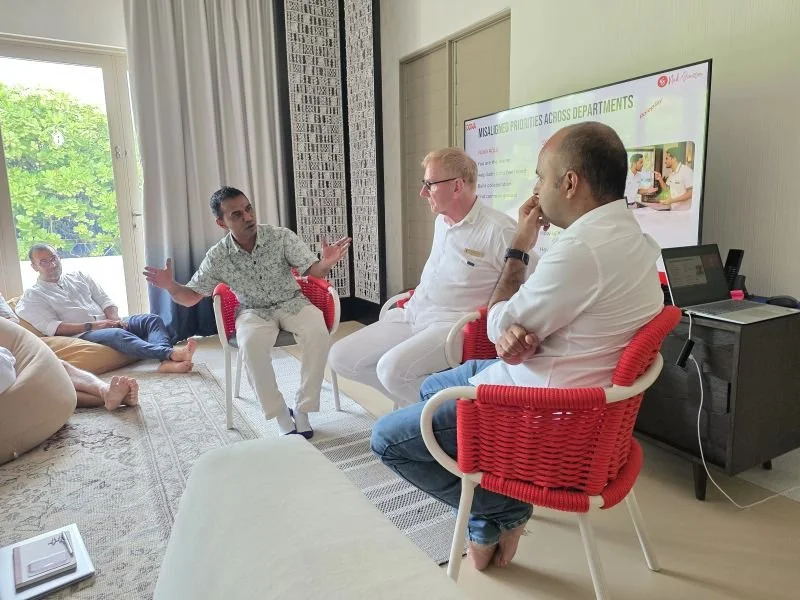
Hospitality Leadership Role Plays
A key feature of the program is the use of realistic hospitality scenarios that allow participants to apply concepts immediately.
Scenarios include:
The Overwater Villa Emergency
Managing communication breakdowns, guest dissatisfaction, and cross-functional collaboration.
Handling Stress Under Pressure
Leading teams effectively during high-pressure operational periods.
Misaligned Priorities Across Departments
Building alignment, collaboration, and mutual understanding between teams.
These practical exercises help participants move from theory to action.
Expected Outcomes
Following the workshop, participants will be able to:
· Build stronger and more connected teams
· Create psychologically safe working environments
· Lead with authenticity and confidence
· Improve communication and collaboration
· Increase trust and accountability
· Navigate difficult conversations more effectively
· Reduce workplace stress and conflict
· Strengthen employee engagement and wellbeing
· Enhance guest experiences through stronger team dynamics
· Develop a culture of continuous learning and improvement

About the Facilitators
Nick Jonsson
Nick Jonsson is a Certified Master Coach (CMC), Professional Certified Coach (PCC), Counsellor, Psychotherapist, TEDx Speaker, bestselling author of Executive Loneliness, and founder of Limitless Executive Solutions.
Ranked #28 in the World among the Global Gurus Top 30 Coaching Professionals, Nick has worked with leaders and organizations across Asia, the Middle East, Europe, and Australia to develop high-performing teams, psychologically safe cultures, and resilient leaders.
His mission is:
“Empowering people to build a Limitless Life through Vulnerability & Holistic Wellbeing.”
Dona Amelia
Dona Amelia is a Global Keynote Speaker, Executive Coach, Leadership Facilitator, and LinkedIn Top Voice.
Known for her dynamic facilitation style and deep expertise in leadership development, communication, and team effectiveness, Dona helps leaders create cultures of trust, engagement, collaboration, and high performance.
Together, Nick and Dona combine global leadership expertise with practical hospitality experience to deliver transformational learning experiences that create lasting impact.

Final Message
High-performing teams do not happen by accident.
They are built intentionally.
They are built through trust.
They are built through courage.
They are built through meaningful conversations.
And they are built by leaders who create environments where people feel safe enough to bring their best selves to work every day.
Because exceptional guest experiences begin with exceptional team experiences.
Or follow Nick on LinkedIn for weekly insights on coaching, leadership, wellbeing, and performance.