

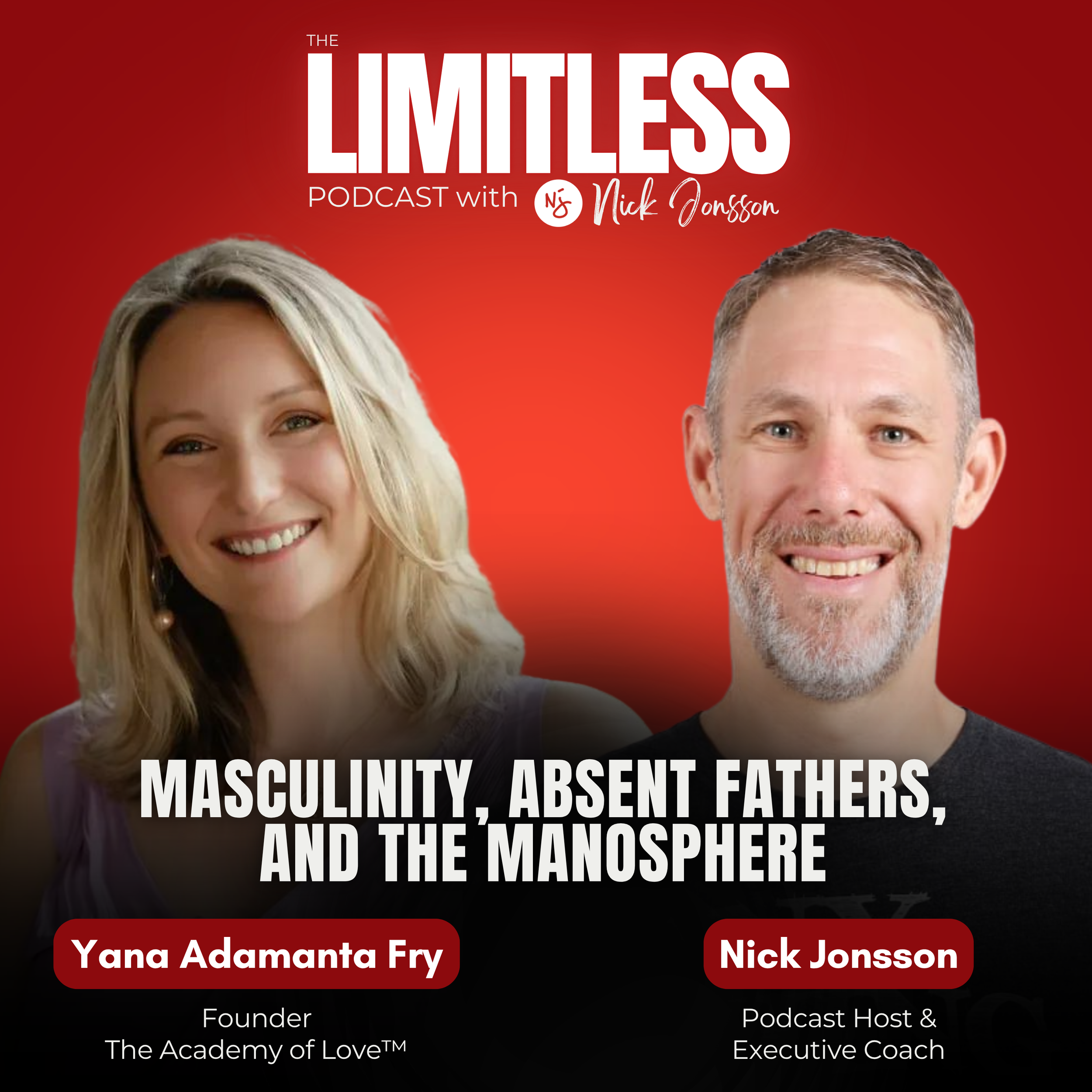
Episode 336: Yana Fry - Masculinity, Absent Fathers, and the Manosphere
Ask most people to define healthy masculinity and you get adjectives. Yana Fry gives you behaviour. A man who is stable and consistent. Who does what he said he would do, shows up when he said he would show up, and finishes what he starts.
She had to go and find that definition, because nobody handed it to her. Her parents divorced when she was eight, after her father spent twenty years married to her mother and then fell in love with her mother’s best friend. Her older brother could not carry it, and the drinking that started around then has gone on for decades. Yana spent years, fifteen of them in therapy, working out what she had never been shown at home.
Which is exactly why her position on angry men is worth sitting with. She has watched the comments fill with hostility beneath a reel about women and marriage after forty. She has looked into where the loudest voices online came from and kept finding the same house: an absent father, or a violent one, and pain nobody ever named. When I asked what she would say if one of those men sat across from her, she did not reach for an argument. She would ask how he is doing.
We also get into something I run into constantly in my own coaching work — men who will tell me things they will never tell their wives. Her answer to that was not the one I was expecting, and it puts the responsibility somewhere uncomfortable.
For anyone who has stopped believing this conversation can still be had honestly.
Contact Yana to collaborate:
Website: https://yanafry.com
LinkedIn: https://www.linkedin.com/in/yanafry/
Instagram: https://www.instagram.com/yanafry/
Episode Transcript
Host: Nick Jonsson
Guest: Yana Fry, Founder, Academy of Love
Nick Jonsson: Welcome back to another episode of the Limitless Podcast. Today I'm very excited, because I have someone with me who I've been talking to for quite some time about the topic we wanted to explore. We're going to dig into masculinity, but actually masculinity in the eyes of a woman. So with that, it's my pleasure to welcome to the Limitless Podcast Yana Fry. Yana, how are you?
Yana Fry: Hi Nick, it's a pleasure to be here.
Nick Jonsson: It's great. I'm so excited that we finally got to do this.
Yana Fry: Me too. Finally, we get to talk about it.
Nick Jonsson: I know. Just to kick us off, who is Yana?
Yana Fry: Yana is a human, a woman, a wife, a mother, a businesswoman, a modern woman who is trying to have it all and isn't sure she's having it all. I'm also someone who is very passionate about love and relationships, and that's how I founded the Academy of Love. Personally, through my own life journey, I have always been fascinated by the dynamics between men and women, masculine and feminine: what makes a relationship last, what makes it happy and mutually nourishing, and what doesn't. And I guess that's probably the theme of our conversation today.
Nick Jonsson: Yeah, I'm very much looking forward to digging into this. You run the Academy of Love. What is that about?
Yana Fry: The Academy of Love is my heart baby. It's a project I started after having my daughter. I realised that I wanted to do something that really nourishes me and ignites me. In the middle of one of those sleepless nights of breastfeeding and co-sleeping, I reflected on what I wanted to do in the spare time I had as a mum, and I just felt that it had to be connected to love. That's when the idea to open an academy of love came up.
Right now it's a space that is open only to women. Maybe in a year or two I will expand it to men. You and I have talked about it for a possible collaboration. But at the moment it stays for women only. Fundamentally, it is where women come to learn how to love themselves first, so that they can truly show up for their partners and love their partners, and then love their work, love their families, and love the world around them.
Nick Jonsson: Beautiful. So what I'm hearing, Yana, is that it's for women to love themselves so they can show up for the couple. And the next chapter might be that you run this for couples, or for men as individuals?
Yana Fry: Exactly. Probably for couples and men. But as a working mum, it all comes in stages, right? There are only 24 hours in a day.
Nick Jonsson: Absolutely. Well, that sounds very exciting and something for us to follow. So let's dig into the topic of today. What does healthy masculinity mean to you?
Yana Fry: This is such a great question, Nick. I'm a girl from a broken family. My parents got divorced when I was eight years old. My father was married to my mum for 20 years, and then he fell in love with my mum's best friend and married her. So it was not a peaceful separation by any means.
My first experience of masculinity was not empowering at all, to be honest. It was a father who was not there. Then my older brother couldn't cope with our parents separating, and he developed an alcohol addiction. That has been going on for decades, and you know how destructive that can be. So my answer comes from someone who was not born into a family structure where I knew what healthy masculinity is.
So I had to learn it later, and I did. It took me many years, a few decades in fact, many books, many resources, and 15 years of therapy to heal everything that happened and to actually understand what it means to be comfortable with the healthy masculine.
In my understanding right now, the healthy masculine is an energetic state, a human being who is stable and consistent. He does what he says he's going to do, shows up when he says he's going to show up, and completes the things he has started. There's a lot of consistency and predictability there.
If we're talking specifically about human beings, I would say a man with a healthy masculine is anchored within himself. For most men, that would probably mean doing enough inner work, just like I did as a woman, and I know you did as a man, because most of us have some kind of trauma or difficult life story. It's like a demon sleeping in the closet. If we don't address it, it's constantly going to come and bite us in all our relationships.
So I feel the first step for a man is to be mature, brave and conscious enough to understand, "Yes, I have to do this inner work," and then to be proactive and find people with whom he can do it, so that he heals himself to the best of his ability. Then there's a chance to show up for the woman from a much more grounded space.
Nick Jonsson: And Yana, the work that you do with women, is that one-on-one, or do you work with them in groups? Can you paint a picture of how someone would work with you?
Yana Fry: Of course. It's actually both. There's a lot of group work. I run online programmes, with women tuning in from all over the world. The highest programme in the Academy of Love, which we call Relational Mastery, is a 12-month programme. It's a one-year commitment, because I feel that transformation takes time. In my experience, it's not something you can do in one or two sessions. It took me 15 years. I'm not sure I can tell them it will take them 15 years, but at least one year of your life you have to commit if you really want a deep transformation.
They do it in facilitated groups, and the content is partly pre-structured and partly live, depending on what we're covering. My baby is still very little, but eventually, once I finish breastfeeding, I would also like to resume retreats, and that's going to be in-person work. But for now, it's all online.
Nick Jonsson: So you're doing this inner work with the women. What about the men, in your experience? The husbands or partners of the women you work with, do they have someone they work on themselves with? Are they reluctant? What do you see? Are they also doing this work?
Yana Fry: Before I started the Academy of Love and decided, at least for now, to focus on working with women, I did work with men. In fact, for almost 12 years of my life, all the coaching and spiritual guidance I did was gender-inclusive. So I have experience of working with men, at least the men who would show up in my space.
In those days, the men who came to my programmes were always the ones looking for healing. So I can't say they were far from it or didn't want to do it. No, they wanted to do it, and they wanted to heal. Maybe there weren't many options for them, because I feel there is much more support for women in this area. For a woman who says she wants to do inner work, healing and feminine work, there are many more facilitators and teachers offering that kind of work. For men, I think the pool of people who can hold space for them is a bit narrow.
And maybe there are also fewer male examples who are a living embodiment of their teaching, because I'm a big believer that you can only teach what you have integrated yourself. This is not book knowledge. You can read some books and get some tools, but if you haven't actually lived through the experience yourself, you can't really guide other people. So I feel there's a smaller pool of men who can do this. Luckily, with people like you, this pool is expanding, and there are more and more men, but still.
That's one side of the story. On the other side, unfortunately, I did hear from quite a few women who came into my space to do this inner work that their partners were either not supportive of them doing it at all, or were not willing to look at themselves. They would blame the women for wanting to do this work and complain: "We've been married for 10, 15, 20 years. It was all fine. And now suddenly you decide you want some kind of awakening and inner work. You're being brainwashed. It's all a sect. What happened to you? It's all wrong." So it's not always positively received.
What I hear from women is that it puts them in a very difficult position. On one hand, they feel this calling to do the healing. On the other hand, if their husband is not supportive, many of them seriously contemplate divorce, because they feel they can't become the best version of themselves. And that creates a downward spiral.
I can also give you an example. I was recently invited on The Forties Formula podcast with Amanda and Jasmin, and we spoke about what happens to women after 40, specifically love and relationships after 40. Afterwards, they posted a reel on Instagram that went viral, and it's still going viral. The reel is about how, after 40, women seem to be waking up. They're questioning their relationship and whether this is the marriage they want to be in. It's exactly what I'm seeing with my students and clients.
To my surprise, as a result of this reel, a lot of women followed my account, but none of them really commented under it. And there were many, many men complaining in the comments about how unfair it is, how women should not be doing this, that it's all perimenopause, that we are all b*tches, that it's all hormonal and not logical at all, that women are basically not reliable. They said content like this tells men never to marry, because when a woman reaches her 40s, she's probably going to leave you anyway, because now she wants love and personal development. So it's interesting how men and women are just not aligned on this topic.
Nick Jonsson: Yeah, this sounds like a big topic indeed. So what is happening when women turn 40, according to you? What is beneath this?
Yana Fry: I won't lie, I think it probably has something to do with hormonal changes, whether they are entering perimenopause or not. There are a lot of changes happening in the body and in the mind biologically, which is very normal. And statistically, we see that many women choose, or circumstantially happen, to have children later. Many are having kids in their 40s, not in their 20s as it used to be. Of course, all of that changes a woman's perspective and values, and suddenly she wants different things in life.
That's one part of it. The other part, I would say, is maturity. For the first 20 years of your life, you're clueless, right? We all are. You're just growing up. For the next 20 years, you try to figure out what you want, who you are, who you want to be with, and what kind of life you want to live. So whether you're a man or a woman, by the time you reach 40, you understand yourself better.
It's just that now, because there are a lot of conversations about it, women maybe have more permission to even ask themselves these questions: Am I okay? Am I happy? Is this what I really want? Do I have to keep putting up with something I've been putting up with but did not like for all these years? Can I choose what I really want and follow my dreams? How much longer am I going to live? How much time do I have left to follow my dreams?
So I think mortality also comes into play, when they start realising, "I'm not going to be here forever, so what's the point of living someone else's dream when I can pursue mine?" I feel all of that is a combination. That's why women who turn 40 can suddenly become more volatile and question more in this area. And I can understand that for men who didn't expect it, it would come as a shock. I fully understand that.
Nick Jonsson: Yeah. So what would be the solution for these kinds of situations when this happens?
Yana Fry: I would strongly recommend couples therapy. Strongly, because otherwise there is a very high chance of divorce. Not because women are right and men are wrong in this particular situation, but simply because if they're not trained in the art of conscious communication, there's miscommunication, and they're not able to speak to each other in a way that lands.
On the contrary, even though they may both feel they're trying to speak what is true for them, it lands as an attack on the other person. The other person gets defensive or withdraws, and the conversation dies. I find that's probably the biggest issue in this situation: a lack of conscious communication, because they don't know how to do it.
So I would strongly recommend going to see a couples therapist who specialises in this. There's also a beautiful methodology called Nonviolent Communication. Go and learn it, practise it, and see how you can talk to each other without triggering each other, while at the same time speaking your truth.
I'm personally a big supporter of families staying together, especially if you have children, because I lived through divorce, and many of my clients have lived through divorce. I know what it means. I always say, if you're in your first marriage and you think it's challenging, and you have kids and you're considering divorce, you have no idea how difficult it will be after the divorce with step-family dynamics if you ever want to remarry. It's a whole new level. So it's actually much easier to make it work in your first marriage.
So don't be lazy. Go and ask for help, and again, commit to at least one year. We're not talking about one or two sessions, where you get upset because the therapist or coach said something that triggered you, and you say, "It's not working, I'm out." Unfortunately, I often hear this about men, because in those situations it's usually the women who convince their partners to go to couples therapy, and the men are reluctant. Often they go, but because they didn't want to be there, when the therapist or coach says something they don't like, they say, "It's not working for me," and that's it.
So be better than that. Give it a year. If you really try to find common ground and understand each other, and after one year it's still not working, then at least you can make a more informed decision about what to do next.
Nick Jonsson: Yeah, I love that you say a one-year commitment, because you've got to give it a fair chance for everyone involved. And I've heard of some bigger cases where that's what it takes. I even know people in the US who said, "We went for half a day a week for one year."
Yana Fry: Exactly. So commit to it. And maybe for guys, I sometimes feel like this: a man can commit to the gym, right? If you have a sporting goal, you go and exercise. If you have a business goal, a certain amount of money, you put your head down, work and make it. It's the same. If you really want your marriage to work, it has to become one of your priorities, in your schedule and in your values, and you have to commit to it.
Nick Jonsson: Yeah, and I can hear you saying that men are reluctant to show up for this. That's my experience as well, Yana, because many of the men I work with are so scared to be vulnerable that they don't share. Many of the high-achieving men I work with don't even trust their wife. They don't trust the woman in their life, so they're scared to open up. There are a lot of secrets I know about my clients that they would never even think about sharing with a partner, and these are big things. So what should we change here to break down the barriers and have more honest conversations, do you think, Yana?
Yana Fry: Wow, this is such a deep and important question, Nick. Here, I feel it's also on women. As coaches, and we are colleagues in this, we know that a person will open up only to the extent that safety has been created. So if a man feels that he cannot talk to his partner about something, it is as much on her as it is on him.
From his side, it could be fear, or vulnerability. But they talk to you, right? They're able to open up in your presence and share all those secrets. Not because you're a man and not a woman, but because you're able to create a safe space, because you know how to do it.
This is actually part of the curriculum I teach inside the Academy of Love. I teach women about healthy masculinity, what it means, and also about men's psychology, and how to create spaces in the relationship where everyone feels safe enough to actually talk and share what is true for them, and share secrets.
I personally believe that in a healthy relationship, both partners would be able to share their secrets. Not just secrets, but things that are shameful and traumatising, things they have probably never shared with anyone. They would share them with their partner. So if you cannot say something to your partner, I would ask questions about your relationship.
Nick Jonsson: The kind of cases brought to me might be that someone has been out for a big night, something happened, maybe they were caught by the police, and there were some after-effects. They wouldn't dare share this with their wife, for fear that she might tell someone else and it would come out, or that it might be held against them if there's ever trouble in the relationship in the future. "I don't want her to have this on record and hold it against me." Those are all the reasons why they keep a distance from their wife. That's high-performing men. If the relationship is a bit shaky, they just move further and further away. So I'm not surprised if women feel that the men are not coming to the table.
Yana Fry: But I also understand men. I fully do in this situation. If the marriage is not stable and the man doesn't feel secure, then of course he wouldn't want to reveal any information that could hypothetically be held against him in court in the case of divorce, money matters and child custody. I understand all of this.
But to me, this kind of relationship especially needs work. Something is not right, because in this kind of dynamic, what is missing is one of the foundational pillars of a relationship, which is friendship.
To me, a husband and wife should first and foremost be each other's best friends. It should be a person you can talk to about anything and share all your secrets with, as I said. You can be open about any of your struggles, mutually, and you know you won't be criticised or blackmailed. You will be understood in whatever is happening.
You're also given space to process it, without the other person trying to fix you or taking responsibility for your journey. It's your journey. You just want to talk with the person you love and have a human conversation. But fundamentally, it's your journey, right? So I feel there is work here for both him and her.
Nick Jonsson: Yeah, I certainly agree with you, Yana. You mentioned masculinity earlier. What are the biggest misconceptions about masculinity today, would you say?
Yana Fry: Just recently, as you and I spoke about, I watched the Inside the Manosphere documentary. Then I did some other research online. That film is in English, and you know I come from Eastern Europe, so I also checked what's happening in Eastern Europe in different languages. I found exactly the same thing: the same patterns, the same type of influencers, and exactly the same story going on. So I feel this is a huge thing right now, cross-culturally, around the world.
There is this rise of men who, from my research, all come from difficult backgrounds. If you actually look at their childhoods, they either grew up without a father, or they grew up in a very violent family where the father was abusing the mother physically, verbally, financially, or in some other way. So they didn't have a healthy family dynamic to begin with.
What I feel has happened is that they have not really processed their traumas. They're probably in complete denial about them. If you asked them, they would say, "I have no trauma. What are you talking about? I'm a man. Men don't have trauma." They don't know what they don't know, or even if they do, they're too scared to look at it.
What we do know is that when trauma is not processed, in my experience, it manifests differently in men and women. For a man, it very often manifests as aggression towards the world or others. This is where all the destructive behaviour comes in: the fights, the wars, discrimination, humiliation. A man releases his pain in that way. I'm not saying it's good or bad; it's just how men often do it.
For women, it's usually the opposite. Women tend to release it internally, and that's why women become suicidal, have eating disorders, become depressed, become their own worst critics, lose massive self-confidence, and keep finding themselves in very destructive, codependent relationships.
So if we look at a man and a woman who both come from difficult backgrounds, which the majority of people do these days, and they haven't worked through it, we have him expressing it externally through aggression, and her internalising it through self-criticism. Of course they're a perfect match. He will bully her, and she will never leave the relationship, because this is trauma bonding, right? So again, I feel it takes two to tango, and the healing needs to happen on both sides.
Nick Jonsson: Yeah, and you mentioned earlier, Yana, the lack of a father figure, a healthy father figure, as a man is growing up. How big a role do you think that plays in this?
Yana Fry: I think it's huge, especially for a boy. I'm not saying that the mother is not important. Of course she's important. But a young boy who grows up without a father who is stable, balanced, grounded and healed to the best of his ability, so that he can provide guidance, has no role models.
And I think this is exactly what has happened with phenomena like the manosphere. From what I have seen, the audience is teenagers and very young men in their 20s who are all lost. They don't have a clear father figure. So where are they going to find one these days? Of course, online. You go on the internet, you see some guy you can somehow relate to, and he becomes your unspoken father figure. And this is very dangerous.
So for any man who has kids, regardless of the relationship he might have with the mother of his children, and I would hope he tries to have a civilised relationship with her, being a father to your children is a whole other conversation. If a man is not there for his boys, there's a very high chance they will grow up to be very destructive. If a man is not there for his daughter, there's a very high chance she will grow up to be in a codependent relationship where she's abused by a man. It's an unfortunate fact, and it's happening in real life.
Nick Jonsson: Yeah, and with so many divorces out there, in many countries almost 50% of marriages end in divorce, right? That means there are a lot of single parents, maybe single mothers raising boys. What should they do to help these boys grow up with healthy masculinity?
Yana Fry: I think it is very tough for a single mum to raise a boy. I think it's a much harder job than raising a daughter when you're a single mum. So first of all, have some compassion and empathy towards the many women who find themselves in this situation. It is very challenging for them.
From the mum's perspective, I would say look around and, to the best of your ability, try to find a man who could be a father figure to your son. Not necessarily your romantic partner or future husband, but specifically a father figure to your son. It could be a friend, a relative, maybe even a colleague at work, anyone you have a good human relationship with who you feel could fill that role.
I would just go and have that conversation with that person, or maybe even several men, and ask: "Look, I'm a single mum raising a boy, and I feel he really needs a father figure. Would you be willing to mentor him? Would you be willing to give some of your time to spend with him, take him on activities, and talk with him about life? I would really appreciate it." That's what I would do as a woman.
On the other hand, as a man, when you look around your neighbourhood, your family and even your friends, and you see single mums trying to raise boys, go and offer your help. Have this conversation with the woman and say, "Hey, I know you're struggling. It must be very difficult trying to do everything for this kid. I would like to help and maybe spend some time with the boy. Would you allow me to do that?"
Nick Jonsson: Yeah, I think there are some great tips there. And when you watched Inside the Manosphere, was there something that stayed with you?
Yana Fry: Yeah, it really unsettled me. It honestly unsettled me. But what I thought about most was actually the consequences of it. Not even the film itself, or the fact that it exists for those guys who are the influencers, but what they are doing to younger boys.
I did a bit more research, and what I found is that, as a result of the movements highlighted in the manosphere, there is now a whole generation of teenage boys who are bullying female teachers at school, especially in state schools. They're refusing to listen to female teachers, they're barking at teachers, and they're trying to trigger their teachers, because somehow they feel it makes them a man.
Being a female teacher in a state school is tough to begin with, because you're already being bullied one way or another. But if you now have this attitude from teenage boys, who can be very harsh and unsentimental, I just think it's not serving anyone. And then I wonder what kind of men those boys are going to grow up to be.
We are talking here about the next generation. Those are the men who are going to go into the workforce and into politics. They're going to marry and have kids. So I'm thinking about what's going to happen to society in 10 or 20 years as a result of this, and I don't think it's a good thing if we don't correct it right now.
Nick Jonsson: Yeah, I share your concern about how they're going to grow up. And if one of these influencers sat across from you today, Yana, what would you want to ask him?
Yana Fry: I would ask him, "How are you doing? Tell me what has really been happening in your life. How is your relationship going with your girlfriend or your wife? How are you feeling under all this pressure as an influencer to constantly perform and create all this content? Are you tired? Do you feel that you always have to perform, always be on, and on camera, even when you don't feel like it?"
I would do my best to create a safe space for them to open up and just talk about what's happening for them. And I would do my best, to the best of my professional ability, to stay non-judgemental and try not to offer any advice, but just give them space to have a human conversation. That's what I would do.
Nick Jonsson: Yeah, and do you think they have any safe spaces? Do you think they have any human conversations at all in their lives?
Yana Fry: I don't think so. And this is something I saw quite a lot in the Inside the Manosphere film, if you watch very closely what goes unsaid between the sentences, their facial expressions and their body language. You could see that those men were not comfortable with many things. They feel very threatened in many ways, so their nervous systems are not relaxed at all.
They feel they have to make money from what they are doing, so there's an expectation to consistently deliver a certain angle in their content, whether they like it or not. I feel that some of them don't even fully believe in it, but it's what drives likes and followers, and it's how they can sell brand sponsorships and make money. So I think it's very tricky. They've almost got themselves into something that, I do wonder, quietly at night, they may be wondering how to get out of.
Nick Jonsson: Yeah, there are a lot of financial scams involved as well. And as you said, they've got to earn money and put food on the table at the end of the day, right?
Yana Fry: Yes, this is their business, so they are monetising it. I have been a content creator for 15 years now, so I know what it means when you create content. If this is your main stream of income, and you've positioned yourself in a particular way as a certain type of content creator, it's very difficult to pivot, change niches and suddenly become something else, because you gained your audience through that particular angle. But you might outgrow it with time. Then what do you do with your business? That also requires a level of maturity, I think.
Nick Jonsson: Yeah, sure. So with these men, who, in our eyes at least, are struggling, what should we do? Has society perhaps done a better job talking about the struggles of women than those of men? And if so, has that been unintentional? What should we do here?
Yana Fry: I have realised over the last three years that there are a lot of angry men in the world right now. I think more than before, at least more than before the pandemic. Or maybe they weren't speaking up as much before, but somehow the internet has become much more hostile. There's much more anger expressed by men on all kinds of issues and topics.
I don't think that's a coincidence. I feel it's the result of what is happening more widely in society, where perhaps men feel there are fewer opportunities for them, maybe fewer job opportunities. Now AI is also coming in, and they feel they're falling behind, with perhaps even fewer opportunities.
We know how important it is for a man to know that he can have a professional path where he can make a living, because for many men, it is a big part of their identity. So if you take that away from them, what are they going to do? In fact, this was even mentioned in the Inside the Manosphere film, where some of those boys or young men said this was the only way for them to make money: to engage in this kind of extreme, violent behaviour on camera, because they can monetise it.
I'm not sure if failure is the right word, but nothing else comes to mind. I would say it's a failure of society, where society is failing men in this regard, and that's why they feel the need to do things like this. And at the same time, of course, with the rise of feminine empowerment, and everyone talking about how it's now the girls' era, "Go, girl, do this," I can see how it is hard for men.
My stepson is 22, so I have the perspective of a young man. My husband is Indian, but his previous wife was fair-skinned, like me, so my stepson looks quite white. So again, there's this cliché opinion about the white man.
When I have conversations with him about the struggles in the world and how difficult it may be for women, from his perspective he says, "It's very unfair. Do you think it's not difficult for me? Do you think it's not difficult for my friends? Do you think it's not difficult to be a white boy these days, when you have fewer opportunities and everyone bullies you just because of your skin colour? That's reverse discrimination, and that's why you have fewer opportunities. The moment you walk into a room, everyone immediately suspects the worst of you. Do you think that's fair?"
I think the solution here would still be to find common ground and actually come back to love. I would still say this, because unfortunately, what I'm seeing right now is the opposite. I'm seeing a war between men and women, where women are gathering their troops on one side and men are building their defences on the other, and they're just clashing. I see it in podcasts, in movies, in the online space and in private conversations. Men and women are constantly going at each other: "This is wrong, it's not fair, you're not doing the right thing."
We will never solve anything this way. I still feel there has to be a grown-up conversation where everyone sits down, maybe in a facilitated space if we don't know how to talk to each other otherwise, and has a non-threatening conversation where we can connect as humans again, with enough safety to talk about our fears and insecurities. Because fundamentally, we are all just afraid. Women are afraid and men are afraid, and that's why there is this clash.
So I would like to see more safe spaces where men and women can come together and share their fears without being scared that it's going to be used against them. And I feel when that happens, there will be many more solutions that are actually beneficial and bring happiness to both sides.
Nick Jonsson: Yeah, and perhaps looking at the bigger picture, you mentioned society as well. The world is perhaps in a challenging state now, with social media, video and AI. There's so much fake content out there, so many wars and so much aggression. So perhaps it's not a surprise that, in this difficult environment, men and women are also having more difficulties, with prices rising and mass layoffs at work. Do you think this all plays a part?
Yana Fry: Oh, absolutely. Massively. I met a friend yesterday who had been employed for 10 years in a very senior position at a company in Singapore, and he told me that two days ago he basically lost his job, and he didn't see it coming.
Economic instability definitely doesn't help, because we know that in times of crisis, humans regress. We become prone to our worst behaviour, because our survival instinct kicks in. We go from the frontal part of the brain into our reptilian brain, and suddenly we're all worried: Is there going to be enough food? Is there going to be another war? Are we going to be bombed? Can I provide for my kids? What's going to happen to my family? What's going to happen to me tomorrow?
So it's pretty much just back to survival. And when we're in survival mode, people are not fair, they're not empathetic, and they're not compassionate, because there's no space for that. So I feel that right now, society is pushing men and women back into survival mode, into regression. That creates more conflict, because everyone is just fighting for their spot in the world, and that doesn't help communication.
Nick Jonsson: Yeah, I think we're on the same page there. So what conversations should we have? What is the path forward? Are you going to bring us back to love again, Yana?
Yana Fry: Yes, and very specifically, I would bring us back to love for ourselves first. I'm not even talking about love towards others. To the men and women who are listening to or watching this, I'm not even saying, "Learn to love your partner," if you find your partner unreasonable. That's not the invitation here. The invitation is: learn to love yourself.
And I don't mean from a narcissistic, egotistical point of view, where you say, "Oh, I don't care, I just choose me." That's not self-love; that's complete denial. True, healthy self-love is when you find enough courage to actually look at all parts of yourself. When you find the courage to look at your traumas, heal them and take action around them. When you find the courage to learn to love the parts of you that you don't like right now, the parts of you that you may be ashamed of, the parts of you that you're scared of.
When you learn to love yourself, and you do just that, I can promise you everything is going to change in your life. When that shift happens, your relationship is going to change, your work is going to change, your relationship with your kids is going to change. Everything is going to shift when you find the courage to look within yourself and love yourself.
Nick Jonsson: What a wonderful way to end today's conversation, Yana. I'm on the same page as you again here. Of course, it's about doing the work on ourselves, and that will make everything much better. Thank you so much, Yana, for being with us today and having this very important conversation about healthy masculinity. Any last words for the listeners? Anything you want to leave people with before I let you go?
Yana Fry: I would love to connect on social media, if I may say so, with the audience that you have. Whether you're a man or a woman, please reach out and connect. If you're a man, just one thing: please don't bully my account. If you want to come, leave a nice comment. Show me that there are decent, conscious men out there. And not just me, show the women in my community too that there are men out there with this level of consciousness. Because when men come and leave very hate-focused comments, the women around me also question things: "Are all men like this?"
So to the male part of your audience, please connect, on my Instagram or YouTube, for example, and just leave a good comment as a man, to give other women hope that men like this exist. And for women, just connect, and let's see, maybe we can explore something for you within the Academy of Love.
Nick Jonsson: Beautiful. Wonderful. Thank you so much, Yana, and thanks to all the listeners as well.
Yana Fry: Thank you. Bye.