Episode 335: Aoife Leggett - How My Lowest Point Became A Turning Point
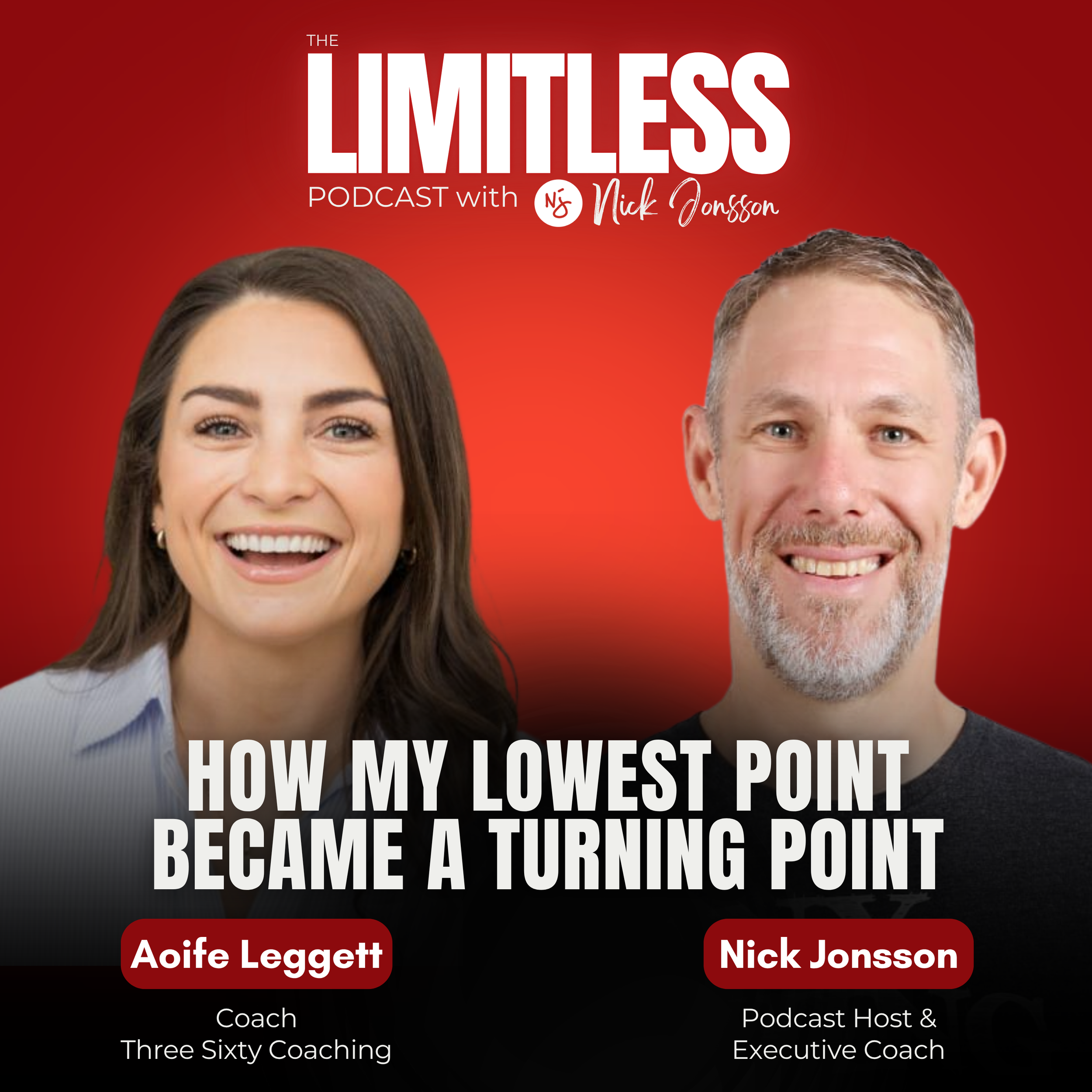
In this episode of Limitless, I sit down with Aoife Leggett, mindset and performance coach, Master Breathwork Teacher, and founder of Three Sixty Coaching in Ireland, for a conversation about burnout, identity, breathwork, and the moment life forces you to stop pretending everything is fine.
Aoife works with high performance athletes, riders, business owners, and individuals who want to perform at their best without losing their health, happiness, or sense of self. But her path into this work did not come from theory. It came from living through a season where, on the outside, she appeared to be functioning, while inside she felt lonely, unmotivated, burnt out, and disconnected from herself.
After years in the equine world, Aoife found herself in a role and relationship that looked right from a distance but felt deeply wrong up close. Then one day, while driving to work, she could not catch her breath. Looking back, she recognized it as the moment her body stopped whispering and started sounding the alarm.
What stayed with me was her honesty around one hard truth: “No one’s coming to save you. It’s your life.”
We talk about performance, nervous system regulation, breathwork, career uncertainty, relationships, rock bottom, and the courage it takes to move home, rebuild routine, ask for support, and begin again.
This episode is for anyone who looks capable on the outside but knows they are no longer living in alignment. Sometimes taking your life back starts with admitting you cannot keep going the same way.
Contact Aoife to collaborate:
Website: https://www.threesixtycoaching.ie/
LinkedIn: https://ie.linkedin.com/in/aoife-leggett-3033b9166
Instagram: @aoifeleggettcoach
Find more episodes: https://www.nickjonsson.com/limitless-podcast
Episode Transcript
Host: Nick Jonsson
Guest: Aoife Leggett, Mindset and Performance Coach, Three Sixty Coaching
Nick Jonsson: Welcome back to another episode of the Limitless Podcast. Today I'm very excited. I'm over in Europe to record this, and I have someone else also in a different part of Europe. While I'm in Sweden, our guest today is in Ireland. We have with us Aoife Leggett. Aoife, a warm welcome to you. How are you today?
Aoife Leggett: Thanks, Nick. Yeah, I'm great. I've had a lovely morning so far, so I'm looking forward to having a chat.
Nick Jonsson: Fantastic. It's a good time of the year. It's easier to have a good morning when it's summer, isn't it?
Aoife Leggett: Yeah, the brightness definitely helps. I don't mind the winter, but you start to notice that it's a little easier to get up and you don't feel as tired in the evenings, which is nice.
Nick Jonsson: Wonderful. For all the listeners who are with us today, Aoife is a coach with Three Sixty Coaching. Today we're going to talk a lot about relationships and about coaching, but also about some of the challenging times in Aoife's life and how she went through them, so hopefully it gives some strength to the listeners. But maybe we can start there. Aoife, who are you today, and what are you most passionate about when it comes to helping people?
Aoife Leggett: So today I work as a mindset and performance coach, mainly coaching high-performance athletes. A lot of them come from the riding space, so eventers and showjumpers. That's linked to my background, which I know we'll get into.
I'm really passionate about helping people feel like they are not only reaching their full potential, but also happy and healthy and enjoying life. I've met many top athletes who are winning those big competitions but feel really lonely. They've said to me, "I drove out of that show just feeling nothing. I'd worked up to that moment, and it didn't give me the joy or the happiness that I thought it would." So yes, I'm passionate about helping people win and feel like they're at the top of their game, whether that's business or sport, but really, that they're enjoying life.
Especially in high-performance sport, the journey takes such a long time, in particular with horses, when you're developing them. I think that comes from my time in the industry as well, and wanting people to really savour the journey rather than just be fixated on the destination. So that's what I do.
Nick Jonsson: Wonderful. What I'm hearing is perhaps two parts to that. One is the mental fitness to win the competition, but the other is to be happy after it. Once you've lifted the trophy up and you've won, you did perform, but if you're not feeling happy after, then what's it all good for?
Aoife Leggett: Yeah, exactly. As a coach, when we dig behind the goals, usually people just want that sense of happiness or fulfilment. So I'm really trying to get people to understand the depth of their drive, and their life as well, so that it's a long-lasting career that is a happy one, not just feeling happy at the peaks.
In high-performance sport, and again especially with horses, there have to be two athletes performing on the day, and horses get injured just like humans do. So there can be a lot of roller coasters in horse sport in particular. I help them navigate that with a little more balance, so the highs are high, but they're not nauseatingly high with a big drop afterwards. And they have a sense of identity outside of the sport as well, so that if they do have an injury or a setback, it's not like their whole world has crumbled.
Nick Jonsson: It sounds like very fascinating work that you do, Aoife, and surely we'll go deeper into this a bit later on. Can I ask you, what experience in your own life led you down the path of coaching?
Aoife Leggett: When I was younger, I rode horses competitively. I rode on some junior teams, and that was always my hobby. When I was in school, and when I went to college later on, I was always working in the stables and doing as much competing and riding as I could.
When I got to college, I didn't really know what I wanted to do. I was unsure, so I studied social science. What led me to make that decision was that I was interested in people, how they act, grow and develop, and how society works. But I was still quite unsure as to what I wanted to do.
I kept working with the horses, and when I finished college, I don't want to say I fell into it, but I was already working for friends of mine during the holidays, and I said, "I'll just do this until I have everything figured out." I didn't know if I wanted to go and specialise in anything. Their business was growing quite rapidly. They were really well known for selling quality sport horses around the world, and a lot of clients would come from America and Europe.
So I ended up working there as the team expanded. I was growing, learning and developing, and I liked going to work on a Monday. For me it was, "Well, I enjoy the work, I'm still learning and developing, so I'll keep going here." My role was management of the team, helping to coordinate visitors coming in, and a little bit of riding as well.
There, I worked with loads of different ages, nationalities and backgrounds. Then I got to a point where I felt this job had led me to a place where I wasn't growing or developing anymore, and it wasn't where I saw myself long-term.
A friend was going off to Canada to do a ski season, and a little bit on a whim, I said, "Right, I don't know what I want to do, but I feel like I need to make a step," so I went with them. While I was over there, I had a skiing fall, broke my leg and tore all the ligaments in my knee. I ended up having quite a long rehab process with two surgeries.
I'd always been interested in fitness and staying fit, but not really with any kind of goal or real knowledge. So when I did injure myself, I had to really educate myself on what correct lifting looked like. And the mental side of that recovery really struck me. It felt so lonely. I remember talking to a physio in Canada, and she said, "I wish I could have groups for all of my ACL people, because most of them are really active, and suddenly that's taken away." You're thinking, "Everyone else is out doing stuff, I feel a bit low, and I don't have that rush from getting outside, cycling, running, whatever it might be."
So that was Canada. When I came home, I started working with horses again, and I was with a partner of mine, and we started working together. They had a lot of older horses that they were competing and selling, and were aiming to qualify for the Olympics.
As we worked together, the yard expanded. When I went there, there were maybe 16 horses, and when I left, there were about 35. The team was maybe two people when I arrived, and about seven or eight when I left. I loved that role because it was almost like we were building the team from the ground up.
When I look back, and when I was working with a coach more recently, I realised that developing people was what gave me purpose and passion: helping someone who came in nervous and didn't see their potential to really grow, flourish and become a key part of the team.
In hindsight, looking back on that journey of my career made me realise something. Afterwards, I worked in a more corporate space, but I knew I really wanted to work one-to-one with people and help them see that they can do the things they maybe don't believe they can, and that there are ways to tap into confidence. That was what led me to coaching and made me feel like this is what I need to do.
In all of my roles before, I'd felt a sense of misalignment towards the end, like, "This doesn't really feel like something I want to do for years to come." That's what led me to train as a coach. I'm also a breathwork teacher, and I studied sport and performance psychology as well.
It's easy to look back now and see all the dots join together, but at the time you're thinking, "I don't really know what I should be doing." Really defining what lit me on fire and what gave me energy helped me slowly plot and navigate my path. I don't know what your journey was like, but mine definitely didn't feel like a straight road. Now when I look back, all of those lessons and experiences were needed to get me here.
Now I work predominantly with riders, and with some business owners as well. They enjoy that I understand the experience. I know that horses and businesses don't just take days off, and there are definitely boundaries you need to set, but there are also specifics in different sports that make them unique. So that's what drove me to work with individuals and teams.
Nick Jonsson: Wonderful. You mentioned coaching is part of it, but also performance psychology and breathwork. What did you start with first, and how did the others come about?
Aoife Leggett: After the horses, I did some work as an operations manager. For a while, again, I was learning and growing, and I loved that, and then I just felt like there was a missing part. A friend of mine recommended a coach who had helped him. I'd never really heard of coaching or done any coaching, but I went and worked with her, and she helped me see what strengths I had. When you're really low and unsure where you want to go or what direction you're in, you tend to think, "Well, I don't have this, and I don't have that." So she really helped me see my strengths.
I said, "I'm really into fitness. I really like getting people involved, seeing people get up early and change how they start the day." And she said, "Would you be a personal trainer?" I said, "Well, I do really enjoy the gym, but to me there's more to fulfilling your true potential than just training." She said, "Well, could you start with that?" So that's actually where I started.
I trained to be a personal trainer, and alongside that I studied performance nutrition. While I was doing those, I was doing my coaching course. After that, I felt there was another part I needed to fill, so I did the breathwork training, which was five levels over about three years, and I'm a master breathwork teacher. Then, once I had started working with clients, I wanted to further develop my skills, so I studied sport and performance psychology as well.
So they all came one after the other, and I still continue to educate myself, like I'm sure you do. When you enjoy it and you're passionate about it, it feels almost like a treat to get to do some CPD. You're like, "Great, I'm on this training course!"
I was lucky that, with my personal training, I was able to work in a gym to support myself while I was doing my studies, so it really helped me plot that path and make my way. I remember all my friends were buying houses and really moving up in their careers, and I said, "Okay, I'm going to give myself two years, and if it doesn't work out, I can go back to a normal job." For a while it was harder for me. I felt like everyone else was moving up and I was just starting off again. But I'm so glad that I made that decision, because I love my work now. I feel really lucky to get to work with amazing clients from all over the world.
Nick Jonsson: Fantastic. And what about the breathwork? Maybe you can talk us through that a little. How important is it for an athlete, and what about professionals? Would they also need breathwork?
Aoife Leggett: Some people will say, "Well, I breathe all the time." The easiest way for me to explain it to riders in particular is that when you're riding a horse, if the horse is tense and holding its breath, you can't get it to relax and soften, and it's not going to give you its best performance.
So that's an easy way for me to get them to understand that, as athletes and humans, there are times when our adrenaline is spiking or we're feeling nervous, and the body becomes tight and tense and we're in fight-or-flight mode. That's particularly true for event riders on cross-country day, which is a high-speed, high-stress, dangerous part of their sport.
If you're in fight-or-flight mode from the minute you wake up at half six or seven, all the way until 5pm when you go, if you're the last of the day, then suddenly you're on course thinking, "I haven't eaten anything because I've felt sick all day, and now there's nothing left in the tank." So for all athletes and riders, when you feel like, "Okay, I'm peaking a little too soon, I'm getting that adrenaline rush, and I don't have to ride for a while," it's a really useful tool. They can go away, regulate their nervous system, calm their breathing down and slow their heart rate. I also use it heavily as part of visualisation and mental preparation for competition.
The athletes find it really beneficial for mental performance. But I also use it myself if I'm on a flight and everyone is pushing to get off and stressing, and you feel like, "Oh, this is annoying." I just use a little bit of breathwork there. Same for presentations and anything like that. It's a really useful tool to reset. You don't need anything with you, and people don't even notice that you're doing it, so it's a very easy and effective tool to slot in.
It was really nice, especially at the last Olympics, to see loads of athletes doing it very openly, so people feel like, "Okay, this is a really useful, effective tool that these top athletes are using. I can do it as well."
Most of the techniques I teach are for nervous system regulation. For any client, what I try to do is give them different tools and preparation exercises, and then they choose what works for them and where they want to have it in their routine. For me personally, I try to do a little bit every morning, and then if I have a talk, a presentation, or a client where I need to make sure I'm in the right headspace, I'll sprinkle it in throughout my day.
Nick Jonsson: Thank you. I also like breathwork. It has helped me a lot with sleep, and with performance at work. And yes, it's broad, but if someone is listening who maybe hasn't done it, they might be at that level you mentioned, where they're just breathing. What tip would you give them, or where can they start if they want to explore breathwork?
Aoife Leggett: I think awareness first of all, and just starting to notice your breath. Lots of us, when we're stressed, breathe short, shallow breaths through the chest, or we might be mouth breathing. What that does is make your heart work harder, because it's beating faster, and you're not using your full lung capacity. So it's more taxing on your body.
Just become aware of it, and start to deepen the inhale, followed by a long, slow exhale. That's a really nice, calming breath to use. Even as I do it now, you can feel your chest and shoulders start to relax.
People love a count; they like to know the numbers. So sometimes I say, roughly breathe in for four and out for six. That's a nice, relaxing, calming breath that helps stimulate the vagus nerve and allows you to move into a state of rest and digest.
But the body and the nervous system will often think, "I don't have time for this, it's not working, let's move on." I always say to people, that's the moment when you need to stick with it and take a few more breaths, and it will help. The more you practise, the more your body starts to recognise the breathing pattern, and the more it's like, "Okay, we're safe, we can relax."
So in for four, out for six is a really simple one. And become aware of your breath both in stressful moments and when you're relaxed, so that you can notice when it's short and shallow and start to shift that.
Nick Jonsson: Wonderful. Thank you for sharing those tips. There might be some listeners who take you up on this. If they want to go deeper, where should someone start? Do they need a certificate or training in breathwork, or to work with a coach like you? What would you recommend for someone who is curious?
Aoife Leggett: I started off just being curious. I started meditating a lot during lockdown, and I knew it really benefited me, but I knew I would find resistance if I told some of the people I'd been working with to try meditating. I've heard people say, "Oh, it doesn't work for me." So I started training with Níall Ó Murchú at Level 1, and we went up through five different levels.
There are loads of really good resources. There's YouTube, you can work with a breathwork coach, and there are lots of apps. I use Insight Timer, there's also the Calm app, and Níall has his own app.
The interesting thing about breathwork is that there are a few different types. There are nervous system regulation techniques, and then there's more active breathwork, such as conscious connected breathwork. People should be aware of what they're getting into, because conscious connected breathwork can sometimes be quite extreme for people who maybe aren't ready for it.
So do a little bit of research and figure out what you want from it. Do you want it to help you calm your nervous system, or are you looking for a deeper, one-off experience? And, the same as when I was starting my coaching journey, just get into it some way. Start off, see what you like or don't like, and it'll take you on a path to figure out whether you want to work with a coach or just keep exploring on your own. It's a really powerful tool.
Nick Jonsson: Wonderful. Thank you so much for sharing all the great work that you do, Aoife. On the Limitless Podcast, we also typically explore whether someone has gone through a challenging period in their life. I believe all of us have seasons that have been harder than others. Maybe we learned something from them, and maybe some new realisations and motivation came out of them as we look back. Would you be comfortable sharing something that happened to you in your life, and if so, what was it?
Aoife Leggett: Yeah, definitely. As you said, we all have challenges in our life. When I was in my second, bigger role in the equine space, where we were working with lots of horses and had a big team, I was working with my partner. Eventually that came to an end, but the journey to that ending was challenging. Our relationship wasn't in a good place, and I knew myself that it wasn't the right role for me.
I remember somebody saying to me afterwards, "You had a good job, you had a great team, you could ride. Most people would have just stayed there and enjoyed a nice life." And I thought, "Well, maybe some people would."
That's why I love podcasts. I was listening to a lot of podcasts when I was in that space. I was feeling lonely, unmotivated and a bit stuck. One of the podcasts was saying, "No one's coming to save you. It's your life. You're going to have to make something of it, or suffer in silence and regret it at the end." I was standing in the yard, and I remember turning around and thinking, "This is not the life for me." I didn't imagine myself building somebody else's dream and being miserable, feeling completely burnt out, tired and unhappy day to day.
My brain had been telling me for a while that this was wrong. I remember my best friend saying, "I don't think you're in a good space. Do you need to make a change?" And I said, "No, no, no, it's fine." I had my head in the sand. Another friend of mine was great; she always rang me. When you're in a bad place, maybe you don't want to answer the phone, but she would just keep ringing and ringing until I answered.
Then one day I was driving to work, and I couldn't really catch my breath. I thought, "What's going on here? This hasn't happened to me before." I didn't realise it at the time, but I was essentially starting to have a small panic attack. I pulled over the car, caught my breath again, and then drove on to work. Looking back now, my brain had been whispering at me, and then suddenly my body said, "No, we need to give her more of an alarm bell to make a change." That was a big sign, and now I really try to listen to the whispers from my brain and my body.
From there, it really felt like I had to make a big change. I lived across the country, I worked with my partner, and I had to pack everything up. I remember a really good friend of mine got the train down to help me pack everything into a lorry to drive home.
I had to move back in with my parents, and I had no job. I remember thinking, "This is really rock bottom." I felt embarrassed. I thought I should have my sh*t together at this stage, as they say. But my family were great, always very supportive, and so were my friends.
I think the thought of starting over felt harder than the reality of it. When I got into the reality, yes, I was living with my parents, but they're amazing and really supportive, they were there to help me, and I had great friends. We do a lot of sea swimming, so every day we would get up and swim in the sea, and I would do some kind of exercise. I knew a routine would help me. Bit by bit, I felt like, "Actually, this is okay. I don't feel so terrible, and it's nice to have a bit of a rest and be around my friends and family." The support system really helped me rebuild.
As I said, that rock bottom, the moment where I made a change, was really important, because it led me to where I am now. Lots of my clients maybe aren't at that point, but they're around that place where they're feeling burnt out or lonely, maybe something's not aligned, or they're not sure what their purpose is. So it gives me a real sense of understanding.
It also made me less fearful of big changes or taking a leap. After that, I definitely took a leap in changing my career, but it didn't feel like the scariest thing ever, because I'd already rebuilt once. I thought, "I can rebuild again." I think it helped me in terms of exposure to risk-taking.
Now I'm very, very grateful that I'm around my family and friends. I love my work, like I said, but I also get to design my life. This morning I went for a run with my two best friends, we met another friend for breakfast, and then here I am working. It really shook me into thinking, "Design the life that you want, because you don't get a second one." Rock bottom is always hard, but with the right support system around you, you can always find your way out. And it's usually better on the other side as well.
Nick Jonsson: Wonderful. Thank you for sharing that personal story and how you went through it. It sounds like there was a lot of loss at once. You lost the relationship and the career, and then perhaps the independence of having your own home, because you had to move back home again. What was the toughest of all those parts?
Aoife Leggett: We lived across the country, like I said, but everything was work. It was my partner's business, everything revolved around work, and I lost my sense of identity there. Even with my friends there, who I was really close with, I was their manager, so there was a bit of a wall up, even with the support system I had down there.
So I think the hardest thing was actually the loss of my own identity. People say to me, "You were a shell of yourself when you came back. There was only a quarter of you left." Realising that had happened, that I'd let everything else take over and let my sense of self take a real backseat, was probably the hardest thing.
Obviously the relationship was a challenge as well, and so was the career. The confusion around the career, knowing that maybe it wasn't where I wanted to continue, was quite hard. It's not like I knew exactly what I wanted to do and could just go and get the same job somewhere else. The relationship, the job and the place I was living were all wrong, so I had to start from scratch.
But for me, the hardest thing was that I lost myself in the middle of it all, and finding out who I was and what was important to me again. Later I had another point in my career where I thought, "This is the wrong role again," but at least I had my sense of self, so I had a stronger compass as to what was important to me.
All of them were challenging for different reasons. I can't give you a straight answer. The relationship, myself and the career: it was all a big loss.
Nick Jonsson: And what did this tough season teach you about yourself?
Aoife Leggett: Mainly, that I have really, really good friends and family. You have resilience because you have to. I know that I thrive on routine, and it really taught me that exercise is super important for my mental health. Being outdoors and near the sea is really important for me as well.
It was probably a podcast again that said you can do anything you put your mind to, and that gave me the confidence to think, "Well, I can give everything a try." I suppose it made me a little more resilient and gutsy when it comes to putting myself out there or trying something new.
Now I maintain that routine: up early, go to the gym, try to get outside, and stay close to friends and family, because I know that's what helps me stay in a good space.
Nick Jonsson: I was just going to ask you, if someone is listening who is going through a challenging time, whether that's a lost connection, a broken relationship, or career uncertainty, which many are facing, what would be your best advice for them? What should they do?
Aoife Leggett: Get up out of bed, get outside, go for a walk or a run. I always love the sea because of the cold exposure. It helps you get out of your head and into your body, and that has always carried me through challenging times, whether that was breakups or difficult times in my career.
I remember my old job was very stressful at one point, and I remember thinking, "After the gym, I don't have time to go for a swim, I need to get back now." Then I said to myself, "No. This is the thing that's keeping you in a good headspace, so make time for it. Take time from somewhere else."
So I would say, find some healthy habits that help you be in a good headspace. Even if you're down, at least you get the chance to have some endorphins, a little bit of adrenaline, or a bit of space to breathe. Get out, get moving, get into some cold water if you can, and surround yourself with people who will help you as much as possible.
Nick Jonsson: I really love that. You talk about helping people reach their full potential. What does that phrase mean to you, especially having been through the tough times you've had with your relationship, your career, moving home and so on? Can you elaborate a little?
Aoife Leggett: I think it's different for everyone. Everyone's view or perception of their full potential is different. Only the other day I asked myself, "Do I think I'm really using my full potential here?" Sometimes you go through phases where work is going well and you're maybe coasting along a little, or you're not pushing yourself to try new things or stretch your comfort zone.
So if you ask yourself honestly, "Do I feel like I'm using my true potential?", is your answer "definitely not", "maybe", "probably", or "nine out of ten"? It's whatever you feel you have in you to give, and whether you feel you're utilising it. It'll be different from person to person, which is the beauty of life.
For me, in the role I'm in now, in my business, I feel like I can tap into all of the areas where I have potential and strengths. The thing about those previous roles is that I was using parts of me that were good, effective or had potential, but other parts of me were not utilised at all. Maybe I felt a sense of loss because they weren't being used.
So I think it's about tapping into all of your strengths and exposing yourself to challenge, so that you stretch that comfort zone, but also feel like you're firing on all cylinders as much as you can.
Nick Jonsson: We're coming towards the end of today, and there's one question I like to ask all our guests. This podcast is called Limitless, so I want to ask you: what does living a truly limitless life mean to you today?
Aoife Leggett: I think it means not allowing limiting beliefs, thoughts, fears or doubts to hold you back from doing the things you would do without them.
For me, a big step was this: I was always number two for people. I was always helping run the business, but I was behind somebody else and their dreams. So a big step for me was stepping out and not being afraid to have my voice heard, not being afraid to put my face out there, and not being afraid to go after the things I was passionate about. Really stepping out of the grip of fear and doubt, and just going after what you want.
Unfortunately, lots of people have to have a life-altering illness, or lose somebody close to them, to get that push to do it. My passion is to try to get people to that place without having to have the scares, the near misses or the loss in their life.
So limitless is not being held back by your own thoughts, your own mindset, fear of what other people might say, or their perception of you, and just doing whatever allows you to be limitless, fulfil your true potential and be happy.
Nick Jonsson: That's a very powerful way to end today, Aoife. Is there a final message you'd like to leave the listeners with, or anything that I forgot to ask you?
Aoife Leggett: No, I don't think so. I think it's that accountability and proactive view that it's your life. It's not your responsibility so much as your chance to make it what you want. Don't put that power in other people's hands. Take it back, see what you want, and go after it.
Nick Jonsson: Fantastic. Thank you so much, Aoife, for coming on our show today, and thanks to all the listeners as well. All the best, and have a great summer.
Aoife Leggett: Thanks, Nick.