Episode 337: Patrick Engasser - Born Blind, Ranked First
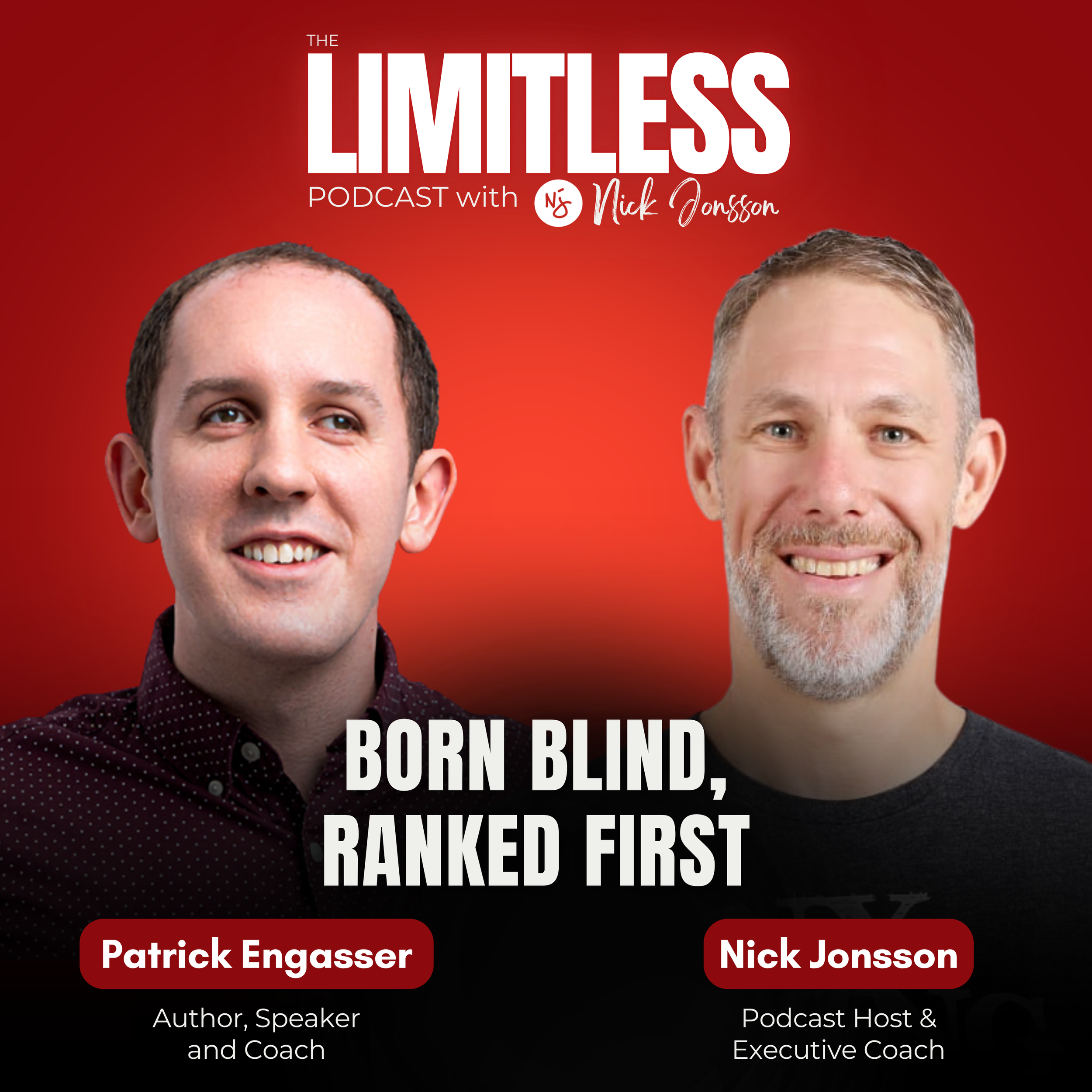
Patrick Engasser had the best excuse available to anyone in outside sales. He was born blind. He cannot drive. The work means walking into companies you have never visited, asking for the decision maker, and reading a room you cannot see. Two years in, he was ranked somewhere in the 500s out of roughly 615 sales professionals in his organisation.
What makes this conversation worth your time is that the blindness turns out not to be the story. Patrick describes those two years as time spent looking out of the window for someone to blame, with reasons good enough that nobody would ever have challenged them. That, he argues, is the more dangerous kind of excuse, because you are never forced to defend it.
“The problem with excuses is they’re very expensive. And a lot of times, the invoice doesn’t show up until later.”
He hired a business and sales coach at the end of that second year. Fourteen months later he was his company’s top new account closer, then a trainer, then district manager for the next decade. But he is careful about where he puts the turning point, and it is not the coach. It is a decision he made before hiring one, and it is the part of this episode I keep coming back to.
We also get into why he thinks confidence works in reverse of how most people are taught, what he means by the difference between vision and sight, and the client who told him her life was over.
For anyone sitting in the 500s right now, quietly running out of reasons to keep going.
Contact Patrick to collaborate:
Website: patrickengasser.com
LinkedIn: https://www.linkedin.com/in/patrick-engasser-645860217/
Episode Transcript
Nick Jonsson: Welcome back to another episode of the Limitless Podcast. Today we have with us Patrick Engasser. He's the founder of If I Can Do It, You Can Do It Coaching. We will dig into Patrick's journey, and what I can share right away is that he is breaking beyond limits, perhaps achieving more than I could ever imagine someone could do from his position. Patrick, a warm welcome to you. How are you today?
Patrick Engasser: Nick, I'm awesome. Thanks for having me, I appreciate it.
Nick Jonsson: We are very pleased to have you with us. First of all, I'm so inspired by the fact that you can even be on a call like this, because you have a disability from birth that I thought we could share with the listeners right away, to inspire them. Patrick, could you share it with us?
Patrick Engasser: Yeah, sure, absolutely. I was born completely blind. And when I say completely blind, I do have some light perception, so if the lights are on in the room, I can see that, but that's about it. It doesn't really help me with any mobility, and I can't drive. If there's a shadow, if you put your hand in front of the light in front of my face, I can see that, but that's pretty much it.
So it helps me a little bit, at least in not being in complete darkness all the time when I open my eyes and it's daylight, but outside of that, it doesn't really help me a lot. It's something I had to get used to from an early age. Like most children, you don't know you're different until you start to figure things out and realise, "Hey, some of these other kids seem to have a superpower that I don't have." Eventually, I realised that my blindness was my superpower, but that came years later. So that's kind of how the story started.
Nick Jonsson: Thank you for being vulnerable and sharing that with us, Patrick. Many people or listeners may view a lack of vision as a limit, and you're on the Limitless Podcast today. How do you see it?
Patrick Engasser: I don't necessarily see it as a lack of vision, just a lack of physical sight. I think that's the way most people see it, as a lack of vision, but I think I have a lot of vision. It took me a while to figure out that there's a difference between the two.
I think it was Helen Keller who said that the only thing worse than being blind is being sighted and having no vision. I haven't been sighted in my whole life, so I can't speak to that. But I think the biggest thing I had to figure out for myself was that I could really take control of what I wanted my life to look like.
There were a lot of limitations that were real, for sure, but there were also a lot of limitations that I put on myself early on, probably, unfortunately, with the help of others who wanted to help me, but who were telling me that there were certain things I wasn't going to be able to do. Some of that was probably true. I wasn't going to be a race car driver, right? There were some limitations. But many of the limitations, like with all of us, and that's not just true for me, it's true for everyone listening or watching, are limitations we put on ourselves that aren't real.
It's a story we tell ourselves, and we have to be very conscious of what that story is, because if we're telling ourselves things that aren't true, but it's a belief created by something that happened to us, or something we did early on in life, that can stick with us for a very long time, or forever, if we allow it to. And we can really give that legs by continuing to replay that story over and over to ourselves.
There were definitely some stories I had to dismantle, stories that started early on in my life and that I had to go back and delete and undo and replace with the beliefs I wanted to have about what was possible for me. That's true for all of us. That's not just true for me because I'm blind. So I think that's the biggest message I want to deliver: wherever you are in life right now, if there are things you don't like about your life, or about your career, or about your business, or about your relationships, you can upgrade those things. You're not stuck with that being your reality forever. And a lot of that starts with changing the story you tell yourself. That's one of the things I do as a business and sales coach and sales trainer: I help people rewrite that story.
Nick Jonsson: Yeah, that's very inspiring indeed, Patrick, and we'll come to how to change your story, and also to how you managed to build a career for yourself despite being born blind. I'd love to dig into what you shared about vision versus sight. You said you couldn't be a race car driver, but what I've heard is that even the best race drivers in the world, if you blindfold them, can drive most of the Formula 1 courses, at least in a simulator, because they are so strong with vision. So vision is something very powerful, and you clearly have vision, even though you don't have sight. Can you elaborate a bit further on the difference?
Patrick Engasser: Yeah. People often think of the two as the same, and that's understandable, especially for somebody who's had both their whole life. A lot of people out there think, "Hey, I have vision and sight, they're the same thing." But for me, I can't see using my eyes. I'm unable to see that the house two doors down the street is blue. But I do have vision for where I want my life to go and what I want it to look like.
I always tell people this, because it's true: my brain, just like everyone else's, thinks in pictures. Your brain visualises. It doesn't think in words, it thinks in pictures. My pictures might not be the same as yours, Nick, or anyone's in your audience, but my brain is still visualising, whether it's something in the past replaying in my mind, something taking place right now in the present, or something I'm visualising in the future.
So you can actually visualise what you want your future to look like, the experiences you want to have, what that feels like, smells like and looks like. Obviously, for me, the looks-like part is based on limited information compared to what you would picture. But using your senses, you can really create in your mind what you want your future to look like. Taking some time, closing your eyes and visualising: that's having vision. Visualising what you want the future to look like, what it would feel like, smell like, sound like, look like, and taste like, I guess, in some cases.
Think about it. I'll just use something tangible that most people can relate to. I want to buy a certain type of car, and I want to drive that car. You can have that experience before you actually drive the car. You can take it for a test drive and have that real-life experience. That's one of the biggest reasons I always tell people to test drive your dreams, whatever they are, whether it's a car or something else, metaphorically speaking.
To use the car example, if you get into the exact car you want to buy, even if you don't have the money yet, and you drive it, you're going to feel the leather seats, or whatever the seats feel like. You're going to feel the steering wheel in your hands, what it feels like to handle that car, how it takes turns, the sound of the engine, the experience of looking through the windshield and looking in the rearview mirror, all of that.
Then you're going to more easily be able to close your eyes that night while you're in bed, or the next morning before you open your eyes, and visualise what it would be like to own that car, because you've already driven it once. So that's an example of visualisation. And as you just said, with your eyes closed, someone can drive a race car around a course, maybe in a simulator in most cases, but they probably could do it on the course if they'd done it enough times, because they can visualise what that would be like.
That's the difference, really, between vision and physical sight. You can, in many cases, experience something in your mind, and the beautiful part is that your subconscious mind doesn't really know the difference between "this is a real experience" and "this isn't", when you're visualising it, if you're getting really crisp and clear about the visualisation. So I encourage people, whether you have sight or not, to visualise the future you want to create, and then start taking the actual steps it's going to take to make that a reality.
Nick Jonsson: Thank you for laying that out so clearly. We have this saying, which I've also heard: if you can see it, you can believe it. Maybe you and I can tweak that one, because even if you cannot see it, if you can visualise it and believe it, you can make it. Would that be right?
Patrick Engasser: 100%. I think that's from Think and Grow Rich by Napoleon Hill. At least that's where I've read it and heard it. But yes, absolutely. If you can visualise it and believe it. It has to be something your brain believes, so you have to be able to logically tell the story of how it's possible. But if you can visualise it and get your brain to believe it, then it absolutely is something you can achieve. If you can see it and believe it, you can achieve it, right? I think that's the quote.
Nick Jonsson: Yeah. And there are so many challenges out there in the world at the moment. Some of my coaching clients have lost a job, have lost a family, some people have lost perhaps all their money. There are a lot of losses, and many people are in a tough spot at the moment. So how can they use your thinking here about visualisation? Can we jump to visualisation right away, or are there some steps that you help your clients with as a coach before they can get to visualising it?
Patrick Engasser: Well, it's a great question, thank you for asking. I think it depends on the situation. If somebody has had an actual tragedy that just happened yesterday, they lost a family member, a spouse, a close friend, that's not something where the next day you say, "Hey, this is adversity, and I'm going to extract something positive from this." Obviously, there's a grieving period, and there's a period of time where it's okay, it's normal, it's a normal human reaction, to be caught up in some really negative emotions. The key is to not stay there.
For all of us, it's going to take a slightly different period of time, depending on the situation and the event that happened, and on how we deal with it. The key is to work through it. It's okay to grieve; as a matter of fact, it's necessary to grieve through that process, and to experience some of the normal emotions you would have during that period of time. The key is to not stay there forever.
We've seen this happen to many, many people. We can probably all relate to, or think of, two different people who had a very similar experience: a close family member died, or they were in a tragic car accident or some type of accident that changed their life. One of them dwelt on it for the rest of their life, for the next 20, 30, 40 years. They lived in that past experience of, "This happened to me, and because it happened to me, my life was ruined."
And there are others who go through a period like that, where it's, "Hey, this really messed me up in a really bad way, this happened to me," but they start taking steps to move forward from it. That may take a week, a month, six months, a year, depending on the experience. But they start to pick up the pieces and say, "Hey, I'm going to work with a coach, or I'm going to work with a therapist, or I'm going to join a group of others who have gone through this same situation, and I'm going to have them help me through this," to find the light at the other end of the tunnel.
So I think the biggest thing is not how you react or respond initially. It's how quickly you can start moving forward again. And that doesn't mean it's a straight path. If you've had something super tragic happen, you're going to have moments where you fall backwards.
But for something that's less tragic, like myself: going through blindness was very difficult early on in my life, in my childhood, especially in that time of life in what we call elementary school or middle school, and then eventually high school. When you're in school trying to fit in with other teenagers and young adults, it's a very tough time, because you're trying to discover who you are, and fitting in and being part of the crowd is super important. That was probably the most challenging time for me. I was bullied at times. Nothing super crazy, but I was definitely not the popular kid.
But moving on from a challenge like that, a challenge where it wasn't dropped on me out of the blue with no preparation, but it is a big challenge: how do you take that challenge, or what most people would perceive as your liability, and turn it into an asset? That's the biggest question I always ask people. If we stopped looking at this as a liability and started looking at it as an asset, what would that look like? What positives could come out of this?
Obviously, you don't say that to someone or ask that question the day after a tragedy happens. As we just talked about, in those situations there's a process. But if it's a challenge in someone's life, such as losing a job, like you just said, that may seem tragic the day after, but in reality their life isn't over, even though they may feel that way.
It reminds me of a client who went to talkwithpatrick.com, did a strategy session and started working with me. Similar to what we're talking about, she was looking for some help with business, but basically she'd had a sales job and she'd been fired from that job, for something she didn't even do. For her, this had been her dream job, and to her this was a tragedy. She actually said the words, "I feel like my life is over."
We started to uncover things and peel back the layers of the onion, and I asked her, "You have tremendous amounts of sales experience. You were doing so well in this business. What makes you think that in the same industry, or even a different industry, you couldn't do it again?" She did end up getting into a different industry and being a top producer for many, many years, and still is to this day. I said, "What makes you think that your life is over? What made you come to that conclusion?"
A lot of the time, it's just this feeling of loss that people have. But in reality, if they can start looking at it as, "Hey, this could actually be a positive once I get through this period, and I'm going to learn something from it," then adversity is actually a great teacher. We don't like going through adversity, but adversity is usually when we become a stronger person. If we look at the times that made us stronger, we can usually all agree it was a challenging time. It's not, "Hey, I got stronger during the summer of my life when everything was going well." We usually get stronger during the winter, during that period when things aren't going right. We learn the most about ourselves and become more resilient during that time.
And that was true of this person. This client became a lot more resilient because of it, became a better sales professional because of it, and decided, "You know what, I'm going to go into an industry in outside sales where I'm essentially self-employed, where someone else doesn't have as much control over my future. I have that control." So this person changed her life for the better because of a situation she thought was really tragic at the time. That's often the case for the most successful people among us. They go through something very challenging, and it helps form them into the person they need to become in order to have the success and build the life they want.
Nick Jonsson: Yeah, Patrick, I love your framing that adversity can be a great teacher, and that if we use it in a positive manner, it can really become our edge. I also believe you're spot on when you say that we cannot expect to do that when it's too raw, too fresh. Grief is a natural healing process. We need to have that grief period before we're ready to look at it. We don't want someone to come up on stage to share a story when they've just gone through a big disaster; but when we're looking back at it, then we can share it with the rest. I have my own story of alcoholism, which I overcame, and when I look back at it, it's indeed one of my greatest supports now, where I can help others.
Patrick, thank you for sharing how you help others. If we go back to how you started, before you became a successful author, top coach and speaker, you were also working in the corporate world. Can you share with us the adversity you had to go through then?
Patrick Engasser: Sure. I started out in collections after college, doing debt collection, and I did not like that. That is the one thing I've ever done for income that I really hated. I hate to use the word hated, but I don't think there's a nicer word I can use that would be accurate. I really did not like it. But it was really good that I went through it. Once again, here's a perfect example of what we just talked about: I spent a few months in that industry, and I learned what I didn't want.
It forced me to do something I probably never would have done otherwise, which is go into outside sales. It's not an obvious path for most people, and certainly not for a guy who can't drive and can't see: a career where you really have to travel to the client. In the outside insurance sales world that I got into, most agents were setting appointments by walking into businesses in person. We call them in-person drops; some people call it canvassing. Basically, you walk into a business, you ask to speak with a decision maker, you have a conversation with them, and you set up an appointment on the spot. You may follow up with a phone call, but the majority of people are setting appointments in person, making that introduction in person.
So for me, this seemed like an impossible task. But I really didn't like what I was doing in collections, so I was willing to give it a shot. A former regional coordinator of a Fortune 500 company, whom I met at the gym, had a conversation with me. He probably should have told me this isn't for you, but he must have liked my moxie, and the fact that I made it clear I was willing to put in the work. So he was willing to give me a shot, brought me in for an interview and offered me the opportunity.
I don't know that anybody in that office really thought I was going to be the next top producer, because I had a lot of challenges that most people in that office didn't have, and most people were not succeeding. Nine out of ten people in that industry were not succeeding. It's just the nature of straight-commission outside sales in the self-employed, 1099 insurance world. At least eight out of ten weren't sticking around for a year or longer. So it was probably a case of, "Hey, give this guy a shot. He won't leave us alone, he's just going to be persistent and keep asking if this is something he can do, so we might as well give him a shot." And so they did.
The biggest thing I had… there were a lot of far more talented professionals who came through that office. I was in my early 20s at the time, I think 23 when I started, 23 or maybe just turned 24. I didn't have any previous sales experience, or any previous self-employed or business experience as an entrepreneur, and here I was, going to do essentially a hybrid of the two. I really didn't have hardly any work experience. But I had a little bit of thick skin from the collections industry, from a lot of hard rejection there. And I really had a strong why, which was that I didn't want to go back to a call centre job.
That was really what separated me, Nick, from the eight or nine out of ten people who didn't make it: they didn't have the same why that I had. They could step into a much better job than the one I had been in, or could go back to. So that, to me, was a driving force.
Number two, I had also been through a lot of what we talked about earlier, the building of resilience. I was a resilient person in terms of my mindset, because I had already been through a lot of challenges. So this, to me, was a big challenge, yes, but it was something I looked at as, "Hey, I can do this." There were a lot of days when that was put to the test, and many times I wanted to quit and thought about it. But then I would think about the world I'd been in, in collections and call centre work, and that I didn't want to go back to it, and that always kept me in the game. It always re-motivated me and got me back in the game.
So that's a tip for everybody out there. If there's something where you think, "I really want this, I'm working at it, but there are days when it feels like I'm never going to break through," first of all, don't tell yourself, "I'm never going to break through." Keep telling yourself it's possible, keep visualising what is possible, and keep doing the work, even when it's hard. But also remind yourself what the alternative is. If the alternative is something you really don't want, a lot of the time that's a great motivator to keep you moving forward, even when you want to give up.
Nick Jonsson: Yeah, so the key words I heard from you here are resilience and persistence, Patrick. You just kept going all the way. I understand you started from the bottom of the organisation, with more than 600 people basically ranking higher than you, but eventually you had success. You even became the top new account closer by your third year. Is that right?
Patrick Engasser: That's correct. The first two years were definitely a slow start. I always jokingly say that I have an award that says "Fast Start" on it, but I don't know how I got it, because the first two years were definitely not a fast start. I had a bit of a boost in the first couple of months, because I had a number of friends and family who were willing to do business with me, but once that dried up, I had to actually learn the skills, stop being an amateur and learn how to be a professional. That's really when I had to face myself, for that two-year period.
I had a lot of excuses, and I sold them to myself over and over again. As you mentioned earlier, there are things a lot of people would look at and say, "Well, that's not an excuse, that's a valid reason not to be successful." But if I boil them down to their most basic form, they really were excuses. And the problem with excuses is that they're very expensive. A lot of the time the invoice doesn't show up until later, so we don't realise how expensive they are and what they're costing us until months or years later.
So after about two years of struggling, I ended up hiring a business and sales coach who coached entrepreneurs and sales professionals, which is where my passion for coaching started. As you mentioned, out of about 615 sales professionals and agents in that organisation, I was in the 500s for pretty much all of that two years. I was probably in the low 500s at the end of the second year. Then I hired that coach, and after 14 months of working together, I went from the 500s to being, as you mentioned, the number one new account closer in terms of new business.
That's really what moved me into a training role for the next year, and then a district manager role the year after that. So within two years I was a district manager, and I held that position for 10 years. It was a great ride, and a lot of fun training, recruiting and developing talent, and building a sales team. But that really happened because it was pretty obvious how I went from the 500s to number one. It was tough to miss.
And that happened because I was coachable. I was willing to take advice and realise that I wasn't going to be successful by myself. I needed to get advice and mentorship. I also took a lot of the top producers out for coffee or lunch or dinner and picked their brains, as well as working with a coach. There's a tip there, for sure: find people who are more successful and are where you want to be, and really tap into their knowledge. That made a huge, huge difference for me.
Most people look out the window and blame, and I was one of those people early on, unfortunately. Maybe not as much as some people, but I certainly did look out the proverbial window and look around for, "Hey, where's the problem? Where can I put this blame?" Eventually I had to realise that the only place I was going to find the problem that was going to make it fixable was in the mirror. Once I decided to look in the mirror, and I know it sounds silly coming from me, the blind guy, but once I looked in the proverbial mirror and said, "Hey, I'm the problem, I need to change. If I want things to change, I'm going to have to make changes," once that happened, my whole life changed over the next year, year and a half.
Nick Jonsson: Yeah, Patrick, thank you for sharing that, and what a beautiful mindset to have. So often, it's easy as a human being to look at everything external and blame politics, the news, the weather, the organisation, other people or circumstances. But you clearly took ownership, looked at yourself and at what you could change and grow. And it was the help of a coach and mentor, as I'm hearing, that really transformed you, right?
Patrick Engasser: Absolutely. Ownership is where the magic happens, right? Your excuses disappear when you start taking ownership. That's really where the rubber meets the road. And it's very difficult. I'm not sitting here saying to anybody out there who is in a tough challenge right now, really in the thick of it, that taking full responsibility is going to be easy.
I mentioned the window, and I say this a lot when I speak, comparing the window to the mirror. We look out the window and look for someone to point the finger at and say, "Hey, that person's the problem, they did this to me." Or, as you just said, the government's the problem, politics is the problem, the economy is the problem, whatever it is. We can all find our boogeyman or boogeywoman. We can always find somebody to blame by looking out the window.
The problem with the window, when I refer to the window, is that it represents blame and excuses. All of those things give away your power. You have no power when you shift your blame and point it at somebody else. When you look in the mirror, it's not about blaming yourself, it's about taking ownership. I talk a lot when I speak about owning the mirror. When you own the mirror and you look in it and say, "Hey, I'm going to change me, because I'm the only one I can change," that's when you regain your power.
Because you can't change anybody else. If you're married and your marriage isn't going well, you can't change your spouse. That's the bad news I have for you. The good news is you can change one of the two people in your marriage, and that's you. And your spouse then has to respond to the changed, new version of you. That may very well change them, or at least get some different reactions. The bad news is you can't change anyone other than yourself, but you can change you. And when you do that, miraculous things tend to start happening.
Nick Jonsson: Yeah, I love how you focus on yourself, and I think that's a good message for all the listeners. Patrick, looking at your life today, you are now a successful author, you do a lot of presentations and you work with clients as a coach. You have a best-selling book called If I Can Do It, You Can Do It. So what do your life and work look like today, Patrick?
Patrick Engasser: I was born and raised in Buffalo, New York. It's very cold there for half the year. That's still where most of my family lives to this day. It's a great place, with a lot of great people. But my wife and I wanted to move to Destin, Florida, and we did that about a year ago.
I started my own coaching and speaking business about five years ago, but it really became the main business in the last couple of years. The goal was to be able to build a business around the life we wanted to design, rather than the other way around. Most people build their life in the scraps of time left over around their career or business, and that's normally how it starts. But I highly recommend being intentional and doing the opposite: finding a way to create that freedom and build the life you want. Whether that's in sales, as an entrepreneur, or in any other career, look for ways to create more freedom for yourself.
We've been blessed enough, and we thank God that we've been blessed enough, to do that in our own lives, and now my passion is teaching other people how they can do the same thing. So I do a lot of sales training for corporations, as you mentioned earlier: ongoing sales trainings and workshops. I also do keynote motivational talks for corporations at their conferences, and I come in and speak at their corporate locations. And then I do a lot of one-on-one and group coaching of sales professionals and entrepreneurs.
My passion is helping people create the life they want, whatever the vehicle is, whether it's a sales career or owning their own business as an entrepreneur. It's really about going after quality over quantity in their business, in their career and in their life as a whole, including their relationships. It all ties together. How we earn our income is what enables the freedom and the choices to happen. But it's about building that foundation of, "This is where I want to go. This is the destination of who I want to become."
With sales, people always think of selling as something you do, but it's really something you become. The same is true of being an entrepreneur. An entrepreneur is not just something you do. Yes, it's that, but it's also someone you become. If you become someone who creates the life of freedom you want, whatever freedom looks like for you, that might be travelling the world, or just being able to invest more time with your spouse, your kids and your friends, hanging out with the people you want to hang out with, when you want, doing what you want.
It might look like taking care of money so that you can go and volunteer to do the work you really want to do, that doesn't pay very well, where you say, "Hey, I could do this just because I want to do the work, and I believe in the mission. I want to do non-profit work doing something I believe in, but I need to make money to support my family first, and create some income, and build a business that will run with or without me."
So those are the things I'm really passionate about. I do that in multiple ways, whether it's leadership or sales training, coaching or speaking, but it all revolves around that North Star for me.
Nick Jonsson: Wonderful. I love how you created the life you want and then the work around it, rather than the other way around. As you rightly say, so many times we do it the wrong way around. And Patrick, your book, If I Can Do It, You Can Do It: if any of the listeners want to pick up a copy, where can they get it, and what can they expect from it?
Patrick Engasser: Absolutely. They can go to my website, patrickengasser.com, or probably the easiest place is to go to Amazon and type in "If I Can Do It, You Can Do It" and my name, Patrick Engasser: E-N-G-A-S-S-E-R.
And what can they expect? The book is designed to share that I've gone through a lot of challenges in my life, and how I've overcome those things. But the story is never meant to end there, because a lot of the time people share stories in books and tell their story, and it's super inspiring, but it doesn't really do anything for the reader in terms of how it can relate to their life. So my goal is: yes, share my story, and hopefully you get some inspiration from it, but the bigger piece of the puzzle is for you to take it and apply the tips in the book to your life.
Whether that's having a better mindset, starting your day the right way with an amazing morning routine that has you excited about the day when you step into it, how to attack your first problem, your biggest problem, first, or surrounding yourself with the right people who are going to uplift you and add value to your life, or how to set goals the right way, big goals, and then break those goals down and attack them one small piece at a time. I really create a roadmap on how to do that. That's what I do in my coaching and training as well, but the book lays it out piece by piece.
It's a 20-tip book. You could start with any of those tips. I certainly recommend starting at tip one, but you could pick out tip 17 and you will probably get something out of it that you can apply to your life.
The other thing I would say is that if somebody has a goal they want to bring to the table that they feel I could help them with, talkwithpatrick.com is the best way to connect with me. That's talkwithpatrick.com. That way you don't have to spell my last name, because I know it's not the easiest.
Nick Jonsson: Fantastic. Thank you so much, Patrick, for all the inspiration today. I think you will inspire many of the listeners, and I really want to thank you for coming on the Limitless Podcast. Just one last question before we let you go: looking ahead, what does a limitless life look like for you, Patrick?
Patrick Engasser: I love that question. I think the biggest thing, and this goes for everybody listening, is the story you tell yourself. The majority of our obstacles are where the limitations come in, obstacles that we create. I understand there are some limitations that are real, but a lot of those limitations are things we put on ourselves.
Living a limitless life really means deciding what you want and what that looks like, having faith and believing it's possible, and then taking the steps that back up that belief. Belief is one thing. You can believe it all you want, but if you're not doing anything, nothing's going to happen. Then you start taking action. And always remember, the first step is the hardest. Once you take the first step or two, the rest of the steps start appearing, and once you start taking that action, you start to build confidence.
Most people think you have to build confidence first, that there's some silver bullet to confidence, that you build confidence and then start taking action. No, it's the other way around. You start taking action, even when you're afraid, and the confidence starts to show up, because it's like, "Oh, I just did that, and something good happened. Maybe if I take another step, more will happen."
So for me, that's the first piece. The other piece is that a limitless life would really be showing my son, I have a three-year-old, that, as the book title says, if I can do it, you can do it. He's going to face obstacles in his life. This is my message, and the impact I want to make on the world in general, the legacy I want to leave, but especially for him, first and foremost. I want him to see that anything is possible, within reason, as long as he believes it's possible, and that he understands that life means you're going to have to do some hard things if you want to overcome the obstacles in front of you. But if you're willing to do that, if you're willing to really step into the opportunity in front of you and know that it's going to be tough at times, but do it anyway, then the sky's the limit. It really can be a limitless life, for you, for him, and for everyone else out there.
Nick Jonsson: Fantastic, and I believe that's a wonderful way to end today. Thank you for all the inspiration again, Patrick, and thanks to all the listeners for joining us on the show. I wish you all a great rest of the day, and a limitless life to all of you. Thank you again, Patrick.
Patrick Engasser: Thanks so much, Nick. God bless.