Episode 338: Scott Lester Woods - Your Brain Isn't Broken, It's Lost
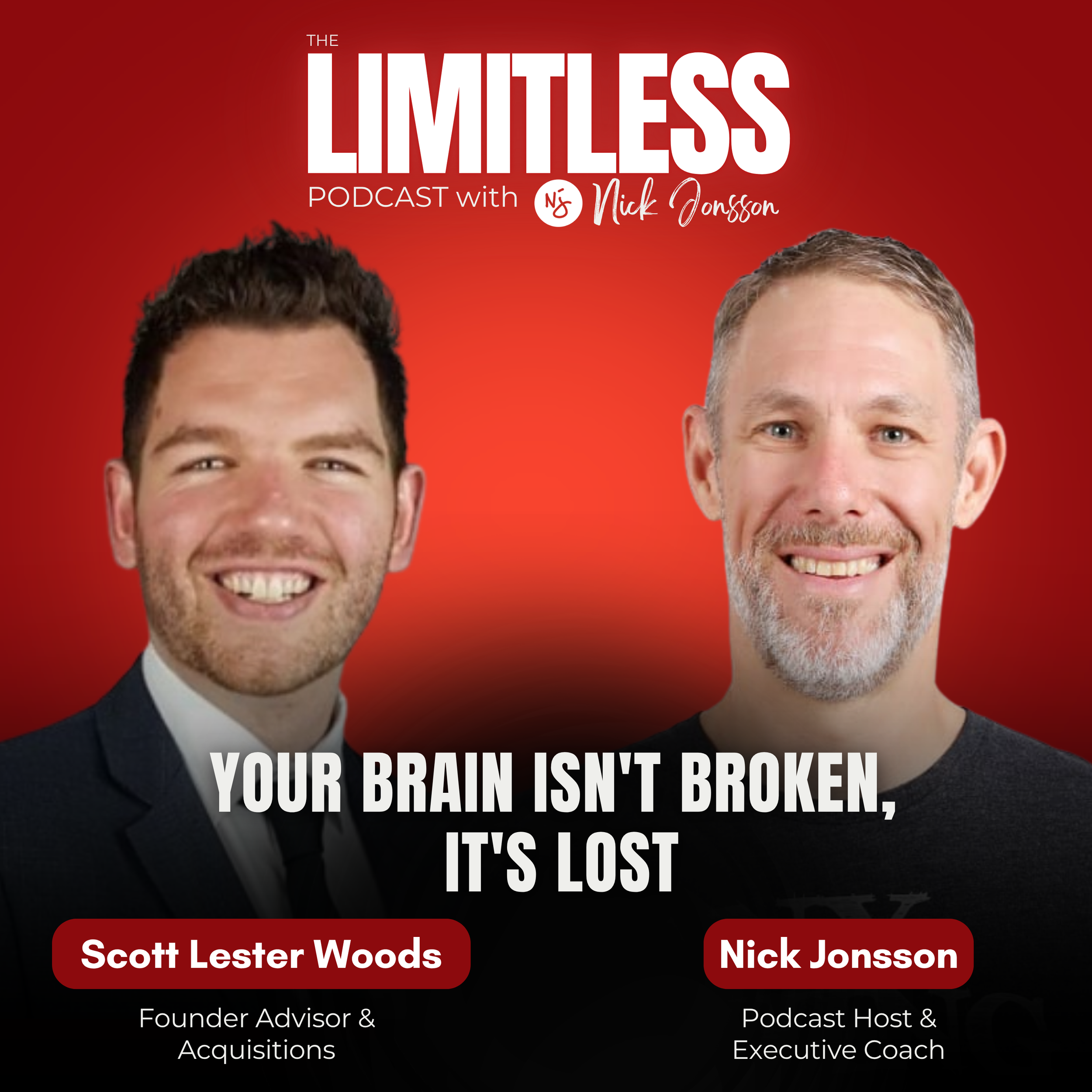
Scott Lester Woods was robbed on his 25th birthday. He was living in a Buddhist temple at the time, and someone walked into his room and took everything he owned. What he remembers is not the loss. It is that nobody there offered him sympathy. They felt sorry for the thief. Then they spent the next day asking him why his happiness was cheap enough that a stolen laptop could carry it off.
He had gone to the temple after a moment on Koh Phi Phi, sitting in the most beautiful place he had ever seen and realising he had brought the same miserable version of himself along with him. That misery started at nineteen, through roughly two years of depression, when he decided some people are simply born with a happy brain and he was not one of them.
What moved him was not a technique. It was a reframe:
"I'm not broke, I don't have a broken brain, I've got a hunter-gatherer nomadic brain, that's been now plonked in a society that it doesn't recognize."
Twelve years on, Scott is a clinical hypnotherapist and identity coach working with founders and high performers at the level of identity rather than willpower — the difference, as he puts it, between becoming a non-smoker and being someone who quit.
When I told him the executives listening are on calls sixteen hours a day, he did not reach for a routine. He said they are one belief and one skill away from changing it.
For anyone who has changed the job, the city, or the relationship, and found they brought the same person along.
Contact Scott to collaborate:
Website: https://scottlesterwoods.com
Instagram: https://www.instagram.com/scottlesterwoods/
Episode Transcript
Scott: Nine times out of ten, the issue, or the thing they want to change, is very rarely strategic. It's very rarely a strategic block that someone is struggling with. They often think it's strategy-related, but the moment you probe a little bit further, 99 times out of 100, Nick, it's going to be mindset.
So for the last 12 years now, it's been my privilege to understand a little bit more about how to change behaviour long-term, how to change things at an identity level, versus just consciously trying to use willpower to make a shift in life. I find that once that change happens, especially at the founder level, companies change quite dramatically. There's this wonderful downstream effect that you see as a result.
Nick Jonsson: Yeah, I think that's an interesting topic to explore indeed, because there's so much change, and everything is changing so quickly, that it's almost impossible for someone to grasp it. And mindset is perhaps the only difference there. Maybe you can elaborate a little more. What kind of mindset should one have today to be able to keep up with everything?
Scott: No one's ever asked me that question. What kind of mindset… First of all, I think it's really handy to define the word mindset, because mindset is a word that I'm sure you've had hundreds of guests use before, and yet when you really probe someone as to what their definition of it is, people often give different responses. Sometimes people think it's just limiting beliefs. For me, it's the psychology that encourages particular actions.
So when it comes to the mindset people need today, what's the psychology they would need in order to take particular actions? I'd say, first, to be able to think critically. People are bombarded with more stimulus in an afternoon than even our hunter-gatherer ancestors would have had in a lifetime. So being able to think critically, and to try to understand their own psychological biases, is a huge one.
Aspects of resilience are huge too, but also being able to feel safe moving into uncomfortable environments. When I'm helping someone essentially recode themselves at an identity level, a huge part of that is for them to recognise that it's safe on the other side of what we're doing. Very often, when people have to make that change, whether it's a deep-down trauma they want to shift or just a new leadership style, they have to recognise that who they are on the other side of that change is going to feel safe eventually. That's the thing I don't think a lot of people understand. When they're making the change, they feel like there's going to be a part of them that has to die, and that's going to be the end. That's just not the case.
So I'd say those are probably the main features I would see in a successful mindset nowadays.
Nick Jonsson: Yeah. And if someone is going through a challenging time… there are a lot of people who have been let go from work, in wave after wave after wave. If someone finds themselves in that challenging spot, not really sure what to do next, do you have any advice for them? What should they do?
Scott: There's definitely an identity aspect again. The main reason for that resistance is this: if someone was, let's say, a software engineer, used to doing coding, they might say, "I went to university or college to do this thing. This is how I've identified myself for the last couple of years, and now suddenly there might not be a need. There's something out there that can code better than me now. Who am I?"
So it's about having a flexible identity, and recognising that you are so much more than your current skill set. You are also what your next skill set can be. There's a wonderful phrase I heard, it might have been Tony Robbins or Jim Rohn who said it, that we're all equal as souls, but we're not equal in the marketplace. So it's about being able to recognise, "Okay, I'm an incredible learning machine. My learning doesn't stop here. My identity is so malleable. Who I've recognised I am, and my skills in the past, aren't necessarily who I'm going to be in the future."
So be open to recognising that you're not only the skills you've had, you're also the skills you can get in the future. The moment people recognise, "Hang on a second, I can learn one thing, I can learn another thing," recognising that that's possible can be quite helpful.
Nick Jonsson: Yeah, and you mentioned identity, and I know that you do identity coaching as well. What would that look like for someone? Are there tools, processes? How do you do identity coaching?
Scott: Yeah, that's very much about helping someone make a change at a subconscious level, so it uses forms of trance and altered states. I developed a process about four years ago, and we got it clinically tested. You can see these changes happen in the brain within 15 minutes, which is really cool.
The way I would normally do it is a little bit like a taxi driver helping someone get to a destination. I only need to know three things. Where is their point A? What is it they believe about themselves? What do they believe about the world right now? What actions are they taking? That's point A.
Then I need to know point B, which is the version of them that becomes the founder they want to be, or the leader they want to be, or the husband or wife or parent they want to be, you name it. And then work out what that person's beliefs are, what actions they take, and what they believe about the world.
And then, what's the gap? Where's the friction point? I use a very particular subconscious process to dissolve that friction point, so that point A now becomes point B. But more importantly, Nick, they feel safe at point B, and that happens in a very safe, fast and effective way. Those are the three pillars of how I work.
Nick Jonsson: Can you talk about someone you've taken through that journey, where they were before, and how they came out the other end?
Scott: Sure. I've worked with people from pretty much every background and incident you can imagine. A very extreme case would be someone with PTSD who'd seen a psychotherapist for 12 years. They were an ex-war veteran, so they had all these unprocessed elements and memories within them.
Within a single session, we were able to essentially neutralise every single memory related to that trauma, which had happened 12 years ago. And remember, they'd had 12 years of psychotherapy, and it hadn't been able to shift that. But then they were able to remember who they were before that incident: that they're not a broken war veteran, they're someone so much more than that. That would be one example where you get to see something happen very quickly, in a wonderful way.
There was also a business owner who had a very successful six-figure agency, and they realised they were broken and burnt out. They were almost the classic burnt-out founder you could imagine, whose whole life revolved around their business. Within a handful of sessions, they got to spend a lot of time in Indonesia and Malaysia, and they were able to completely restructure things so that their business revolved around their life, instead of the other way around.
They were able to turn it into a lifestyle business that was actually more profitable afterwards, because they realised, "Oh no, I don't need to be the burnt-out founder anymore. I can be the founder who has fun. And actually, the moment I put these different constraints in my business, lo and behold, now I can do this nomadically, now I can have more fun, now I don't need to have that pressure, and now I have a lot more clarity about what I want to do, without the blocks of feeling like I can't do it anymore." Hopefully that makes sense.
Nick Jonsson: Yeah, and I like that you mentioned fun, and fun for founders, because as you say, it's so easy for a founder to have the business take over every angle of their life. Even if they're on vacation, or trying to take one, they'll constantly be on call, sitting there working. I find it's very hard for founders to detach. So fun and recreation could be something, as long as you can detach. How would that work? Would your model also help them detach, so they can do something that is more fun?
Scott: That's a trickle-down effect of what happens when someone changes their identity. One of the easiest examples of this: I trained in hypnosis about 10 years ago, and hypnosis is very famous for helping people stop smoking. But to help someone stop smoking for good, so they never have a cigarette again, you don't try to help them change at a behavioural level. If you say, "Right, what I need you to do is XYZ to stop having cigarettes," that's not it. The highest-leverage way you can use a session is to help them identify as a non-smoker.
So the moment that part of them goes, "Huh, that's weird, no part of me feels like a smoker anymore," well, guess what? The behaviour change of not smoking is just a wonderful byproduct of that.
So if we're trying to take a busy founder who has this deep-seated subconscious identity of a burnt-out founder, or a busy person, or a perfectionist, or whatever vice they're living with, and you try to get them to detach manually, there's going to be this weird disconnect where they feel really uncomfortable not working on the business and trying to have fun. The moment you change it at an identity level, and they recognise that they are now a founder who has fun, or a fun founder, or whatever you want that identity to be, detaching becomes an effortless action as a result.
Nick Jonsson: Yeah, that definitely makes sense, and I think that's essential for people to balance their life. I don't like the term work-life balance myself, because it implies there are only two parts to life. I'd rather use the term life balance, and look at all the different parts we can put into our life and focus on: quality of relationships and everything else. Is that something you also do in your coaching?
Scott: 100%. It's not something I manually try to push, but every single time, when you have a handful of sessions with someone, even by session three, relationships, emotional control and the physical body all come to the forefront. Like you said, I always like the phrase work-life integration. They're always things that integrate with each other. People who think they can completely compartmentalise each of those things have probably lied to themselves about other things too.
So all those pieces are part of the pie, because it's amazing what can happen if a founder feels like they're looking after their body, they feel great emotionally, their business feels like it's making progress, and yet something feels stuck. Nine times out of ten, you look a little bit further and they say, "Oh yeah, my relationship's been in pieces for the last eight years, and I haven't really had the time, space or ability to look at that." So everything comes up to the forefront. You end up feeling a lot more like a therapist than a coach a lot of the time, when all these other pieces come to the surface.
Nick Jonsson: Yeah. And what about yourself, Scott? Is there an underlying reason or motivation for you to help founders with this?
Scott: 100%. We spoke about this briefly. When I was about 19, I generally believed I was broken. Now, when it comes to things like depression or anxiety, there's a lot of awareness about that nowadays, which is wonderful. I don't think the solutions are quite as good as they need to be, but the awareness is certainly a lot stronger than it was when I was 19. I didn't know what anxiety was. I didn't really understand the concept of depression. I'd known a couple of people who had taken pills the doctor had given them to make them feel a bit better, but I didn't understand anything about SSRIs. So I just thought that some people were born with the happy genes and the happy brain, and people like me had just been dealt a bad hand.
There was a lot of noise out there, and unfortunately there's a lot more noise today. But I got obsessed with neuroscience, anthropology, spirituality, psychology, biology, you name it: understanding the mechanics of what it means to be human. And before I knew it, I recognised, "Oh, I'm not broken. I don't have a broken brain. I've got a hunter-gatherer nomadic brain that's now been plonked into a society it doesn't recognise."
The moment that switch happened, a lot of the symptoms started to reduce, because I recognised that if I'm not playing by the rules of the system of my body and my brain, there's going to be disharmony, and I'm going to feel it, and if I don't listen to it, it's going to get worse.
My favourite example of this: people know instinctively that we're more closely related to a chimpanzee and a bonobo than an African elephant is to an Indian elephant. So if you take an ape out of, let's say, the Borneo jungle, rip it away from its tribe, stop it from moving, give it processed food and shine blue light in its eyes all day long, is that animal going to start thriving? Most people instinctively say, "Well, of course not." And you say, "Okay, well, that's kind of what we've done with our hunter-gatherer nomadic bodies."
So the moment I was able to recognise that and realise, "Oh, okay, there are systems to this, there are rules to this," my symptoms disappeared pretty quickly.
And then I did everything you could imagine. I went to most seminars. To say I've read a lot of books would be an understatement. I climbed mountains with Wim Hof to learn about the mind-body connection. I lived in a Buddhist temple for two years to learn about meditation and spirituality. I was just trying to work out what the signal is within the noise, because when you explore things like personal growth, or when you speak to multiple scientists, and I got to interview some really prominent neuroscientists as well, to understand what on earth is going on and how I "fix" myself… Obviously, I didn't need to fix myself. I was never broken.
In both worlds, the scientific community and the spiritual community, living in a Buddhist temple, there's a lot of dogma in both camps. So it was really difficult to work out what is the variable that makes the change, and what's the dogma and the spiritual noise that's not really necessary.
Because I spent a lot of time, years, not necessarily wasted, but bouncing between different paths, being told lots of different information and going through all sorts of ups and downs, I've become viscerally passionate about trying to save that time for other people. I know what it's like to be in a Buddhist temple believing one thing, when actually, if I'd done these other things, I would have got the results 10 times quicker. So it's that time and that pain that I want to help other people avoid.
Nick Jonsson: Yeah, I'd like to hear a bit more about spending two years in a Buddhist temple. That is perhaps at the extreme end, especially when it comes to time. I had one of my coaching clients on a call yesterday who was considering going for a one-week silent retreat, but when he looked at it, one week away from family and business seemed too difficult for this particular founder. So two years is indeed a big investment. I also heard you say that maybe we don't need to invest two years to find a way to meditate. Maybe you can elaborate a little on that.
Scott: What was wonderful about it is that I'm a huge fan of immersion. If I'm trying to learn Italian and I'm thrown into the middle of Rome, I'm much more likely to get a better grasp of Italian, and to be able to apply it practically, if I go to Rome.
In my mind, it all started because I was not too far away from where you are now, a few hours away. I was in Koh Phi Phi. I'd just learned to scuba dive, and I realised, "I'm in this perfect location now, and I've brought the same miserable bugger with me." I thought, "Huh, something's off here." It's the famous thing about travelling, right? Wherever you go, there you are. And I realised there's nothing to escape from apart from the thing that's between my own ears.
So that's when I decided, okay, who knows about this? I thought, well, Buddhism seems to have been around for a while, and there's a lot of neuroscience that seems to echo a lot of the teachings. Now, full disclaimer, Nick: I'm not a Buddhist. I don't think I ever have been. But I was still very fascinated by the philosophy. When I went there, they knew I wasn't a Buddhist, they knew I wasn't necessarily on the path, but they knew I was curious, and they could see I was open to it.
So every day you'd start with these meditations. There were often lots of silent retreats at the monastery at the time. It was wonderful to be in that world, and I must say I was extremely fulfilled living there. But I was also extremely broke.
Because what started to happen, when I went full-blown into the spiritual world, was that… not to criticise Buddhism, but absolutely everything is seen through one particular lens. So let's say you hurt your back: well, it's because you were self-cherishing. Not because I'd been doing kettlebell swings with something too heavy for me two days previously.
So there were lots of beliefs that were interesting, and it was a really immersive experience, challenging your own reality many times, and then taking what works and leaving what didn't. But I would say that if you spend your time around people whose only role is to achieve enlightenment, and the only way they believe they can do that is to help others achieve enlightenment, you're going to spend time in a really wonderful place. That's what I got to do.
There were some very particular lessons I got to learn first-hand. On my 25th birthday, when I was still staying there, someone had broken into my room and stolen everything. Not one of the monks, someone from outside, off the street. I thought it was a joke. One of the nuns called me up, because I was away at the time, and said, "Scott, you need to come back. Someone's stolen all your things." I thought they were playing a prank on me, that they probably just wanted me to come back because they wanted to celebrate my birthday with me.
So I walked in and said, "Okay, where's the stripper?" And quick as a flash, one of the nuns said, "He's in there, dressed as a police officer." I walked in, and it turned out it was a police officer. Someone had stolen everything.
What fascinated me about that experience is that even though everything had been taken, there was no sympathy from any of the residents there. They didn't say, "Oh gosh, this must be so hard for you, your laptop's been taken, this has been taken." I don't think my passport had been taken, so I was lucky with that. But there was none of that whatsoever. They felt true pity for the person who'd stolen my things, because they thought, "Oh gosh, the bad karma this person has created for themselves. What a sad thing to have gone through."
And there I am thinking, "Well, what about my stuff? My stuff's been taken." But they taught me very quickly. It was a very interesting 24 hours, where they got to say, "Why is your happiness so cheap, that you would give it away the moment someone takes a laptop?" The whole process seemed nonsensical to them. "Why on earth… you're okay, you're healthy, you can still serve other people, you can still do the work you're doing. Why on earth would you be upset or angry at this person, who was clearly in a bad place to take it in the first place?"
Lessons like that were extremely powerful. Even now: there was a mistake made yesterday where I essentially lost £2,000. And it was wonderful, because there were maybe three seconds of suffering before I thought, "It was never really mine to begin with." So immersive lessons like that can be extremely powerful.
Nick Jonsson: Yeah, thanks for sharing those lessons. And what did you do after coming out of two years in the temple? Did you manage to get back to the world, or was that the real world? Was it difficult, or how did you transition?
Scott: Not really. The temple and real life were very well integrated, so it never felt like I was truly separated from the work I was doing, which was really handy.
I'm trying to remember what happened afterwards. I think I met my ex-partner, and slowly but surely I just began building my business. I sort of felt like I'd done things the other way around. You often hear with a lot of business success stories that they do the achievement side first. They rise up the ladder for the achievement, and then they go, "Huh, I'm not fulfilled. Now I need to work out what fulfilment is." I kind of feel like I did that in reverse.
I was listening to a lot of people talking about achievement, and then finally saying these things, these wonderful mic-drop moments from influencers of, "And none of it really mattered." And I thought, "Well, that's weird, because I kind of grew up with those realisations." It was the skill of achievement that I hadn't really been taught.
So I went the other way around. It was, "How can I feel fulfilled first?" And then, "Oh, but now I'm completely broke, and I need to work out how to actually achieve the levels of success that I want, that give me the freedom I want," and then to balance both. It's felt weird doing it the other way around, because most of the people who are known in the world of achievement did it the other way: they achieved out of the huge levels of deprivation they had in their own fulfilment. So it's been interesting attempting to do it in reverse.
Nick Jonsson: And everything you're sharing now, is that something you bring into your work with your clients?
Scott: 100%, but only as and when it's required. All the work I've done has always been founder-led. What does this person want to achieve? Okay, let me get them there in the safest, fastest, most effective way for them. And then, as a result, there are always byproducts and things that come out.
The privilege I have is that I can get those results very quickly. So we don't need to spend 12 months getting someone to a place of achievement only for them to say, "Oh, this is empty." We can get to those places very, very quickly, which means the fulfilment side can come out a lot faster.
Nick Jonsson: Yeah. So looking back on your story, you were 19 when you were depressed, and 25 when you were in the temple. How long were you in the depression, and what helped you get out of it? Was it the reading of books and so on? Maybe you can elaborate in a bit more detail, so we can understand. It might be that someone listening is going through a tough time, so there might be some light you can shine on that.
Scott: Yeah, sure. It was approximately two years of that depression. At the time, that was the learning, the researching, the working out how to get to a better place. The thing that really shifted for me was the paradigm shift, and again, it was an identity shift: recognising, "Oh, I've been identifying as this broken boy for a long period of time." The moment I recognised, "Oh no, I'm a hunter-gatherer nomad stuck in a society that's not built for thriving," it was that shift that allowed me to ask, "Okay, so what are the pillars that need to change?"
Well, what would a hunter-gatherer nomad have done many years ago? They'd have a strong sense of community. Their sleep would be off the charts, because their circadian rhythm would be incredible. They'd be eating whole foods. They'd be moving. They wouldn't necessarily be exercising, but they would be moving, because the body's not built to exercise, it's built to move, and we're the best movers on the planet. Homo sapiens are the only species that climb mountains, swim oceans, climb trees, run and sprint, the whole shebang. We really are incredible movers, which is one of the reasons we've been able to go to every corner of the planet.
We've also been able to actively experience discomfort, and the world we're in isn't built for that anymore. So even something like a cold shower or a cold plunge, which I do with the Wim Hof work, is a big one. Also, thinking in the present. People forget that a hunter-gatherer nomad isn't wired to see more than three months ahead. It was only when the agricultural revolution kicked off and we started growing crops that suddenly we had to think, "Oh gosh, what are the crops going to be like in three months' time? If there's a really bad storm, it's going to take out a huge part of our food supply, and then what do we do?" Beforehand it was always, "What do we eat? Whatever we catch and find today, or whatever we caught and found yesterday."
So being able to understand that present mentality, and then building my world more around that hunter-gatherer nomadic life, really helped. Those were the practical pieces.
And then, when I learned how to do very effective subconscious recoding, helping things change at an identity level, that was the 2.0 version of it. Unfortunately, that's not something you can do over a podcast. Most people end up listening to some sort of hypnosis recording, and sometimes they work, sometimes they don't, because they're not personalised, and very often they're not effective, for a number of reasons.
But I'd say those things in tandem, understanding the hunter-gatherer nomadic tenets and knowing how to reprogram the subconscious, are a game changer. Because I've found that when someone's depressed, when someone's anxious, when someone's at rock bottom, there are patterns. It's very difficult, I'd say almost impossible, for someone to have a great sense of community and therefore a great sense of meaning, great sleep, an excellent diet — not just eating well, but actually giving their body the nutrients it needs to flourish — to be moving, to be experiencing discomfort, to be experiencing progress, to believe that they are enough, that they're capable, that they don't need to be perfect, that they're worthy, that they belong… It's very difficult to have that software in place and to feel rotten.
Nick Jonsson: I like that you say move, rather than exercise. I talk a lot about moving. There's that famous book called Born to Run, but I'd challenge it a little. I love running, and I love everything about it, but if we want to be inclusive and think of everyone, it's about moving, and I do believe we were born to move. It's something I talk about all the time: that we need to be intentional and make a plan to move, and ideally move in nature, wherever we can find it around us, to connect with the source.
I spend between 15 and 25 hours a week myself moving in nature. That's how I recharge my batteries. It can be swimming, cycling or running. Today I was out cycling in a nature reserve here in Thailand, in the rain. That was my recharge today. So whatever works for us. That's also what you found, Scott. We don't really hear this much, so how important do you think it is for someone who's listening?
Scott: When it comes to movement, I would say there's a wonderful book called Spark by a neuropsychiatrist called John Ratey. Once you finish that, and once you look up the studies he's discussing, you start to realise that people talk about exercise being good for the body, but the brain gets a far more significant benefit than the body does when it's moving. It's difficult for the brain to feel amazing without that sense of movement.
And again, we're just not set up in a culture at the moment where movement is a natural part of it. People have to make that extra effort, because there's a shop on every corner. You can call your friends and order food to your house, for goodness' sake. There are fewer reasons to move than there ever were before.
That's one of the reasons, as I said beforehand, that I'm based in Dartmoor. One of the reasons I'm in Dartmoor is that it's one of the best places for nature in the UK. I can move two minutes that way and I'm across these amazing, beautiful moorlands. So I'd say it's incredibly important. It was either Hippocrates or Socrates who said: if you're in a bad mood, go for a walk; if you're still in a bad mood, walk again. It's a huge part of being human.
Nick Jonsson: Yeah, absolutely. That's something I use with my coaching and therapy clients as well, in terms of how to deal with panic attacks. If it's getting bad, yes, there's medication for it, but that's like putting on a plaster: once we remove it, we still need to be able to heal ourselves. Going for a walk, or a shower. And I like that you also talked about how we humans are supposed to be able to deal with a cold plunge and these kinds of things, and bring those challenges into our life. I know that you also climbed some mountains. Maybe you can elaborate on that, and how did that help you, Scott?
Scott: Yeah, sure. I spent a week with Wim Hof in Poland. This is 10 years ago now, so it was December 2016. One of the things they do is all sorts of mini-exercises with breathwork, meditation and cold plunges. And on the fourth day, you end up climbing Mount Śnieżka, which is the highest mountain on the Czech-Polish border. That was around minus six degrees, and you're asked to climb it wearing nothing but shorts and shoes, so you're completely topless when you do it. Beforehand you think it's going to be impossible, and yet you do it and it's effortless.
I was very privileged to meet my best friend on that retreat. We've spoken pretty much every day since. A couple of weeks after we got back from Poland, we met up and did mountains in the UK as well. The coldest one we did was minus 15 degrees. That was in November, in England, on Scafell Pike, which is the tallest mountain in the UK.
We did actually try to break a world record, where we tried to climb the Three Peaks in the UK in the fastest time in sub-zero temperatures wearing only shorts and shoes. But after we climbed Snowdon, which was on Boxing Day, the 26th of December 2016, we ended up almost dying on that first mountain. As we were slowly going to the second mountain, my friend pulled over to the side of the road and said, "Scott, I think we should call it a day. After the incident that happened last night, I think we're just laughing in the faces of the gods if we keep doing this."
So we ended up climbing that mountain again about two months later. We have still yet to do those Three Peaks, because of the near-fatal incident we had the first time we were climbing.
Nick Jonsson: Sounds like a challenge to have ahead of you. When will it happen, Scott?
Scott: That's a good question. We were going to bring in… we ended up having a Zoom chat and looking at dates with a guy called Josef Köberl, who was almost known as the Austrian Wim Hof. He beat Wim Hof's Iceman records several years ago, and he was going to do it with us. We were going to raise some money for charity. But it still hasn't happened. I don't know if my friend will do it, because since then he's had a child, and I think he wants to make sure he's around for that. But it would have to be at some point… So I'm going off on a tangent here, Nick. You've got me excited, because I'm thinking, actually, maybe it could happen this year.
Nick Jonsson: Yes. Well, you have to keep us posted. Looking forward to perhaps having you back on the show again when you've done it.
Scott: That'd be it. I'd have to show some victory pictures.
Nick Jonsson: Yeah, that sounds really fascinating. Thanks, Scott, for coming on the show and sharing about your own challenges, how you got out of them, and some really inspirational things you have done and are doing. Is there any question I forgot to ask you? Anything you want to leave the listeners with before I let you go?
Scott: What is the biggest challenge your current audience are facing, do you think?
Nick Jonsson: I think it's burnout. A lot of executives are burning out these days, and they struggle to keep up with their physical health, their mental health and their social health. Work is taking more and more of the time. There are fewer people doing more, so they're working across more time zones and more calls. I know many people who can say they're in meetings 16 hours a day. There's no time for anything we've spoken about today, Monday to Friday.
Scott: Okay. Then maybe something that would be helpful for them, listening, is this: if that's the avatar we're thinking about, they are essentially one skill set and one psychological limiting belief away from changing that. There's one little bit of software change that has to happen in the brain, and there's one skill, most likely the art of delegation, that has to happen. And there's going to be a belief around delegation that's stopping them from doing it, because there are far more successful individuals than them, in very, very similar industries, who aren't going through burnout. It's not because they're part of the lucky sperm club. It's because a psychological shift, and also a strategic shift, is being made. So the answer is there.
What I would say is: go and find someone who has solved not a general problem, but the exact problem you're facing. So if you own a digital marketing agency, and you know there was a digital marketing agency founder who was working 16 hours a day and was able to do XYZ, go and find that person, ask them what they did, and implement it. The reason I'd say go and ask them is that if they had the exact same situation you're in, that in itself will help dislodge the psychological limiting belief as well.
Nick Jonsson: Yeah, thank you for that, Scott. That sounds like a good idea. I also believe we can ask ourselves: am I really the first person in the world who has ever faced this problem? Most likely, someone has faced it before, and we can indeed learn from them.
Scott: 100%.
Nick Jonsson: All right, thank you so much, Scott, for coming on the show, and thanks to all the listeners as well. I wish you a great summer ahead. Take care, and thank you.