The Business Benefits of Psychological Safety
Psychological safety is often described as a “soft skill,” but for modern organisations, it has very real business consequences. When people feel safe to speak honestly, ask questions, admit mistakes, offer ideas, and challenge assumptions, teams become more agile, more accountable, and more effective.
The opposite is also true. When employees do not feel safe, they withhold information. They avoid difficult conversations. They filter feedback, hide mistakes, and wait for someone else to raise concerns. Over time, this creates slower decision-making, weaker collaboration, reduced innovation, and higher levels of stress inside the organisation.
Psychological safety matters because it directly affects how teams communicate, solve problems, and perform under pressure. Leaders may invest heavily in strategy, technology, and talent, but if people are afraid to speak openly, the organisation will never access the full intelligence of its people.
Research from Dr. Amy Edmondson and Google’s Project Aristotle has helped bring this topic into the centre of leadership development. Dr. Edmondson’s work showed that psychological safety is essential for learning and performance because people need to feel safe enough to take interpersonal risks. Google’s Project Aristotle found that psychological safety was one of the most important factors in determining team effectiveness, even more important than individual intelligence, seniority, or personality type.
For organisations, this means psychological safety is not just about making people feel comfortable. It is about creating the conditions where high performance can happen sustainably.
Organisations that invest in psychological safety often experience:
Higher employee engagement and morale
Better communication across teams and departments
Greater innovation and creativity
Faster problem-solving and decision-making
Increased accountability
Lower employee turnover
Stronger collaboration
Higher levels of trust
Greater resilience during organisational change
Improved customer experience
Rather than slowing organisations down, psychological safety helps teams move faster because people raise issues earlier, share ideas more freely, and work through challenges more honestly. It allows organisations to replace silence with clarity, fear with trust, and avoidance with constructive action.
This is why psychological safety has become one of the most important leadership capabilities for organisations that want to build high-performing, resilient, and future-ready teams.
Why Leadership Workshops Create Lasting Change
Reading about leadership can create awareness, but awareness alone rarely changes behaviour. Most leaders already know that trust, communication, and accountability matter. The real challenge is translating that knowledge into daily leadership practice, especially when pressure is high, conversations are difficult, or team dynamics are complex.
This is where leadership workshops become powerful.
A well-designed Team Psychological Safety workshop gives leaders the opportunity to experience new ways of thinking, practise new behaviours, and receive honest feedback in a supportive environment. Instead of simply learning about psychological safety as a concept, participants begin to recognise how their own communication style, responses, assumptions, and habits influence the culture around them.
At Limitless Executive Solutions, our workshops are designed to be interactive, practical, and relevant to real workplace challenges. They are not presentation-based sessions where people passively listen. They are facilitated experiences where leaders reflect, discuss, practise, and apply.
Participants engage in:
Leadership self-assessments
Team discussions
Reflection exercises
Practical workplace scenarios
Communication activities
Group coaching
Action planning
Every activity is designed to help leaders understand the connection between their behaviour and the psychological safety of their teams. For example, the way a leader responds to a mistake can either encourage learning or create fear. The way a leader handles disagreement can either strengthen trust or silence future feedback. The way a leader invites participation can either unlock diverse thinking or reinforce hierarchy.
By the end of the workshop, participants do not simply understand psychological safety. They leave with a clearer view of their team culture, practical tools they can apply immediately, and a concrete action plan for strengthening trust, communication, accountability, and performance.
This is what creates lasting change: not inspiration alone, but insight followed by action.
Psychological Safety in Action
Over the years, we have had the privilege of delivering Team Psychological Safety workshops for leadership teams across a wide range of industries, including hospitality, healthcare, education, financial services, technology, and multinational organisations. Each industry has its own pressures, but the deeper leadership challenges are often remarkably similar.
Leaders want stronger collaboration, more honest communication, and higher accountability. Employees want to know that their voices matter. Organisations want people to take ownership, contribute ideas, and solve problems earlier rather than waiting until issues become difficult to manage.
Psychological safety sits at the centre of all of this.
One example is our Team Psychological Safety programme delivered for the leadership team at LUX* South Ari Atoll Maldives. During the programme, leaders explored practical ways to strengthen trust, improve communication, embrace diverse perspectives, and create an environment where employees felt safe to contribute their best ideas.
What makes these sessions powerful is that they move beyond theory. Leaders begin to see how psychological safety shows up in everyday moments: a team meeting, a performance conversation, a mistake, a disagreement, a new idea, or a difficult question. Culture is not shaped only by major decisions. It is shaped by repeated responses.
When leaders respond with curiosity instead of blame, trust grows. When leaders invite feedback instead of defending their position, communication improves. When leaders acknowledge uncertainty instead of pretending to have all the answers, people feel more able to speak honestly.
While every organisation is different, the principles remain consistent. When leaders intentionally develop psychological safety, they create cultures where people can contribute fully, collaborate openly, and perform at their best.
Why Organisations Choose Limitless Executive Solutions
At Limitless Executive Solutions, we believe leadership development should create lasting behavioural change, not simply deliver an inspiring day of training. A powerful workshop should not end when participants leave the room. It should change the way leaders think, communicate, make decisions, and build trust with their teams.
Our Team Psychological Safety workshops combine internationally recognised research with practical leadership experience gained from working with organisations throughout Asia and internationally. The programmes are facilitated by Nick Jonsson and Dona Amelia, Certified Team Psychological Safety Practitioners, and are tailored to the organisation’s unique culture, leadership challenges, and strategic objectives.
This matters because psychological safety cannot be built through generic advice. A senior leadership team, a hospitality management team, a fast-growing technology company, and an organisation going through change may all need psychological safety, but they need it applied in different ways. The workshop must reflect the context, the people, and the business reality.
Participants leave with:
A deeper understanding of psychological safety
Practical leadership tools they can apply immediately
Greater confidence leading difficult conversations
Stronger communication skills
Clear actions to improve trust and accountability
A shared language for building healthier, higher-performing teams
Our goal is simple: to help organisations build cultures where people feel safe enough to contribute fully, collaborate openly, and achieve extraordinary results together.
The real value of this work is not only in improving how people feel. It is in improving how teams function. When psychological safety increases, leaders get better information, employees become more engaged, and teams become more capable of handling pressure, conflict, and change.
That is why psychological safety is both a human priority and a business advantage.
Building High-Performing Teams Starts with Leadership
Every leader influences culture.
Every conversation shapes trust.
Every response to a mistake, a new idea, or a difficult question either strengthens or weakens psychological safety.
The most successful organisations understand that culture is not something they hope for. It is something they intentionally create. Psychological safety does not happen because a company has strong values written on a website. It happens when leaders consistently behave in ways that make honesty, learning, and accountability possible.
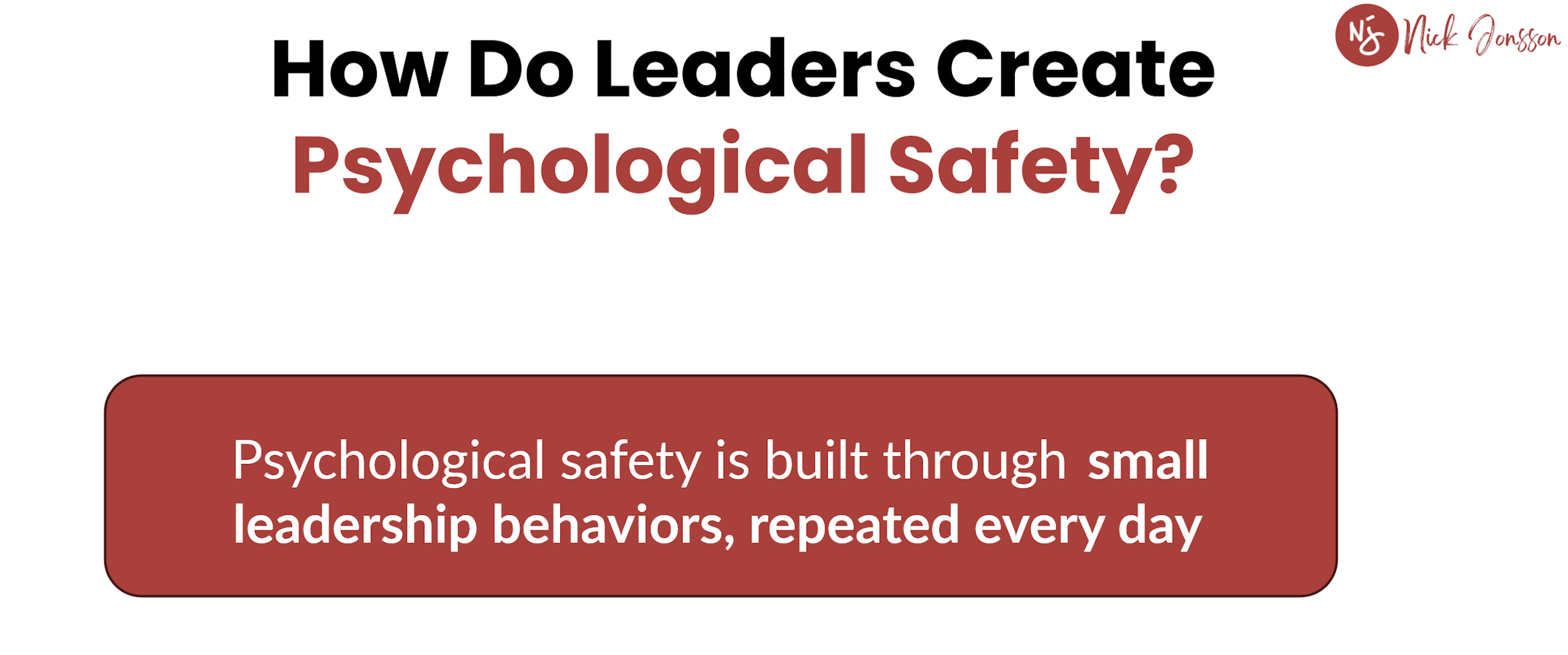
This begins with small but powerful leadership choices. Do leaders invite people to challenge ideas? Do they listen when concerns are raised? Do they respond calmly when mistakes happen? Do they encourage participation from quieter voices? Do they create space for reflection after projects, conflicts, or setbacks?
These behaviours may seem simple, but they shape whether people feel safe enough to contribute.
By investing in leadership development and psychological safety, organisations create workplaces where people are engaged, innovative, accountable, and resilient. That investment benefits employees, customers, stakeholders, and the long-term success of the organisation.
High-performing teams are not built by pressure alone. Pressure may create short-term output, but trust creates sustainable performance. When people feel psychologically safe, they are more willing to raise risks early, share ideas before they are perfect, ask for help when needed, and take responsibility for improvement.
That is how teams become stronger.
And it starts with leadership.
Ready to Build a Psychologically Safe Workplace?
If your organisation is looking to strengthen leadership capability, improve communication, and develop high-performing teams built on trust, our Team Psychological Safety Workshops provide practical, evidence-based solutions that leaders can implement immediately.
Using the internationally recognised Team.As.One® methodology, Nick Jonsson and Dona Amelia help leaders translate the science of psychological safety into everyday leadership behaviours that improve collaboration, innovation, accountability, and organisational performance.
Whether you are developing new managers, strengthening executive teams, improving communication across departments, or building a culture that supports sustainable growth, we can tailor a workshop to your organisation’s needs.
Our programmes can support:
Executive leadership teams
Senior managers
HR professionals
Department heads
Project teams
Emerging leaders
Hospitality and service teams
Organisations navigating growth or change
A psychologically safe workplace does not mean a workplace without challenge. It means a workplace where challenge can be handled with trust, maturity, and honesty.
If your team is hitting targets but avoiding difficult conversations, if feedback feels filtered, or if trust is quietly declining underneath the surface, this may be the right time to begin.
Learn more about our Team Psychological Safety Workshops and discover how your leaders can create workplaces where people feel safe to speak up, support one another, embrace challenges, and perform at their very best.
Frequently Asked Questions
What is psychological safety?
Psychological safety is a shared belief that team members can speak openly, ask questions, admit mistakes, offer ideas, and challenge assumptions without fear of embarrassment, rejection, or punishment. It is recognised as one of the most important characteristics of high-performing teams because it enables honest communication, learning, innovation, and accountability.
Why are leadership workshops important for psychological safety?
Leadership behaviours have the greatest influence on whether employees feel psychologically safe. Workshops give leaders practical tools to build trust, improve communication, encourage participation, manage conflict, and strengthen accountability. They also create a structured environment where leaders can reflect on how their own behaviour affects team culture.
What are the seven elements of Team Psychological Safety?
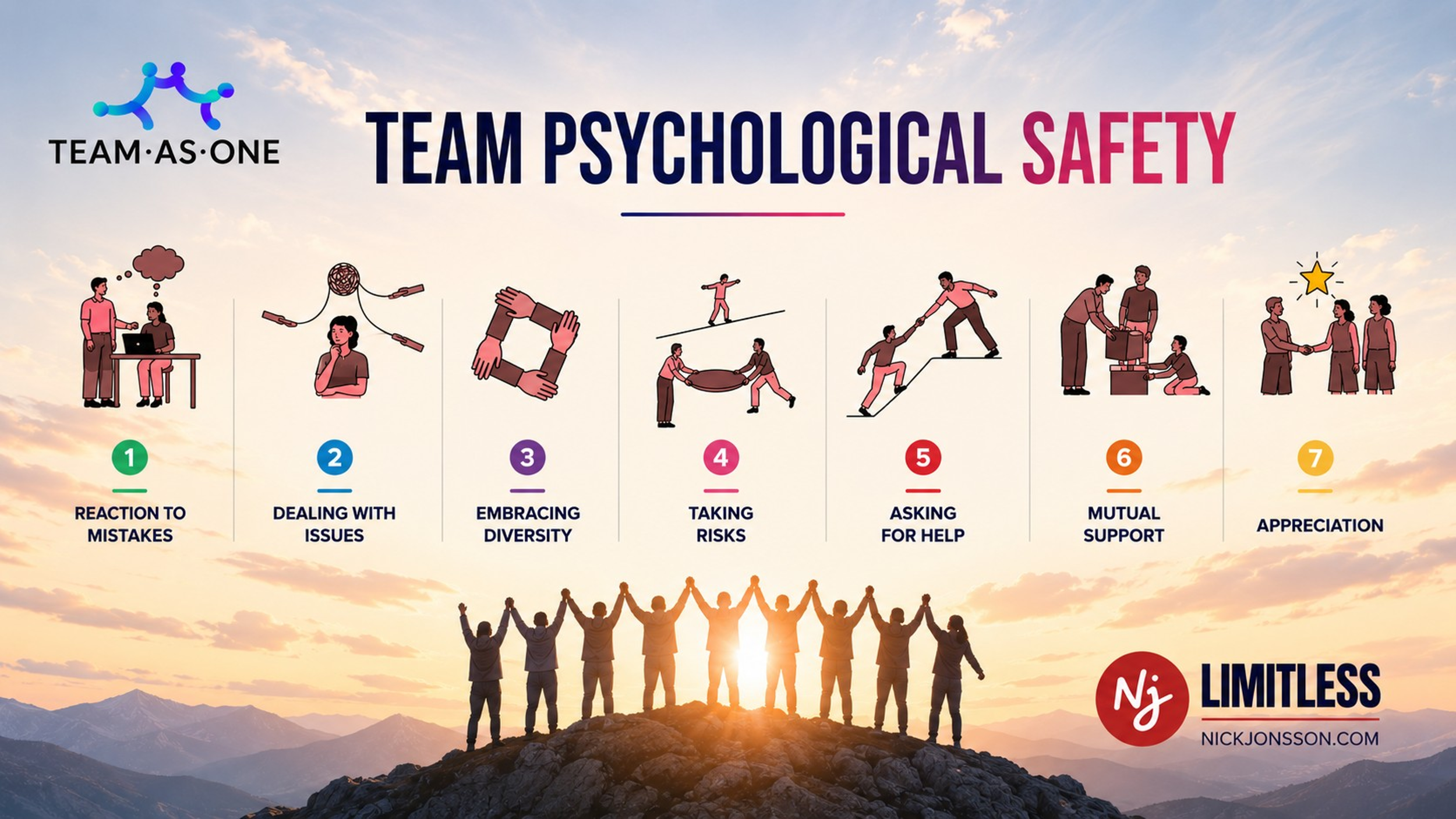
The Team.As.One® methodology focuses on seven essential elements:
Reaction to Mistakes
Dealing with Issues
Embracing Diversity
Taking Risks
Asking for Help
Mutual Support
Appreciation
Together, these elements provide leaders with a practical framework for understanding and strengthening psychological safety within their teams.
Who should attend a Team Psychological Safety workshop?
These workshops are ideal for executive teams, senior leaders, managers, HR professionals, department heads, project teams, and organisations looking to strengthen collaboration, communication, trust, innovation, employee wellbeing, and team performance.
How long is a Team Psychological Safety workshop?
Programmes can be tailored to your organisation’s needs. They can be delivered as keynote presentations, half-day workshops, full-day leadership programmes, or multi-session development journeys depending on the size of the team, leadership objectives, and desired outcomes.
How does psychological safety improve business performance?
Psychological safety improves business performance by helping teams communicate more openly, solve problems earlier, share ideas more freely, and make better decisions. It also supports stronger engagement, lower turnover, better collaboration, and greater resilience during change.
Is psychological safety the same as being nice?
No. Psychological safety is not about avoiding difficult conversations or lowering standards. It is about creating enough trust for people to speak honestly, challenge ideas respectfully, and hold each other accountable in a constructive way.
Or follow Nick on LinkedIn for weekly insights on coaching, leadership, wellbeing, and performance.