

How to Measure Team Psychological Safety
By Nick Jonsson - Global Gurus Top 30 Coach 2026 | Certified TEAM Psychological Safety practitioner | Speaker, Executive Coach, Counsellor and Psychotherapist
A practical framework for turning speaking up, learning, and collaboration into measurable leadership priorities
What gets measured gets discussed. And what gets discussed gets improved.
Most leadership teams say they value openness, trust, honest communication, and collaboration. These are words that appear in values statements, leadership presentations, and culture documents across organizations around the world. But saying that a team values openness does not mean people actually feel safe to speak openly when it matters most.
The real test is not whether people agree with psychological safety in theory. The real test is what happens in practice.
Can someone admit a mistake without being blamed or labelled? Can a junior team member challenge a senior colleague’s idea? Can people raise difficult issues before they become serious problems? Can someone ask for help without being seen as weak? Can the team discuss risk, failure, pressure, and disagreement without people becoming defensive or silent?
That is why measuring team psychological safety matters.
Measurement gives leaders a clearer view of what is really happening beneath the surface. It turns broad ideas like trust, openness, and communication into something more observable. It shows where the team experience is strong, where it is inconsistent, and where leadership behavior may be unintentionally encouraging silence.
The goal is not to chase a perfect score. The goal is to start better conversations.
When leadership teams measure psychological safety properly, they create a baseline for learning. They can see where people feel able to contribute, where they may be holding back, and which leadership behaviors will have the greatest impact on communication, accountability, collaboration, and performance.
For leaders, this is one of the most practical ways to move psychological safety from an abstract idea into everyday leadership practice.
What is team psychological safety?
Team psychological safety is the shared belief that a team is safe for interpersonal risk-taking. It means people believe they can speak up, ask questions, disagree, admit mistakes, report concerns, request support, and contribute different perspectives without fear of embarrassment, punishment, rejection, or damage to their reputation.
Professor Amy Edmondson’s work has been central to how organizations understand psychological safety today. Her research helped leaders see that performance is not only shaped by talent, strategy, or technical expertise. It is also shaped by what people believe will happen when they take the risk of being honest.
Psychological safety is related to trust, but it is not exactly the same.
Trust often focuses on what I expect another person to do over time. Psychological safety is more immediate. It asks:
If I speak up now, what will happen?
If I challenge this idea, will I be respected or punished?
If I admit I made a mistake, will the team learn from it or hold it against me?
If I ask for help, will people support me or see me as incapable?
These questions matter because they shape behavior. People rarely announce that they do not feel safe. They simply stop contributing fully. They stay quiet in meetings. They share concerns privately instead of raising them in the room. They avoid mistakes rather than learn from them. They protect themselves instead of challenging the team to improve.
That silence can become costly.
Why leadership teams should measure psychological safety
Psychological safety is difficult to judge from the outside. A quiet meeting can look aligned, but it may simply mean people have learned that silence is safer than honesty. A leadership team may appear respectful, but still avoid difficult conversations. A team may describe itself as collaborative while certain voices are rarely heard.
Without measurement, leaders are often relying on assumptions.
A Team Psychological Safety Assessment helps replace assumption with evidence. It allows leaders to understand how people actually experience the team environment, not simply how the team intends to behave.
There are several reasons this matters.
First, silence is hard to observe. If people are holding back concerns, risks, or different perspectives, leaders may not know until the consequences become visible.
Second, one overall score can conceal very different realities. A team may feel comfortable asking for help but still avoid challenging ideas. Another team may be strong in mutual support but weak in dealing with mistakes. Measurement helps leaders move from vague culture conversations to specific behavior patterns.
Third, different team members may experience the same culture very differently. Seniority, role, tenure, location, identity, personality, or proximity to the leader can all influence whether someone feels safe to speak up. Variation is not a problem to hide. It is useful information.
Fourth, measurement creates a baseline. Leaders can choose one or two priorities, take action, and later re-measure whether those actions changed the team experience.
Finally, a credible assessment shifts the conversation away from personality and blame. Instead of asking, “Who is the problem?” the team can ask, “What patterns are we creating, and what leadership behaviors need to change?”
That is a much healthier starting point.
Psychological safety is not comfort, consensus, or lower standards
One of the biggest misunderstandings about psychological safety is the idea that it means making everyone comfortable all the time. It does not.
Psychological safety is not about avoiding difficult conversations. It is not about universal agreement. It is not about reducing accountability or lowering performance standards. In fact, the strongest teams often combine high psychological safety with high accountability.
A psychologically safe leadership team can still challenge weak thinking. It can still debate difficult decisions. It can still hold people responsible for commitments. The difference is that candor is used in service of learning and performance, rather than avoided through fear or delivered through humiliation.
This distinction is important for leadership teams. Low psychological safety often leads to silence, politics, blame, and avoidance. High psychological safety allows for honesty, learning, ownership, and improvement. The point is not to make leadership easier. The point is to make leadership more truthful.
The seven elements of Team Psychological Safety
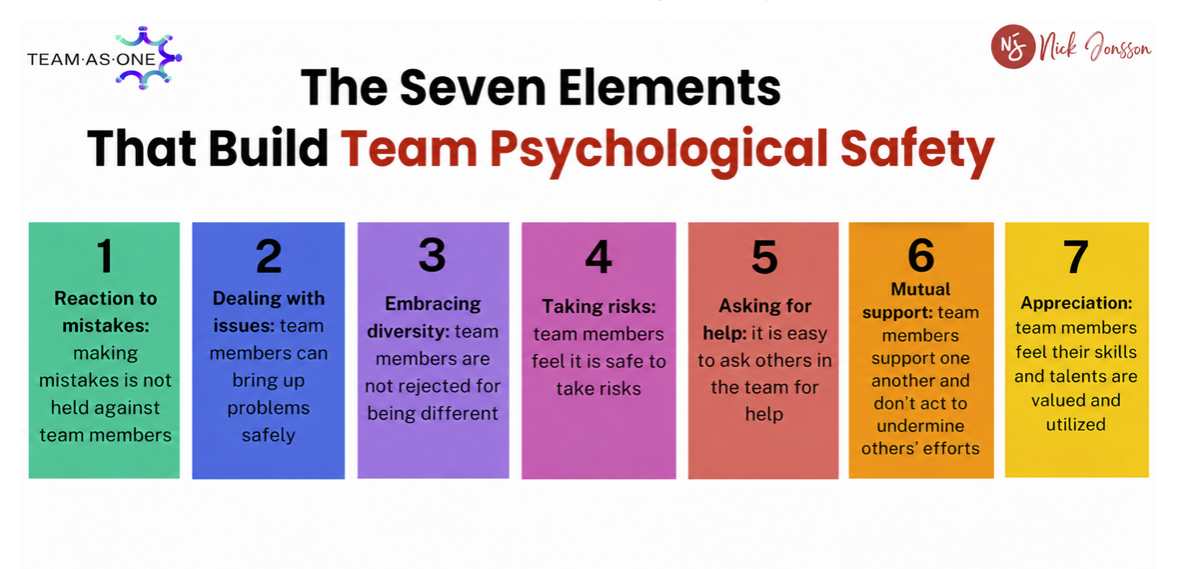
The TEAM.AS.ONE framework makes psychological safety more practical by breaking it down into seven observable elements. Together, these elements help leaders understand how safe it feels to learn, contribute, take interpersonal risks, and collaborate inside a specific team.
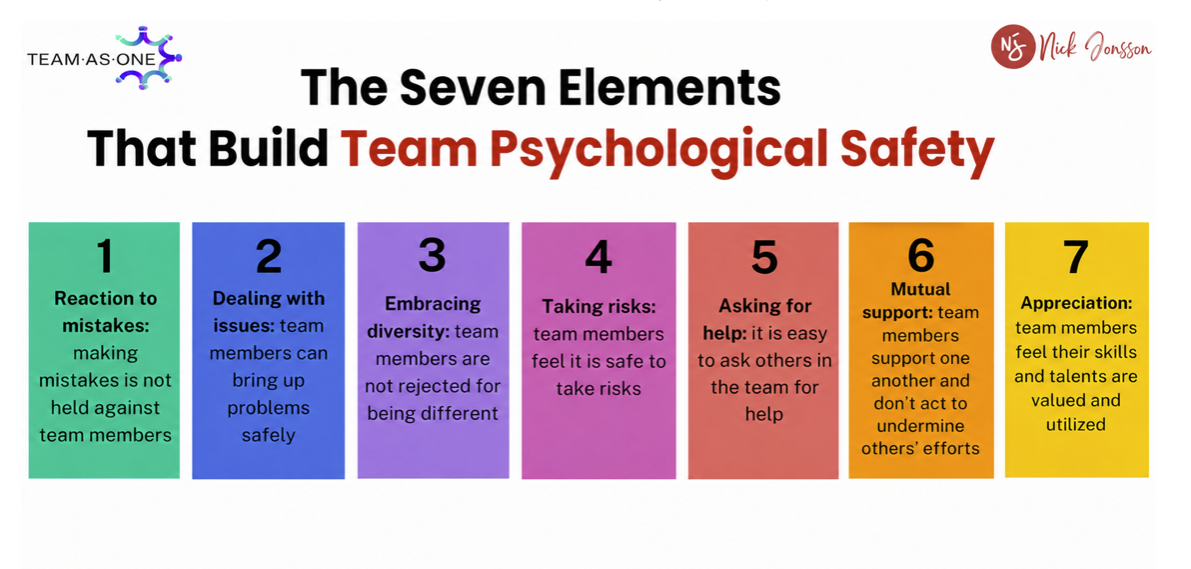
Framework used with permission from supplied TEAM.AS.ONE training material.
1. Reaction to mistakes
This element looks at whether mistakes are held against people or treated as opportunities for learning. In a psychologically safe team, mistakes are not ignored, excused, or hidden. They are examined with curiosity, accountability, and a focus on improvement.
A useful leadership question is: When something goes wrong here, what does our first reaction teach people to do next time?
If the first reaction is blame, people learn to hide. If the first reaction is curiosity and accountability, people learn to speak earlier and improve faster.
2. Dealing with issues
This element measures whether team members can raise problems, risks, and difficult topics safely. Many leadership teams do not suffer because no one sees the issue. They suffer because people discuss the issue privately but avoid raising it in the meeting where it can actually be addressed.
A useful leadership question is: Which issues are repeatedly discussed outside the meeting but rarely raised inside it?
That gap is often where psychological safety needs attention.
3. Embracing diversity
This element examines whether different experiences, backgrounds, thinking styles, and perspectives are genuinely welcomed. Diversity does not create value simply by existing in the room. It creates value when contrasting viewpoints are invited, heard, and allowed to influence decisions.
A useful leadership question is: Whose perspective is routinely heard, and whose perspective is easy to overlook?
If the same voices always dominate, the team may be missing valuable insight.
4. Taking risks
This element looks at whether people feel able to propose unfinished, unconventional, or unproven ideas. Innovation requires a degree of uncertainty. If people are only rewarded for safe, polished, and guaranteed ideas, the team will slowly become less creative.
A useful leadership question is: Do we reward only successful ideas, or do we also value disciplined learning from intelligent experiments?
Psychological safety does not mean reckless risk-taking. It means creating space for sensible experimentation.
5. Asking for help
This element measures whether asking for support is treated as responsible or weak. In many high-performing environments, capable people hide struggle because they fear losing credibility. Over time, this increases stress, reduces learning, and can contribute to burnout.
A useful leadership question is: How does the team respond when a capable person says, “I need support”?
The answer reveals a lot about the culture.
6. Mutual support
This element examines whether team members actively support one another or quietly undermine each other’s efforts. A leadership team may talk about collaboration, but incentives, status, competition, or unclear ownership can still encourage people to protect their own area rather than support the whole.
A useful leadership question is: Do our systems encourage support, or do they quietly reward internal competition?
High-performing teams understand that mutual support is not optional. It is part of execution.
7. Appreciation
This element looks at whether people feel their skills, talents, and contributions are recognised and used well. Appreciation is not only about saying thank you. It is about noticing specific contributions, valuing quieter work, and ensuring people’s strengths are not wasted.
A useful leadership question is: Who has contributed meaningfully without receiving specific recognition?
When appreciation is specific and fair, people are more likely to stay engaged and contribute fully.
How a Team Psychological Safety Assessment works
A robust Team Psychological Safety Assessment gathers anonymous responses from the people who share the team environment. It measures each of the seven elements and shows both the average experience and the consistency of that experience across respondents.
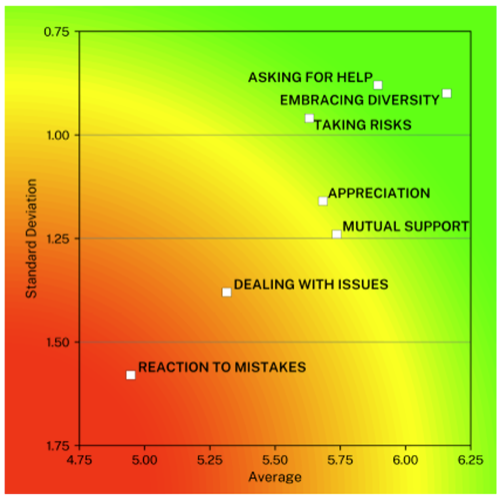
Illustrative Team Psychological Safety Assessment output
Both are important.
The average result shows the overall strength of an element. The consistency, often reflected through spread or standard deviation, shows whether people experience that element in a similar way.
This is where many leaders need to look carefully.
A relatively strong average with wide variation can be just as important as a low average. It may mean that psychological safety depends on role, status, tenure, location, identity, personality, or closeness to the leader. Some people may feel very safe, while others are holding back.
That is why leaders should read both position and consistency.
A report should not be treated as a verdict. It should be treated as a hypothesis to explore with the team. Green areas may highlight strengths to protect and use. Red areas may highlight priorities for discussion and improvement. Gaps between elements help leaders see where broad ideas like trust become specific team behaviors.
The purpose is not to expose individuals. The purpose is to understand the system.
A five-step measurement cycle for leaders
Measuring psychological safety is only useful if leaders are prepared to act on what they learn. A survey without discussion can make trust worse, not better. People may feel they were asked for honesty, but nothing changed.
A stronger approach follows a five-step cycle.
1. Prepare
Before running an assessment, explain why it is being done, how anonymity will be protected, how results will be used, and what will happen next. Leaders should not collect data unless they are prepared to respond.
Preparation matters because the process itself sends a message. If people suspect the assessment is performative, unsafe, or designed to identify individuals, they will not answer honestly.
2. Measure
Use a credible, anonymous team-level instrument. Include the regular members of the team who share work, goals, interactions, and leadership context. Choose a period that reflects normal work rather than a single unusual event.
Psychological safety is most meaningful at the local team level. It is not just an organization-wide concept. People experience safety in the teams where they work every day.
3. Discuss
Share the results transparently. Begin with strengths before exploring one or two priority areas. Ask what behaviors, situations, routines, or leadership responses may sit behind the pattern.
This discussion must be handled carefully. Leaders should thank the team for candor, listen without defensiveness, and avoid turning the conversation into a debate about whether the data is “right.” The better question is: What can we learn from this?
4. Act
Translate insight into a few observable commitments. Do not try to fix all seven elements at once. Choose one or two areas where improvement would meaningfully affect team goals, then define what will change in meetings, communication, decision-making, and daily behavior.
Action must be specific.
Not: “We will communicate better.”
Better: “We will add a standing risks and tensions item to every leadership meeting, and we will invite the voices closest to the work first.”
5. Re-measure
After enough time has passed for behavior to change, repeat the assessment. Compare patterns, discuss what improved, and refine the next cycle.
Re-measurement shows whether the team culture is genuinely changing or whether the discussion created short-term awareness without lasting behavior change.
Leadership behavior is the biggest lever
Psychological safety is created in small moments. A leader’s reaction to bad news, disagreement, uncertainty, or a mistake sends a stronger signal than any statement of values. People watch what leaders do when honesty becomes inconvenient. The TEAM.AS.ONE approach describes three useful dimensions of leadership behavior: role-modelling, supportive responding, and team enabling.
Role-modelling
Leaders build psychological safety when they admit what they do not know, name their own mistakes, ask for feedback, and show that learning is compatible with authority.
This is especially important in senior teams. If leaders pretend to have all the answers, people below them often learn to do the same.
Supportive responding
When someone speaks up, the leader’s first response matters. A defensive reaction can silence future honesty. A calm and curious response can create more openness.
Supportive responding means thanking the person, asking questions, separating the messenger from the message, and explaining what will happen next.
Team enabling
Leaders also create psychological safety through the way they design the team environment. This includes inclusive meetings, clear decision processes, constructive dissent, balanced airtime, learning reviews, and simple routines that make it easier for concerns to travel upward.
In other words, psychological safety is not only a mindset. It is designed into how the team works.
From scores to meaningful action
The value of measurement lies in the response. A leadership team should resist the temptation to fix everything at once. Trying to address all seven elements immediately often leads to vague commitments and little progress. It is usually more effective to choose one or two priority areas and agree on behaviors that can be observed.
Here are practical examples of how leaders can respond to different result patterns:
| Result Pattern | Practical Leadership Response |
|---|---|
| If reaction to mistakes is weak | Use blameless learning reviews: What happened? What conditions contributed? What will we change? |
| If dealing with issues is weak | Add a standing “risks and tensions” agenda item and invite the most junior or closest-to-the-work voices first. |
| If embracing diversity is weak | Use structured rounds and explicitly ask which perspectives or stakeholders are missing. |
| If taking risks is weak | Define safe-to-try experiments, boundaries and learning criteria before judging results. |
| If asking for help is weak | Leaders model requests for help and teams use brief workload and support check-ins. |
| If mutual support is weak | Clarify shared outcomes, dependencies and how team members will respond when a colleague is under pressure. |
| If appreciation is weak | Recognise specific contributions and connect people’s talents to meaningful responsibilities. |
These actions are simple, but they are not always easy. They require leaders to stay consistent, especially when pressure increases.
That is where facilitated debriefs, leadership coaching, and team workshops can help turn insight into sustained behavior change.
Download the Team Psychological Safety Leadership Checklist
To help leaders begin this work, I have created a practical Team Psychological Safety Leadership Checklist that can be used as a reflection and conversation tool. Use it to notice patterns, prepare a team discussion, and identify one or two leadership priorities across the seven elements of psychological safety.
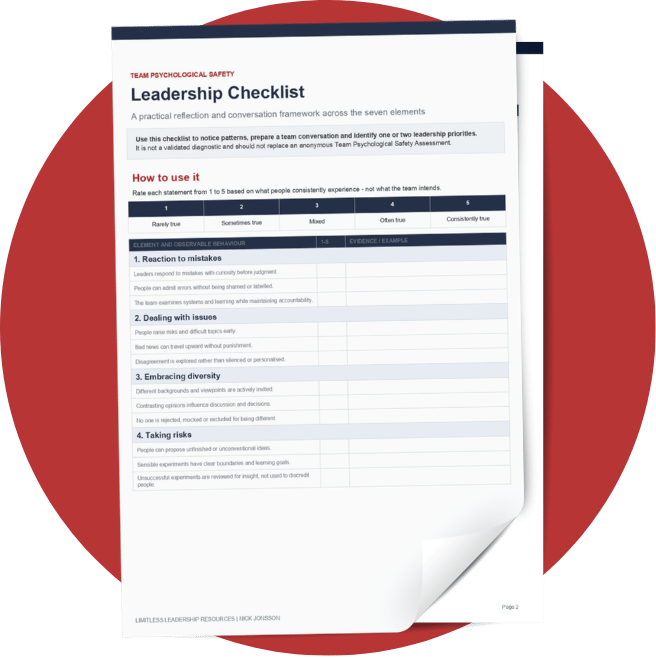
This checklist is not a replacement for a validated, anonymous Team Psychological Safety Assessment. It is a starting point. It helps leaders reflect on visible behaviors and ask better questions before beginning a deeper measurement and development process.
The checklist invites leaders to rate what people consistently experience across areas such as reaction to mistakes, dealing with issues, embracing diversity, taking risks, asking for help, mutual support, and appreciation. It also includes reflection questions to turn insight into action, including:
What strengths should we protect?
Where is the experience inconsistent?
What are people not saying?
What will leaders do differently?
How will we know it is improving?
The final section helps leaders create a 30-day commitment by choosing a priority element, defining one leadership behavior to practice, assigning ownership, and setting a first review date.
The aim is not a perfect score. The aim is a focused learning cycle.
Common measurement mistakes to avoid
Measuring psychological safety can be powerful, but only if it is done with care. Poor measurement can create cynicism, fear, or survey fatigue.
Here are common mistakes leadership teams should avoid:
Running a survey and never discussing the results.
Using the data to identify, expose, or blame individuals.
Treating psychological safety as an HR score rather than a team learning process.
Assuming a high average means every person has the same experience.
Confusing psychological safety with universal agreement or reduced performance standards.
Changing the questions or method every cycle, making comparison unreliable.
Expecting the team to speak more openly while leaders remain defensive when they do.
The most damaging mistake is asking for honesty and then punishing, ignoring, or over-explaining what people share. Measurement creates expectation. Leadership response determines whether trust grows or declines.
When should a leadership team measure psychological safety?
Leadership teams should measure psychological safety when they want a clearer view of how people communicate, collaborate, raise concerns, learn from mistakes, and handle difficult conversations.
This is especially useful during moments such as:
Leadership team development
Organizational change
Culture transformation
Post-merger integration
Rapid growth
Conflict or communication breakdown
Low engagement or high turnover
Executive retreats
Team off-sites
Leadership workshops
Preparing for major strategic change
It can also be valuable when the team appears successful on paper but something feels “off” underneath: filtered feedback, passive agreement, unresolved tension, or a lack of honest challenge.
You do not need to wait for a crisis. In fact, the best time to measure psychological safety is often before silence becomes expensive.
How psychological safety supports performance
Psychological safety is not separate from performance. It directly supports it.
When people feel safe to speak up, leaders receive better information. Risks surface earlier. Mistakes become learning opportunities. People ask for help before problems escalate. Teams challenge weak assumptions before decisions become costly. Innovation improves because people are more willing to share ideas before they are fully polished.
This is why psychological safety matters so much inside leadership teams. The behavior of the leadership team sets the tone for the rest of the organization. If senior leaders avoid difficult conversations, the culture below them learns to do the same. If senior leaders respond to honesty with curiosity, accountability, and respect, the organization receives a different message.
High standards and psychological safety belong together. Without psychological safety, high standards can become fear. Without high standards, psychological safety can become comfort. Together, they create the conditions for sustainable performance.
How Nick Jonsson supports leadership teams
Through Team Psychological Safety workshops, leadership workshops and training, facilitated debriefs, keynote speaking, Belbin Team Coaching, and private executive coaching, I help leadership teams move from awareness to action.
This work is designed for organizations that want to understand where trust is strong, where people may be holding back, and which leadership behaviors will create the greatest improvement.
A Team Psychological Safety Assessment can help your leadership team measure the current experience. A facilitated debrief can help the team interpret the patterns without defensiveness. A tailored workshop can help leaders practice the behaviors required to improve communication, accountability, collaboration, and performance.
For leaders who are navigating personal pressure, burnout, isolation, or emotional strain, my work in private coaching and counselling and therapy can also provide a confidential space for deeper reflection and support.
Psychological safety starts with leadership. And leadership starts with the courage to look honestly at what is really happening.
Common Questions About Measuring Psychological Safety
How do you measure team psychological safety?
Team psychological safety is measured through an anonymous team-level assessment that examines specific interpersonal behaviors, not only a generic engagement score. A strong process reviews both average results and consistency across respondents, discusses the patterns with the team, agrees on observable actions, and re-measures after behavior has had time to change.
Is psychological safety the same as trust?
No. Trust and psychological safety are related, but they are not identical. Trust often focuses on whether another person will act favorably over time. Psychological safety focuses on whether I expect negative interpersonal consequences if I speak up, admit a mistake, ask for help, or challenge an idea now.
What are the seven elements of Team Psychological Safety?
The seven elements are reaction to mistakes, dealing with issues, embracing diversity, taking risks, asking for help, mutual support, and appreciation. Together, they help leaders understand how safe it feels for people to learn, contribute, raise concerns, and collaborate within a specific team.
Who should complete a Team Psychological Safety Assessment?
The regular members of a clearly defined team should complete the assessment. This usually includes people who share work, goals, interactions, and a team leader. Psychological safety is most meaningful at the local team level because that is where people experience day-to-day communication and leadership behavior.
How often should a team measure psychological safety?
A team should establish a baseline, act on one or two priorities, allow enough time for behavior to change, and then re-measure. The timing should match the intervention and team context rather than becoming a survey ritual.
Can a team have high standards and high psychological safety?
Yes. Psychological safety is not about lowering accountability. It allows teams to surface problems earlier, challenge weak thinking, learn faster, and pursue high standards without relying on fear.
What should a leader do after receiving the results?
A leader should share the findings, thank the team for candor, explore patterns without defensiveness, choose a small number of priorities, agree on specific behaviors, and report back on progress. The response matters more than the score itself.
Final Thought: measure to learn, not to judge
Team psychological safety is not built through a one-off workshop, a slogan, or a perfect score. It grows when leaders consistently make it safer to tell the truth, ask for support, challenge assumptions, learn from mistakes, and contribute different perspectives.
Measurement makes those experiences visible. Discussion turns the data into understanding. Leadership action turns understanding into new habits. Re-measurement shows whether the team culture is genuinely changing.
What gets measured gets discussed. What gets discussed gets improved. And when leaders respond constructively to what they learn, people become more willing to speak up.
Would you like to understand where your leadership team is strong, where people may be holding back, and which leadership behaviors will create the greatest improvement?
Contact Nick Jonsson to discuss a Team Psychological Safety Assessment, facilitated leadership debrief, keynote session, or tailored team workshop.
About Nick Jonsson
Nick Jonsson is a professional speaker, Certified Master Coach (CMC), ICF-certified Executive and Life Coach (PCC), Counsellor and Psychotherapist, and a certified Team Psychological Safety practitioner. Ranked #28 in the World among the Global Gurus Top 30 Coaching Professionals for 2026, he helps leaders and teams strengthen vulnerability, holistic wellbeing, psychological safety and sustainable high performance. He is the bestselling author of Executive Loneliness and the founder of Limitless Executive Solutions.
His mission is: Empowering people to build a Limitless Life through Vulnerability & Holistic Wellbeing.
Sources and further reading
Or follow Nick on LinkedIn for weekly insights on coaching, leadership, wellbeing, and performance.