Building High-Performing Hospitality Teams at Holiday Inn Resort Kandooma Maldives with Nick Jonsson and Dona Amelia
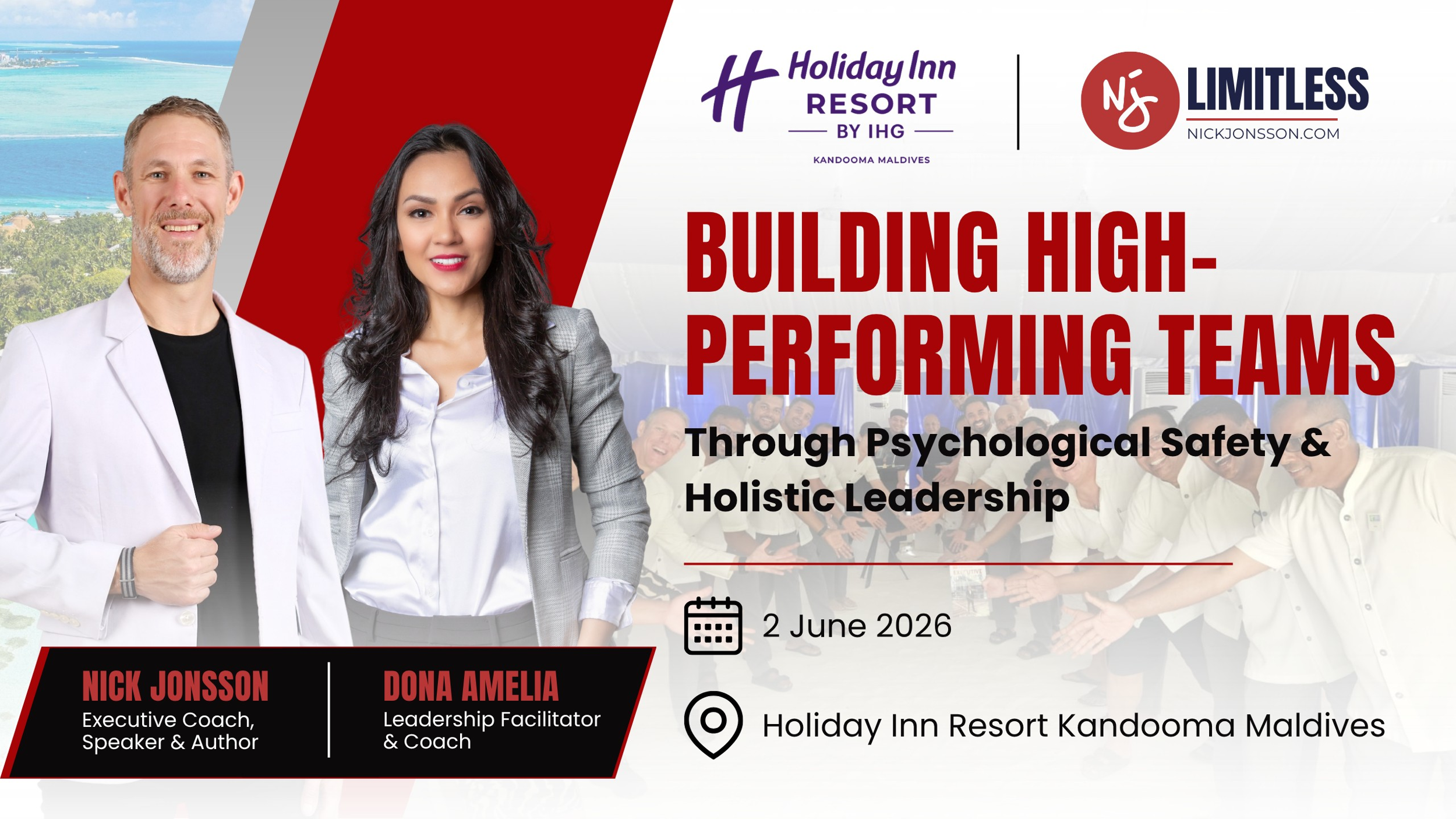
Building High-Performing Hospitality Teams at Holiday Inn Resort Kandooma Maldives
Strengthening Trust, Communication, Collaboration, and Psychological Safety Through Holistic Leadership
Client
Holiday Inn Resort Kandooma Maldives
Facilitators
Nick Jonsson & Dona Amelia
Program
Building High-Performing Teams Through Psychological Safety & Holistic Leadership
Date
2 June 2026
Audience
Department Heads, Managers, Supervisors, and Emerging Leaders from across Holiday Inn Resort Kandooma Maldives
Building Stronger Leaders and Stronger Teams in Hospitality
Delivering exceptional guest experiences requires far more than operational excellence.
It requires leaders who communicate effectively.
It requires teams that trust one another.
It requires departments that collaborate under pressure.
Most importantly, it requires a culture where people feel safe to speak up, share concerns, ask for help, admit mistakes, and contribute ideas.
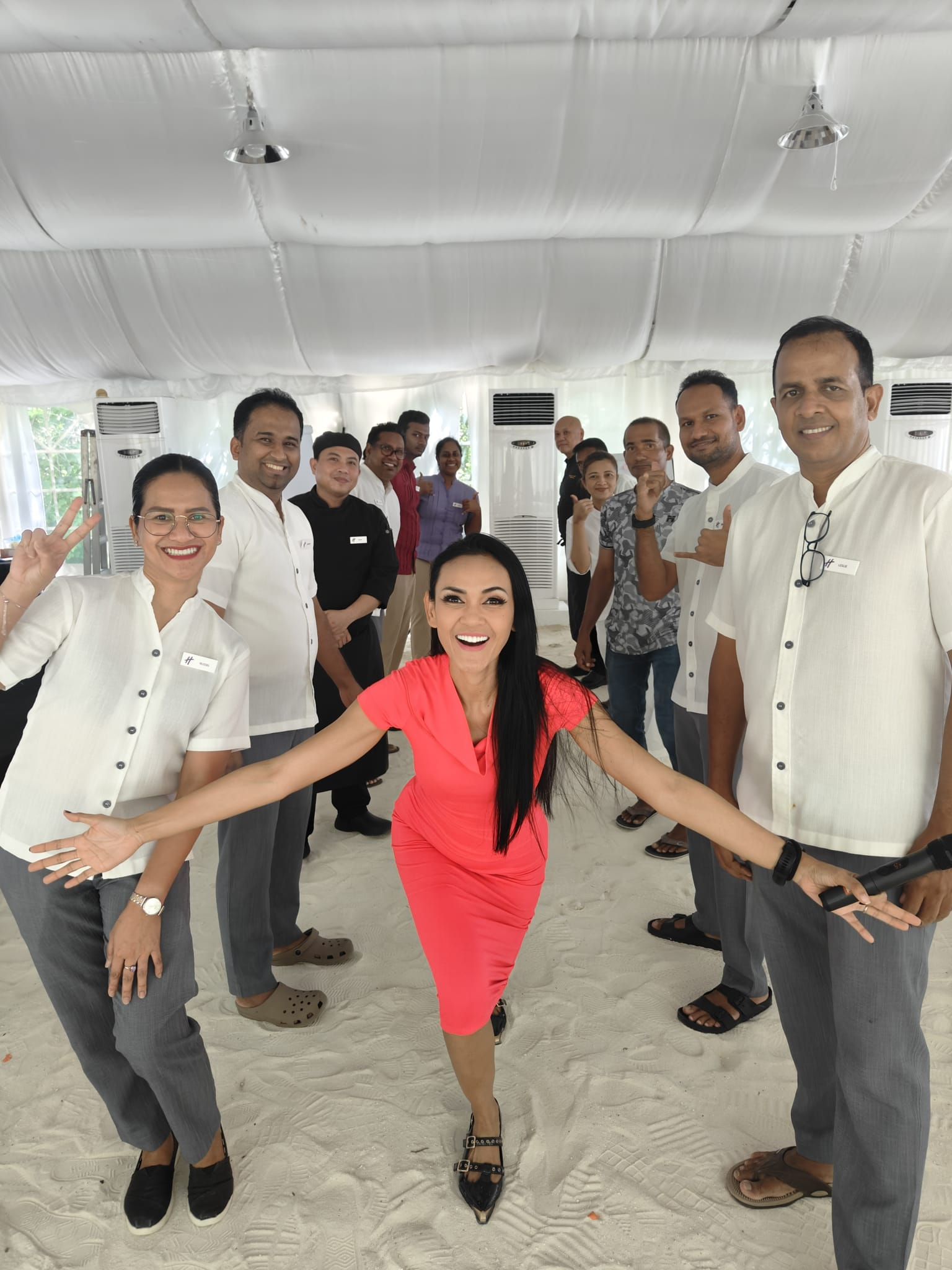
To support this vision, Holiday Inn Resort Kandooma Maldives partnered with leadership facilitators Nick Jonsson and Dona Amelia to deliver an immersive leadership development workshop focused on building high-performing teams through Psychological Safety and Holistic Leadership.
The full-day workshop brought together leaders from across the resort to explore practical leadership behaviours that strengthen communication, improve collaboration, and create stronger team cultures.
About Holiday Inn Resort Kandooma Maldives
Located in the South Malé Atoll, Holiday Inn Resort Kandooma Maldives is one of the Maldives’ most recognised hospitality brands.
With guests arriving from around the world expecting exceptional service, memorable experiences, and seamless operations, leadership effectiveness plays a critical role in maintaining the resort’s high standards.
Every guest interaction depends on effective collaboration between departments including Front Office, Housekeeping, Engineering, Food & Beverage, Recreation, Finance, Human Resources, Sales & Marketing, Purchasing, and Operations.
Guests do not experience departments.
They experience one resort.
They experience one team.
For this reason, building trust, communication, teamwork, and leadership capability remains a strategic priority.
The Leadership Challenge
Like many hospitality organisations, Holiday Inn Resort Kandooma Maldives operates in a fast-moving environment where leaders must balance:
· Guest expectations
· Operational demands
· Team engagement
· Service recovery situations
· Cross-department communication
· Employee wellbeing
· Accountability
· Performance management
In these environments, technical expertise alone is not enough.
Leaders must also create trust.
They must facilitate communication.
They must navigate difficult conversations.
They must support people under pressure.
And they must create an environment where team members feel safe enough to speak openly and contribute fully.
This workshop was designed to strengthen exactly those capabilities.

Leadership Endorsement
Following the workshop, Holiday Inn Resort Kandooma Maldives shared overwhelmingly positive feedback regarding both the content and facilitation of the session.
According to the resort’s leadership team:
“The workshop was highly valuable and impactful. Leaders found the content both inspiring and highly relevant to their daily leadership responsibilities.”
“The engaging facilitation style, practical insights, and ability to connect leadership concepts with real-world applications were particularly appreciated.”
“We truly appreciate the contribution made to the development of our leaders and look forward to future opportunities to continue learning and growing together.”
This endorsement reflects the practical impact of the workshop and its direct relevance to hospitality leadership.
Workshop Objectives
The workshop was designed around six key objectives:
1. Strengthen Team Psychological Safety
Help leaders create environments where employees feel safe to speak up, ask questions, raise concerns, share ideas, and learn from mistakes.
2. Improve Cross-Department Collaboration
Strengthen communication and teamwork across departments to improve operational effectiveness and guest satisfaction.
3. Develop Coaching Leadership Skills
Equip leaders with practical tools for active listening, coaching conversations, feedback, feedforward, and difficult conversations.
4. Increase Leadership Self-Awareness
Encourage reflection through the Holistic Leadership framework.
5. Improve Team Communication
Develop stronger communication habits that support trust, clarity, and accountability.
6. Build High-Performing Teams
Help leaders understand how trust, culture, communication, and leadership behaviours influence team performance.
The Holistic Leadership Framework
The workshop began with an exploration of Holistic Leadership.
Developed by Nick Jonsson, Holistic Leadership integrates:
· Physical Health
· Mental Health
· Emotional Health
· Psychological Health
· Social Wellbeing
· Resilience
· Professional Responsibilities
Participants reflected on Nick’s Five Steps to Holistic Leadership:
1. Surrender
2. Purpose
3. Connection
4. Goals
5. Discipline
Leaders discussed personal growth, leadership challenges, healthy habits, purpose, accountability, and the connection between personal wellbeing and professional performance.
The message was clear:
Strong teams begin with strong leaders.
Team Psychological Safety
The central focus of the workshop was Team Psychological Safety.
Psychological Safety is defined as a shared belief that a team is safe for interpersonal risk-taking.
In practical terms, this means employees feel safe to:
· Speak up
· Admit mistakes
· Ask for help
· Share ideas
· Challenge assumptions respectfully
· Raise concerns early
· Give feedback
· Learn openly
Participants explored the research of Amy Edmondson and Google’s Project Aristotle, which identified Psychological Safety as one of the most important factors in high-performing teams.
The discussion focused on how Psychological Safety improves:
· Communication
· Trust
· Collaboration
· Innovation
· Employee engagement
· Team performance
· Guest experience
The Cost of Silence
One of the most impactful conversations of the day centred on the cost of silence.
Participants explored how organisational problems often occur when employees feel unable to raise concerns, challenge decisions, or ask for support.
Examples included:
· Communication breakdowns
· Missed operational issues
· Service recovery failures
· Unresolved team tensions
· Poor cross-department collaboration
The discussion reinforced that high-performing teams are not teams without mistakes.
They are teams that identify issues early and address them openly.
The Seven Elements of Team Psychological Safety
Participants explored seven practical behaviours that help create psychologically safe teams:
Reaction to Mistakes
Learning rather than blaming.
Dealing with Issues
Addressing concerns early and constructively.
Embracing Diversity
Valuing different perspectives and viewpoints.
Taking Risks
Encouraging ideas, experimentation, and innovation.
Asking for Help
Normalising support-seeking behaviour.
Mutual Support
Helping colleagues succeed.
Appreciation
Recognising effort and contribution.
Participants worked in groups to identify positive and negative behaviours associated with each element and discussed how these behaviours show up within hospitality environments.

Coaching Skills for Hospitality Leaders
The second half of the workshop focused on coaching and communication skills.
Leaders explored the difference between directing, mentoring, and coaching and learned practical tools to support stronger conversations with employees.
Key skills included:
Active Listening
Listening to understand rather than listening to respond.
Powerful Questions
Using open-ended questions that encourage ownership and problem-solving.
Feedback
Creating a culture where feedback is welcomed, appreciated, and used for growth.
Feedforward
Focusing on future improvement rather than past mistakes.
Difficult Conversations
Approaching challenging situations with courage, empathy, clarity, and professionalism.
These tools help leaders build stronger relationships, improve communication, and increase accountability.
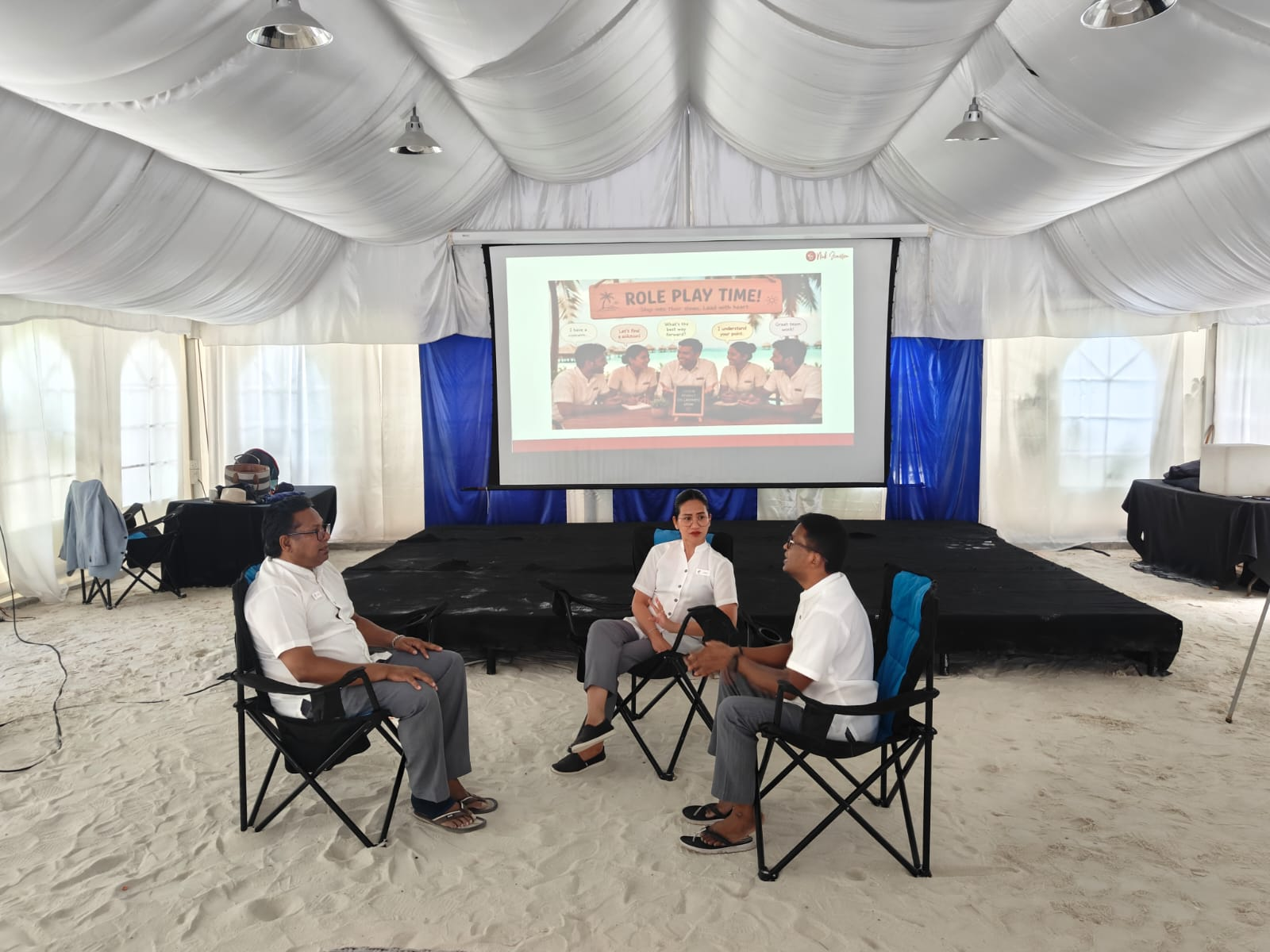
Hospitality Role Plays and Real-World Application
A major strength of the workshop was the use of hospitality-specific role plays.
Participants applied the concepts through realistic scenarios including:
The Overwater Villa Emergency
Managing guest expectations during a villa maintenance issue while coordinating across departments.
Handling Stress Under Pressure
Supporting employees during peak operational periods while maintaining professionalism and composure.
Misaligned Priorities Across Departments
Helping departments find alignment when priorities and pressures differ.
The role plays created opportunities for leaders to practise communication, coaching, Psychological Safety, and collaboration in realistic hospitality situations.
Participant Feedback
The workshop received overwhelmingly positive feedback across all participating departments.
Participants consistently rated the workshop as highly relevant, practical, engaging, and immediately applicable.
What Participants Found Most Valuable
Several themes emerged repeatedly throughout the feedback forms.
Participants most frequently highlighted:
· Psychological Safety
· Active Listening
· Difficult Conversations
· Leadership Communication
· Coaching Skills
· Real-Life Hospitality Scenarios
· Role Plays
· Holistic Leadership
· Building High-Performing Teams
Anonymous Participant Comments
“An extremely useful and active session. Looking forward to the next one.”
“The workshop was engaging and impactful, with varied delivery styles that made the message clear, relatable, and practical for real-world leadership.”
“A highly informative and enjoyable session on leadership and culture.”
“I gained clear, practical strategies that I can apply immediately to my goals.”
“The role plays brought the learning to life and helped us practise difficult conversations in a safe environment.”
“Active Listening was one of the most valuable takeaways and something I will apply immediately.”
“The workshop provided a strong foundation for building high-performing teams.”
“Amazing session. I learned a lot and look forward to future workshops.”
Key Outcomes
Participants reported plans to immediately apply:
· Active Listening
· Better coaching conversations
· Stronger communication
· Psychological Safety practices
· Improved difficult conversations
· Better collaboration across departments
· More supportive leadership behaviours
· Greater trust-building practices
One of the strongest findings from the feedback was the emphasis on Active Listening as a leadership capability.
Participants repeatedly identified listening, communication, and Psychological Safety as critical tools they intended to implement within their teams.
Future Development Opportunities
Feedback also demonstrated strong interest in continued leadership development.
Participants requested:
· Additional leadership workshops
· Coaching and mentoring programs
· More communication skills training
· Additional difficult conversation practice
· Ongoing Psychological Safety development
· Future leadership learning opportunities
This reflects a strong commitment to continuous growth and leadership excellence across Holiday Inn Resort Kandooma Maldives.
Why This Workshop Was Successful
Several factors contributed to the success of the program:
· Practical and immediately applicable tools
· Hospitality-specific examples
· Interactive facilitation
· Real-world role plays
· Leadership self-reflection
· Open discussion and participation
· Psychological Safety concepts grounded in daily work realities
· Strong balance between theory and practice
Participants left with practical actions they could immediately implement with their teams.
About Nick Jonsson
Nick Jonsson is a Professional Speaker, Certified Master Coach (CMC), ICF Professional Certified Coach (PCC), Counsellor, Psychotherapist, bestselling author of Executive Loneliness, and founder of Limitless Executive Solutions.
Ranked #28 in the World among the Global Gurus Top 30 Coaching Professionals for 2026, Nick specialises in Holistic Leadership, Psychological Safety, Mental Wellbeing, Leadership Development, Resilience, Executive Coaching, and Culture Transformation.
His mission is:
Empowering people to build a Limitless Life through Vulnerability & Holistic Wellbeing.
About Dona Amelia
Dona Amelia is a Leadership Facilitator, Executive Coach, Keynote Speaker, and leadership development professional known for her engaging facilitation style and ability to connect leadership concepts with practical workplace application.
Together, Nick Jonsson and Dona Amelia create highly interactive leadership development experiences that help leaders strengthen communication, trust, collaboration, and team performance.
Conclusion
Building high-performing hospitality teams requires more than technical expertise.
It requires trust.
It requires communication.
It requires leaders who listen.
It requires teams that support one another.
And it requires an environment where people feel safe to speak up, contribute ideas, ask for help, and learn from mistakes.
The leadership development workshop at Holiday Inn Resort Kandooma Maldives helped strengthen these foundations through Psychological Safety, Holistic Leadership, coaching skills, communication, and practical hospitality application.
The overwhelmingly positive participant feedback, leadership endorsement, and strong demand for future development programs demonstrate the value of investing in leadership capability, team culture, and Psychological Safety.
Because exceptional guest experiences begin with exceptional team experiences.
Or follow Nick on LinkedIn for weekly insights on coaching, leadership, wellbeing, and performance.