

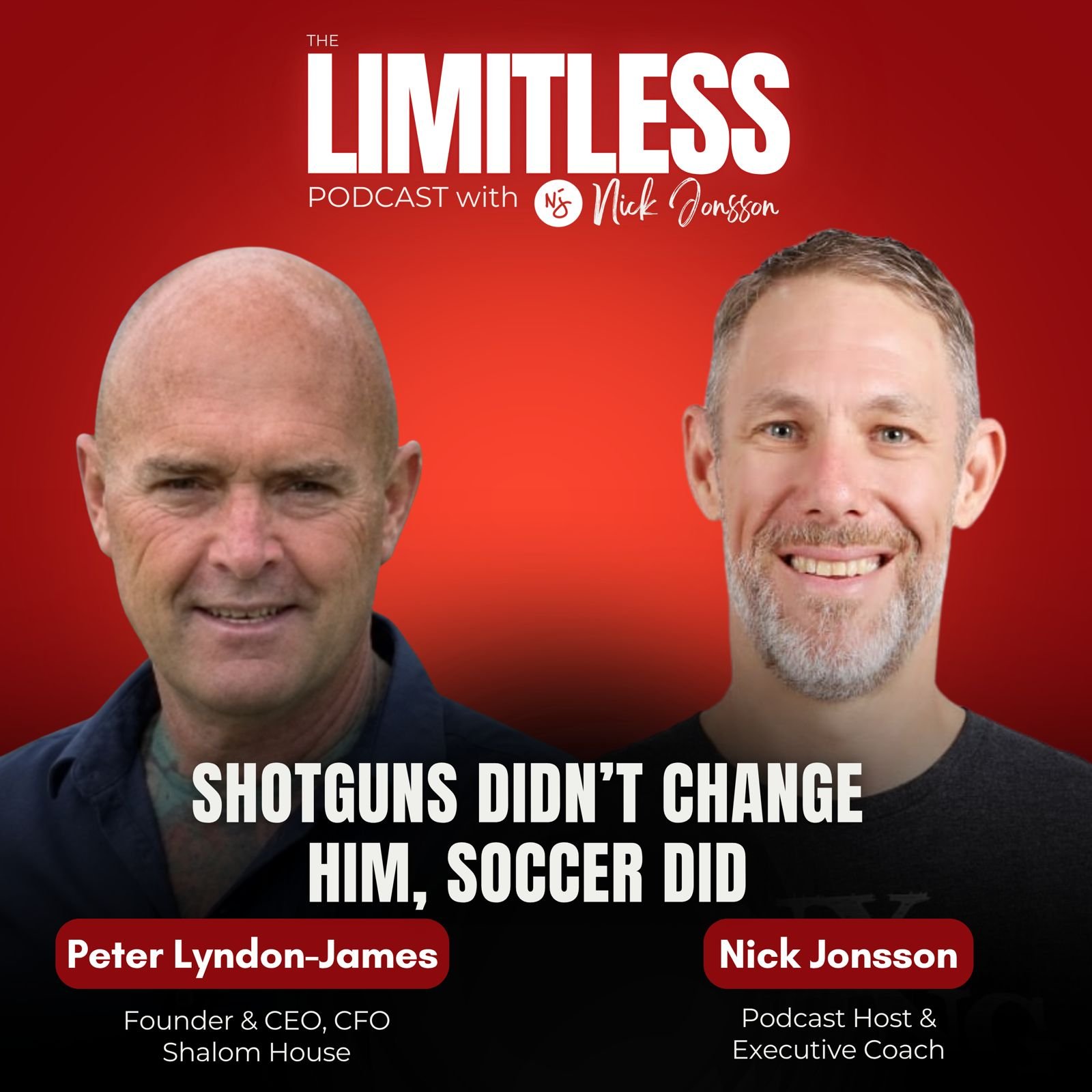
A helicopter over the roof. Tactical response police through the front and back doors. Shotguns in the corridor. None of that changed him. What changed him happened the next day, at a children’s soccer match across the road from his house.
Peter Lyndon-James, founder of Shalom House in Western Australia, had got out of lockup that morning. The dads stood in a circle with their legs apart, and when a kid put the ball through, the father would roll around on the ground making his boy feel like something. Watching them, he thought that if it happened to him he was leaving. His son kicked the ball through his legs. He turned around, walked off and started crying.
He says he spent 26 years in prisons and institutions, starting at nine, and that he had committed no crime when it began. He kept running away from foster placements, so they put him in a boys’ prison alongside a hundred other children whose stories matched his. Sixteen primary schools. Bread with the mould picked off for breakfast. Sexually abused at eight by a relative of a boy he had befriended that day.
“Even when I wasn’t in prison, I was still in prison.”
What followed the soccer match was a prayer, cutting off everyone he knew, six weeks detoxing in a caravan park, and changing his plea from not guilty to guilty so he could go back to jail. Then theology, five years as a volunteer prison chaplain, ten unpaid years living on his wife’s income, and Shalom House in 2012.
The people who come to him now, he says, include pilots on 600 thousand a year, CEOs and lawyers charging 900 dollars an hour. The root cause, in his view, is almost always the same. The drug is only a blanket over it.
For anyone who got out years ago and is still living inside it.
If this raises anything for you, please talk to someone. In Australia, Lifeline is available on 13 11 14.
👇 Connect with Peter Lyndon-James
Website https://peterlyndonjames.com.au/
Explore more: https://www.nickjonsson.com
Episode Transcript
Nick Jonsson: Welcome back to another episode of the Limitless Podcast. Today we have with us Peter Lyndon-James. He's the founder and CEO of the Western Australia Shalom Group, or Shalom House. I met Peter at one of the conferences on addiction, and I listened to his talk and thought immediately, this is an absolutely wonderful guest for our show. Peter, a warm welcome to you. How are you today?
Peter Lyndon-James: Yeah, very good, thanks, Nick.
Nick Jonsson: It's fantastic to have you with us today, and good to get an insight into your office and to say a brief hello to your team before we started. But if we go back a bit in time, your life was very different. Maybe you can take us back to where it all started. As I read your story, the TRG had just kicked in the door of your house. Maybe we can start there today, if it's not too painful to go back.
Peter Lyndon-James: Yeah. That was around 2001. I was selling two and a half kilos of methamphetamine a day. Lots of guns and drugs. I'd been doing that for 26-odd years, since the age of nine.
I woke up one morning and there was a helicopter over the roof, and the tactical response group came through the front and the back. Shotguns pointed at me the first time I walked into the corridor, telling me to get down.
Nick Jonsson: And what unfolded after that? What happened? You were married at the time, and you had a son as well, if I understand correctly?
Peter Lyndon-James: Yeah. I spent 26 years in prisons and institutions, from basically the age of seven. A lot of foster families, children's homes. I was the product of dysfunctional parents, I'd say. Mum chose alcohol over me. Dad went off with a 15-year-old. As a young kid, I couldn't understand why my life was falling apart through my parents' choices. All I really ever wanted was my mum and my dad.
Through their choices, Mum got put into rehab, and that disappeared. I kept getting put with other foster families and in other children's homes. One of the children's homes I was in, they had their own kid, and I knew that those were their parents and not mine. I didn't fit, and so I just kept running away. And I got sexually abused when I was eight.
They got sick of me running away, so they put me in a boys' prison, which wasn't like the children's homes. That became the start of my criminal career. I'd never committed a crime, but I was put in an offenders' institution where there were 100-plus kids who all had stories like mine. They all came from broken families. So I just started doing what I've done. I ended up spending seven years in boys' prisons, and then two years in another prison, for kids aged 16 and over. I've also spent time in all the prisons in Western Australia.
My whole life, all I wanted was to be a geek, a normal person. A geek, for those of you listening, is a productive member of society who's free of drugs and substances, who went to one school, who in the morning jumped into bed with Mum and Dad for a cuddle, who played sports. I never had any of that.
I met my wife when I was 19. She's a country girl. She grew up on a farm, never committed any crimes, never used any drugs, never drank alcohol. And we ended up having a couple of kids. I introduced her to drugs and started ruining her life the way I'd ruined mine. I'd been around Australia seven times, running from myself, but wherever I went, I took myself with me.
It wasn't until 2001, when I had a five-year-old and a three-year-old boy, that things changed. I'd just been raided by the TRG, and I'd got up after 16 days of no sleep.
My wife, being a country girl, was big on the kids playing sports. My son's first ever sports match was soccer, across the road from where we lived. In those days I had a big beard and tattoos and a whole heap of stuff, gold rings and all that. I went over the road with my young son the day after getting out of lock-up, and there were a lot of dads there, and they were all normal dads. Geeks.
The deal was that the dads had to stand there in a big circle with their legs spread, and if the kid kicked the ball through the dad's legs, the dad would roll around on the ground, making the kids all laugh. I never had a dad to do that. My dad never read me any books, and my mum never did any of that stuff.
I remember watching the kids kick the ball through their dads' legs, and the dads rolling around on the ground, and the son feeling special. And I was thinking to myself, if that happens to me, I'm out of here. And then my youngest boy kicked the ball through my legs. When he did, I turned my back, walked off and just started crying. I couldn't do it. I went over to my wife and said, "You'd better go and look after the boy."
That was the day that really broke me. For those who aren't coming from a faith background, I chucked a prayer up and said, "I really need your help. I don't want to do this anymore." My whole life, being trapped in prisons and institutions, stuck on the streets, all I ever wanted was to be normal: to have one school, a family holiday, one group of friends, and to be like other kids.
And I could see what I was doing to my kids. It was the first time I really saw that my kids were going to live the life I was living, unless something changed. And I just didn't know how to change. I'd been a drug addict since I was a kid. I'd been addicted to whatever drugs there were, from methamphetamines to amphetamines to alcohol. I was at the bottom of the bottom.
Nick Jonsson: I could hear a strong desire in what you said, Peter, that you just wanted what other kids had, to be like them. Can you elaborate a little? What was it like to look at other kids and other families, and look at yourself and want that? Can you take us a bit deeper into that?
Peter Lyndon-James: I went to 16 different primary schools, and I didn't get past Grade 6. So I never really had one group of friends. And when I did go to school, I didn't have lunch. Mum had spent all the money on alcohol. We used to get up in the morning and grab bread. I can remember sometimes the bread was mouldy, and we'd pick the mould off the bread, break the bread up, put it in a bowl with milk and sugar, and have that for breakfast. Or I'd go to school and take somebody else's lunch, because I didn't have my own.
Kids used to pick on me because I was a poor kid. Everyone else had a uniform and I didn't. I was in shorts and a t-shirt, or a singlet. I just felt I didn't belong.
I remember once, there were five of us. My brothers and sisters went to stay with my grandma, and I went to stay with a foster family, because there was no room. Once, I stayed at Grandma's for a week or so, and they enrolled me in football. I was probably eight or nine, and I'd never played sports.
I remember grabbing the ball as a kid. It was pouring with rain, and I grabbed the ball, and I got mud all over my hands. So I put the ball down to wipe the mud off, and everyone started laughing. I thought, no, I'm going to prove them wrong. So I did whatever I could to get the ball, and I got it and ran straight towards the goal and kicked the goal. And then they started laughing even more, because it was the opposition's goal, not my own.
It was just about being that normal kid. You know what I mean? I just wanted to be loved. I just wanted to have Mum and Dad read a book, and do normal stuff like normal people. But I never had that.
Nick Jonsson: I hear a lot of loneliness there, and changing 16 schools, if I heard you correctly, must be very tough. A lot of restarting, when you're already feeling like you don't have much, like you're one of the poor kids, with your clothes and uniform not looking like the others, and then changing the whole time. It must have been very tough for you to fit in. Is that something you carried with you later, into your teens as well?
Peter Lyndon-James: Yeah, it's childhood trauma. Being put with all these different foster families and in children's homes, and just wanting your mum, and not understanding as a child why you're being put in all these different places: it does mess with your head.
I got put with a foster family and my mum went into a drug and alcohol rehab. When she got out of rehab, she went back to the same man she'd been drinking with. The same bloke who used to grab my mum by the hair and literally give her black eyes and a broken nose. I'd walk out at three o'clock in the morning, after all the screaming had stopped, and Mum would be sitting on the end of the couch with blood running down her face, and her false teeth snapped in half, sitting there trying to put her teeth back together. And I'd get put in a children's home, and then when we got out of the children's home, we'd get put back with my mum, and she was with the same bloke who had done all that to us.
I started hanging around a park in a suburb of Perth called Gosnells. I met a young kid there at the park and we became mates. He said, "Do you want to stay in my caravan tonight?" So I stayed in his caravan. That night I woke up at three o'clock in the morning, and I had to pretend I was asleep while my mate's uncle was sexually abusing me. I was an eight-year-old kid, and this bloke was doing that to me, and I'd never been so scared in my life.
I remember walking out of the caravan, and I heard this voice saying, "Tell your mum." And I heard this other voice saying, "No, she doesn't love you. She loves men and alcohol more than she loves you." And that's the day I put the walls up in my life. I was just angry. I blamed everybody else for why I was the way I was. How could that happen to me? Why didn't my mum protect me?
So I was just an angry little boy, and I didn't know how to deal with the trauma I had on the inside, in my heart. I believe that out of the heart flow the issues of life. As a man or a woman thinks in their heart, so they are. You are what you think. And I thought I was useless, that I was no good. So I just built the walls up and did whatever I could to protect myself from the pain and the hurt that had happened to me.
Nick Jonsson: Thank you for sharing that, Peter. It sounds very painful. Later on in your life, you came to a turning point. In many people's lives we talk about rock bottom being the turning point. What was yours? What was the incident that put you into recovery and sobriety, and into the life you have today?
Peter Lyndon-James: There were a few times where I tried to change, tried to hang around different people. But I needed some sort of drug to help me cope. Every time I tried, I didn't feel like I was good enough, so I'd go back to where I felt comfortable. But everywhere I felt comfortable, I was doing what I didn't want to do.
Like I said, that time at Grasshopper Soccer, I prayed and said, "God, I really need your help. I want my life to change." For me, that was the turning point. I had a faith encounter with God.
I started doing a whole heap of things after that. I had a big factory full of cars and a lot of illegal stuff, and I gave away all the illegal stuff. I was on bail at the time on firearms charges. I swapped the dodgy life for a legit one. I cut off everybody I knew, went out to a caravan park and basically detoxed myself over the next six weeks, off all drugs.
I changed my plea at court from not guilty to guilty, and I went back to jail. When I got out of jail in 2001, I went and studied theology, from 2002 to 2005. Then I became a volunteer prison chaplain at Casuarina Prison, the largest public prison here in Western Australia.
I did that for five years, watching the same kids I'd grown up with, now adults, going in and out, in and out, in and out. The second they got out of prison, they'd be picking up a pipe, having a smoke, popping a pill, and the cycle just kept continuing. I was trying to work out for myself, having spent 26 years in prisons and institutions and then changed my life, why that keeps happening within the prison system.
I did that for five years and finished in 2010. Then I became a full-time volunteer. For the next 10 years, from 2010 to 2020, I didn't have an income. My wife worked to support me. I volunteered at a lot of homeless shelters and drug rehabilitation centres, studying all the different rehabilitation models within Western Australia. And in 2012 I decided to start my own.
Nick Jonsson: Very inspiring. Thank you for sharing all of that, and the turn. So in 2012 you started Shalom House. What is it like today, who does it support, and what's its main purpose?
Peter Lyndon-James: I originally started Shalom with men. I put four fellows in a house and just started discipling people, mentoring people. Over time it grew. Today we have 160 residents: men, women and children, spread across 13 properties. We're fully accredited in Australia and New Zealand, and we're a registered not-for-profit organisation. We don't apply for grants or funding. We are 100% self-funded.
Shalom is not just focused on rehabilitation, but also on reintegration and re-socialisation. We help people deal with any life-controlling issue, and 90%-plus of the time the root cause is childhood trauma, or some trauma they've gone through that they don't know how to fix.
Here, we get everybody 100% debt-free, working back in the community, and restored: not just themselves, but their whole family structure. A driver's licence, a car. We have a lot of what we call training centres here, where we do carpentry, boilermaking, engineering and manufacturing.
The whole of Shalom is actually run by the residents within the programme. We move the residents around every three months and teach them how to run the various departments, and try to find out what makes them tick and help them work out what direction they want to go in life. There are five stages to the programme, and the average resident is here for one to three years.
Nick Jonsson: What I'm hearing is that you don't only help them get clean and sober, but also help them find purpose. You're thinking it through: when they come out, they need a driving licence, they need a job, they need some purpose in life. How important is it that people have purpose when they start a new life, clean and sober?
Peter Lyndon-James: Extremely important. And so is the culture, the structure, and the friendship group they're around. So we don't just do rehabilitation; we do reintegration and re-socialisation from basically day one.
We try to get them a whole new circle of friends, so they can see that other people are hurting like they're hurting, but other people handle it differently. Their go-to when a problem comes is to have a pipe, or a drink, or a snort, or whatever it may be. But that doesn't fix the problem, it just puts a blanket over it. They can try to hide it as much as they want, but the problem gets bigger and bigger and bigger, until one day you end up at a big brick wall, you hear a voice telling you to kill yourself, and everything just falls in a heap.
So we help them build a new circle of friends, get employment, and get off Centrelink benefits; in Australia we have a welfare system where they can get unemployment benefits, and we get them off that. We get them apprenticeships and training. It's really important to build the whole person, not just part of the person. It's really important to have the psychiatrist, the psychologist, the child psychologist, the employer, the home life and the family life all on the same page. So here we have our own psychiatrists, psychologists and counsellors, and we have everybody on the same page.
We don't have one programme, we have 160 programmes, because I have 160 people. Each person learns differently, thinks differently, and wants to do something different with their life. So we come alongside them and map out their programme for them.
Nick Jonsson: And what's the difference between that and prison? Isn't that the work of a prison as well? If someone goes to prison, they become clean and sober, so wouldn't they be rehabilitated and ready for the workplace when they come out? What's the difference with the work you do at Shalom House?
Peter Lyndon-James: Prisons don't fix people, they make people worse. You can see that by the numbers. When I was in Casuarina Prison, a maximum-security prison, in 2001, we had three to a cell. A new prison opened up, and they started filtering people up there to reduce the numbers at Casuarina. When I started at Casuarina as a chaplain in 2005, they had 300 prisoners. When I finished in 2010, they had 700 prisoners. Today they've got 2,200 prisoners: three to four people in a cell, 18-hour lockdowns, mattresses on the floor.
When you get put in prison, you have to learn to project an image so that you fit in with where you are. You conform to the environment you're in. And in prison, kindness is seen as weakness. You get taught a culture in there. It's an us-and-them mentality. If you speak up, you're seen as a dog. So when you live in that environment for one month, two months, six months, twelve months, you conform to it, and you actually come out worse than you went in.
And not only that: your ability to access a higher level of drugs, larger quantities of drugs, firearms, and the network of people and the friendships you make inside. That's who you feel comfortable around. When you get out, having spent one, two, five years in that environment, you still only feel comfortable around them. You don't feel comfortable around normal people.
So I have a saying: you can take the prisoner out of prison, but then you've got to get the prison out of the prisoner. I spent 26 years in prisons and institutions from the age of nine, and even when I wasn't in prison, I was still in prison.
And to effectively help people deal with addiction… you can class addiction in five categories: A, B, C, D and E. The addicts we deal with are E. They're the ones who've hit the brick wall and ended in a big finale. But you've got to ask yourself what type of E you're dealing with. Are they an E1, an E2 or an E3?
An E1 will do whatever it takes to change. No matter what. They'll stop smoking, they'll stop using antidepressants, they'll do whatever. They just want to change, they want their family back.
An E2 just wants to escape their circumstances. They know they've hit the brick wall and they want the circumstances to change, but they still want the kick in the chemical. They want to go from the heroin to the methadone or the Suboxone. They still want the antidepressants, the Seroquel, the lithium, the Zyprexa. They look for a chemical to cover over the trauma, which doesn't deal with the trauma.
And the E3s are the roosters. They're the ones who will stand over you, kick you, bash you.
At the moment, the prison system, right across the globe, puts all the Es together. So the E3s are the ones who control the prison. The E2s are the ones always sneaking in the drugs and then lining up at the medication line to get the legal ones. And the E1s generally want to change. When you put all three together, naturally you have a rooster and you have a pecking order. So the prison system doesn't work. They don't sort people.
What we do here is only take in E1s, those who will do whatever it takes to change. There are other rehabilitation centres that deal with E2s. With an E2, who wants the kick in the chemical or the relief in their circumstances, it's important to work out what they need, not what they want. Because addicts know how to tell professionals and doctors whatever they want to hear to get what they want. And what they want is not what they need. They go from one Valium to two, because they don't get a kick off two, then to four, and then they want to go to Xanax, and they don't realise they're just getting more and more addicted.
Nick Jonsson: Thank you for sharing, Peter. Many listeners might have their own struggles, their own addictions, their own circumstances. I love your saying there about taking the prisoner out of the prison and the prison out of the prisoner. Perhaps the listeners have their own internal prisons. It could be shame, addiction, fear, trauma, guilt, identity, or anything else they're going through. Based on your lived experience, do you have any advice or tips for listeners who are going through a difficult time today? What's the first step they can take today to get out of the challenges they're facing?
Peter Lyndon-James: In my 15 years running Shalom, we've had pilots in here who are on 600 grand a year. We have CEOs. We have lawyers who are on 900 bucks an hour. We have people from the low economic end of society and the high economic end. But the root cause of why they are what they are is some form of trauma.
It's guilt, it's shame, it's unforgiveness, it's bitterness, it's bullying, it's fear, it's a lack of performance. I find the drugs give them a performance level. But there's an underlying reason why they're like they are. When you take the blanket off, you've got to deal with the root cause. Sooner or later, they will hit the wall.
There's no shame in speaking up and saying, "I'm struggling." There's no shame in that. For me, what you keep in the dark, the dark has access to. There's a dark and there's a light. Some people call it God, some people call it the devil. There's a light, there's a dark, there's a good, there's a bad. And one says you're useless, one says you're loved. One says, "Don't tell anybody," the other wants you to speak up. The one that says "don't tell anybody" is the dark, and the dark wants access to your life, and the dark wants to destroy you, wants you dead. Whereas the light says, "Come on, mate, you can speak up." The light is truth. It's out in the open. There's no shame in talking about things in the open.
For me personally, I didn't realise what my root cause, my childhood trauma, was. I used the drugs to cover over my guilt, my anger. I had unforgiveness towards my mum. I had unforgiveness towards my dad. I had shame because of what that man had done to me. I'd slept around behind my wife's back, I'd had gonorrhoea and genital warts, I'd broken into houses, stolen cars, all that stuff. It was all under the blanket of the drug.
I started to deal with it and talk about it, and bit by bit I felt all the hooks coming out of my back. Bit by bit, my thinking started to change, my speech started to change. But you won't do it with a kick in the chemical. For me, I did it by speaking it out loud, owning my mistakes, and allowing people to help me see what I couldn't see. And my life started to change.
So if somebody out there is struggling with addiction, and you find your identity in using meth, or coke, or whatever it may be to improve your performance, you'll be feeling convicted deep down. One voice says you shouldn't be doing it, and the other says you need to speak up. If you listen to the dark, you're going to stay where you're at. But if you listen to the light, all of a sudden it's like cracking an eggshell, and all of a sudden you can see. I think that's a big enough start.
There are a lot of good people out there. I've heard your story, I've heard your testimony, and I was pretty blown away by what you shared. People like yourself that they could reach out to. And there are people like me, who relate to me, who can reach out to me. There are people who can relate to you. But there'll be somebody in your circle you can speak up to.
Nick Jonsson: Thank you for sharing that, and thank you for your vulnerability, Peter. And thank you for the great work you're doing at Shalom. I hope there's someone listening who will reach out to you, or to me, or to someone else, and seek help today. Any final message for the listeners, or anything I forgot to ask you, before we let you go and do your meaningful work?
Peter Lyndon-James: No, I just appreciate your time, Nick. We appreciate the talk and the interview. It's good.
Nick Jonsson: Thank you so much, Peter. Keep up your great work with Shalom House, and I hope to see you on the speaking circuit at another addiction conference.
Peter Lyndon-James: Good on you, Nick. Thank you.
Nick Jonsson: Thank you, and thanks to the listeners. Bye for now.