

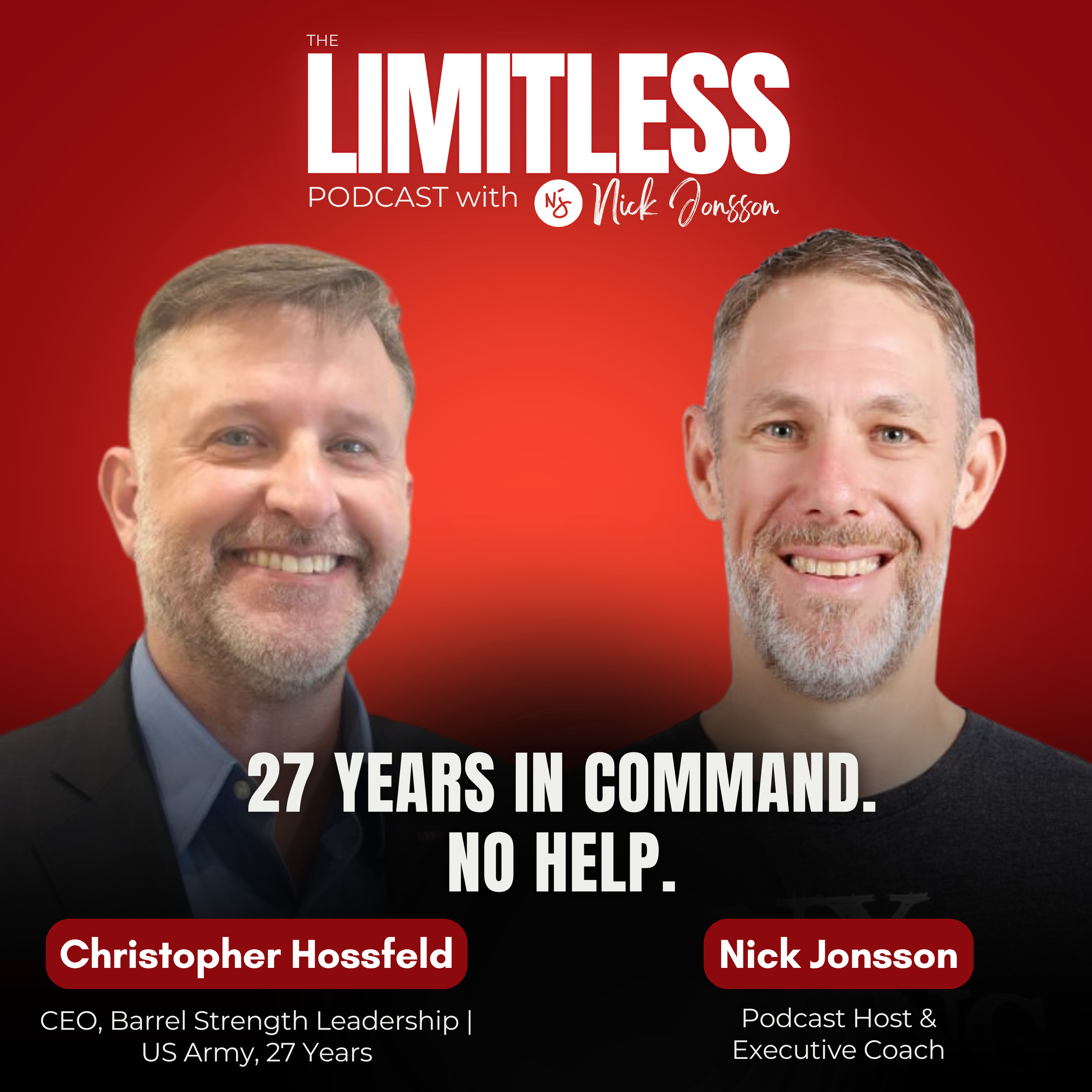
The damage did not arrive as a breakdown. It showed up as protectiveness — the trait any team would praise in a leader, and the one that quietly drove decisions that were not the right ones, because he could not stand the thought of anyone else feeling what he had felt.
Chris Hossfeld spent 27 years as a US Army infantry officer, four of those deployments in combat, the first as a company commander in Iraq. On Christmas Eve a vehicle-borne IED knocked him out. He was not thinking straight, and on his first patrol back out he missed something. One of his soldiers was killed. Seventeen were wounded. He helped carry that soldier out.
It was very late in those 27 years before he got help for what followed. He lost two soldiers during his time in command, roughly twenty to thirty days apart, and he names what he carries without softening it:
“My name is Chris, and I have survivor’s guilt.”
What he has done with it is the part worth sitting with. He is not trying to resolve it. He runs on Saturday mornings to music played at the memorial services, keeping them in mind on purpose rather than waiting for a post from a former soldier to do it for him. And he has pointed the guilt outward: he realised he had been only one commander with a whole team he had not fully invested in, and building leaders became the work.
For anyone who has quietly turned a bad outcome into a personality trait.
👇 Connect with Chris Hossfeld
LinkedIn: https://www.linkedin.com/in/christopher-hossfeld-635a80105/
Explore more: https://www.nickjonsson.com
Episode Transcript
Nick Jonsson: Welcome back to another episode of the Limitless Podcast. Today we have with us Chris Hossfeld. He's here to talk about Barrel Strength Leadership. Chris, a warm welcome to you. How are you?
Chris Hossfeld: I'm doing all right. It's an early morning for me, but that's okay.
Nick Jonsson: It's a very early start for you today, so thank you so much for making it happen. We're going to talk a little about loss today. At Limitless, we talk about the challenges we go through in life. It's a rollercoaster for most of us, but it's how we deal with those challenges and how we come back.
So I'm going to go straight into it. I understand that you have been in combat, and that you've been around the loss of your soldiers. What are the challenges for a soldier? Most of our listeners are executives, entrepreneurs or business owners, and perhaps they haven't seen life from your side. So let's start right there. Share a little about the loss you've experienced, and perhaps about the first soldier whose loss affected you.
Chris Hossfeld: My first combat tour was as a company commander. If you've ever watched Saving Private Ryan or Band of Brothers, that's what I did. I was an infantry officer. I did all the cool things: I jumped out of aeroplanes and flew in helicopters during my career. But my first combat tour was in Iraq.
I had been knocked out on Christmas Eve, of all days, by a vehicle-borne IED, and I wasn't thinking right. So on really the first day I was able to go back out on patrol, I missed something that led directly to my soldier being lost and 17 being wounded. I helped carry that soldier out.
It made certain parts of my personality become overbearing over time. I felt this need to be protective. I didn't want anyone else to ever have the sort of feeling I had. And it caused me to do things that weren't really the best. It led to certain problems, even over 27 years in the military. It wasn't until very late that I got some help for it. PTSD is real.
But I think for executives, with any company they have, their employees, their team, whatever their baby is, when something doesn't go right, most of them take it very personally. They wonder what they did. The really bad ones will say, "Hey, it was that team member's fault, it was that person's fault." But the good ones internalise it. They're critical of themselves. What did they do to contribute? Is there something they could have done to help prevent that sort of failure?
So I think that's part of what I bring with my company, taking people to battlefields. I'm able to have someone look at it through that historical perspective, and through my own personal stories, and then maybe challenge them on the way they're thinking about solving problems: what it is they need to do, personally, professionally, or for their team.
Nick Jonsson: In the workplace, we'd perhaps have the time and space, after an accident or a disaster or a mistake, to pause and reflect, to go home over the weekend, recover, and come back with fresh eyes the next week to look at it. But what about in combat? Do you even have time to grieve? Do you have time to pause and reflect, or does it just keep moving?
Chris Hossfeld: You just keep moving, in general. And it's at those times that it matters whether or not you've built up the skills and the tools to find a way to decompress. Sometimes that's finding the right person to confide in. But it's very difficult to do that, and that's what I think is so unique about combat leaders: they have to do it at such a rapid pace, with such uncertainty, because they don't have the luxury of time.
But there are some great things that can come from that as well: learning to trust your intuition, really developing trust in others. And when you do have the luxury of time, that allows you to spend more time investing in those individuals, developing more trust, giving them opportunities where the stakes aren't life or death. You can help them learn, mitigate risks, let them experiment, which you can't really do in combat.
So I think it helps challenge people to think, "If I didn't have any time, who is the person I could trust?" And sometimes that's really hard, especially when you're a business leader, or you're lonely at the top as a company commander, where you feel responsible for everything your organisation does or fails to do. In combat, that is tough. It can be very weighty. So how you deal with that over time is, I think, a very interesting aspect of mental wellness. And what do you do physically, to keep your body going under that immense stress? We all have stresses. How we deal with them, I think, comes down to tools that everyone needs.
Nick Jonsson: And at that moment, Chris, if you've faced the loss of someone, perhaps even a friend, someone you cared about, who was your soldier, and you're putting the grief aside because you have to move forward and don't have time for it… What I've learned and understood about grief is that it's a natural healing process. There's not much we can do. If we medicate ourselves in whatever shape or form, we're just postponing the grief. We need to deal with it, we need to sit with it. But if you don't have the time and space to do that in combat, does that grief come back at you later? What's your experience?
Chris Hossfeld: It does. Sometimes it's hours later, sometimes it's days, sometimes it's years. But I think what's really key is how you develop your own resiliency to be able to deal with that grief.
It's okay to feel that loss. It's okay to be emotionally spent at times. It's what you do with that. What systems, what people do you have around you? Family. Religion. Physical fitness. They're all things that, put in the right balance for that individual, can be helpful in getting through a healing process.
I like to go running now, even in my retired days, on Saturday mornings, because it gives me time to think, and to listen to music, some of which is music from my deployment that we played at memorial services. It reminds me to think of them, to not let that sacrifice go to waste. What can I do to be better for them? It challenges me in a good way. And it also clears my mind, so I can deal with the other stresses that come about during the week.
Nick Jonsson: Thank you for sharing that. So those are some coping mechanisms: even when you're very busy out there, you can still fit in some exercise as a way to deal with it. And what about guilt? I would imagine there are often questions where we ask ourselves, "Did I miss something? Could I have done something? Could I have prevented it? Did we take too much risk here?" Especially for you, in command. What about healthy responsibility versus guilt? Is that something you've reflected on as well?
Chris Hossfeld: My name is Chris, and I have survivor's guilt. My name is Chris, and I feel shame that I failed my soldiers. That I failed Oscar and Nate Swindell, the two soldiers I lost during my time in command, maybe 20 to 30 days apart. Very tough on me.
And that guilt has come out in good ways. It has given me a commitment to my craft, to teaching others from my mistakes, to teaching others what I think they may be able to do to better cope with uncertainty and with the problems around them. And it is something I deal with all the time.
Just a meme, or a post on Facebook or Instagram from one of my former soldiers, reminds me of all my soldiers at all my various levels of command and leadership who were killed or injured, sometimes under the orders that I gave them, or the plan that I drew up.
Most CEOs don't have to deal with that, but their losses are going to be just as real in terms of time, money, maybe even employees who have to be let go and who lose their livelihood when the business falls apart, or when a segment goes under. These are all things people can learn a great deal from. But again, you're not going to forget those significant emotional events in your life.
Nick Jonsson: It sounds like we can learn a lot from combat and bring it into business and leadership. You founded Barrel Strength Leadership, which grew out of your own belief that leadership is forged through reflection, humility and growth. I read in your bio that you've refined the insights from walking battlefields into useful stories and tools for leaders to use in the workplace. Can you elaborate a little on the work you do, and the learnings and teachings?
Chris Hossfeld: My favourite group is soon-to-be commissioned officers. They're in a commissioning programme for their service, and I've taken them to Gettysburg, or Normandy, or Italy. We walk the battlefield and talk about weighty decisions. What went right, what went wrong? Using the frame of what happened there, we look at things that can trip leaders up. Cognitive bias.
There's a reason a whole lot of armour didn't go down to attack the Allies as they landed at Normandy. It's because they believed what they wanted to believe, and we fed them the idea that Patton was going to cross at Calais. They wanted to believe it, so they did.
So you can challenge an executive: what systems do you have to prevent that in yourself, in your company, in your organisation, in order to prevent loss, to mitigate risk, and in how you like to have things reported to you?
There are great stories. Operation Market Garden in the Netherlands: literally a bridge too far. It was a strategic failure. What can we learn from it? How did they plan it? What didn't they take into account? What understanding didn't they have? Maybe too rigid a time schedule. No flexibility. Is that something business people can say, "Oh yes, absolutely"?
You can learn from that failure, but there are also great successes in it, in various portions of the battlefield. Tremendous heroism. You can talk about how you build culture in your organisation, how you build resiliency.
The Battle of the Bulge: the winter of 1944, the coldest in European history for at least 50 years, minus 20 degrees. How do you build resiliency? How do you build people, a culture, a climate, an organisation that says: we can, we will, and we will not quit?
Nick Jonsson: And if we link this to top performance: there's so much pressure in the workplace now. Everyone is cutting costs, reducing headcount, and we still have to perform more. So what do you think leaders can learn from combat, from your experience, when it comes to high performance in the workplace?
Chris Hossfeld: I think in today's business world, with the pressures of trying to hit whatever metrics you think are important, you may be measuring the wrong thing. And especially in the days of AI producing instant results, you may miss out on those important conversations and the relationships that actually make business deals work. The ones that actually let you know your employees, their strengths and their weaknesses, and how to use those as opportunities for growth, as well as for mitigating risk. If I understand my employees, I know how best to use their strengths.
And when I have the right people, people I can trust through a relationship, I can delegate authority and responsibility, so that I'm not the only one making the decisions and burning myself out. Oh my goodness, can leaders learn from that. Do only the things that only you can do.
Nick Jonsson: And what about separating ourselves from our work, from our assignments? There's the question of identity. Many senior leaders, people in the C-suite, put their heart and soul into the business, to the point where they almost define themselves by the company's values and purpose. Today, with all the acquisitions, mergers and layoffs, suddenly you can be let go. I know many senior leaders who then find themselves in a depression, or whose bad habits turn into addictions: alcohol, drugs, all kinds of unhealthy coping mechanisms. How can you separate your identity from the business you work for? Is that something you can learn from how you dealt with it as a soldier?
Chris Hossfeld: Absolutely. In the military, you are so defined by what uniform you wear. What badge do you have? What patch do you have on your arm? What qualification badges? It's very visible. I'm wearing one right now, the Combat Infantryman Badge, or the Expert Infantryman Badge. These are all things that define you.
The day you're done and you're not wearing that uniform anymore, your identity has to change. And if you haven't been thinking about that, if you haven't been working on a well-rounded identity, in and out of business, you're going to feel lost when that's gone. Whether it's being part of a team, being part of a business, a merger or acquisition where your company is no longer known by that name, or the product you built as an engineer going away. All these things can be lost.
So what do you do? How does your company invest in you as an individual? How did they prepare you for those things? I love the idea of mentorship. But how many people say, "I'm just going to be your business coach," and then they're not mentoring you in all aspects of your life? They're not asking what your educational goals are, what your personal goals are, what your goals are for your kids, whether you even want kids. If it's just business, then business becomes your entire identity.
Nick Jonsson: Chris, looking at your life today, what are your biggest takeaways from your work as a commander? What can you take from that into your personal and professional life now, where you'd say, "Yes, it was painful, yes, it came at a cost, but it built me into the person I am today"?
Chris Hossfeld: Absolutely. It put an accelerant on my passion for developing leaders. Because I realised, through that loss, that I was only one commander. I had a team. Did I invest in all of them? Did I give them all the tools that I could?
It gave me a commitment to trying to build better leaders, and that's what I want to do in the business world. That's what I want to do for colleges, for business schools, and for individuals who want personal or professional growth.
And I want to do it not in a ballroom with a hundred people, but somewhere that evokes emotion. Because, as we've been talking about, so much of this is tied to emotion. Some of the best learning comes when it's tied to an emotion, and I want to do it in a way that evokes an emotion of honour, and of understanding of what happened. Maybe it piques a little interest in history that they didn't quite have before, and now they can pick out that one mistake in a movie.
But most of all, it gives them a new framework for solving problems. And if I can help someone solve a problem, and they come back six weeks or a year later and say, "You told me this, and I didn't think about it at the time, but man, that hit right at this moment," that is joy in my life now. That's why I love what I get to do.
Nick Jonsson: Fantastic. And you live in Texas, is that right?
Chris Hossfeld: Correct.
Nick Jonsson: Can you share a case study, or a company you've worked with, in Texas or elsewhere around the world, to inspire us a little? Maybe a listener will want to call you up to talk more about the services you offer.
Chris Hossfeld: Yes. I've done it for several universities, for military units, and I have a couple of business clients I do it for. I go to Gettysburg, Normandy and Italy. I'm doing Sicily, to follow in the footsteps of one person's father, where they fought, to make that personal connection to a place they were.
And for some business executives, we're doing one focused on inspiring people to lead. What can we learn about resiliency that inspires us from a unit in the Battle of the Bulge? You may have heard of it: the 101st Airborne Division. I served in that unit. I commanded a battalion in that organisation, so I can bring my own personal connection to that history, and talk to leaders about what makes an organisation great, and what they can do to inspire their subordinates to achieve greatness. That's what it's about.
Nick Jonsson: Thank you, very inspiring. I had a look at your website and your services, and it sounds very bespoke and very different. I think people like to look into history and learn from it. Thank you so much for the inspiration today, Chris. I think you're the first guest to come at it from this angle, at least on the Limitless Podcast. Is there anything I forgot to ask you, anything you want to leave the listeners with?
Chris Hossfeld: Investing in people. That's what you and I do: we invest in people. That is money and time well spent, and it's personally and professionally rewarding.
Nick Jonsson: Thank you so much, Chris. Thanks for getting up so early in the morning to come on the show. I wish you a good rest, or a nap, or whatever gets you through the day today. Thank you for all the inspiration, Chris, and thanks to all the listeners as well.
Chris Hossfeld: Great, thank you.