

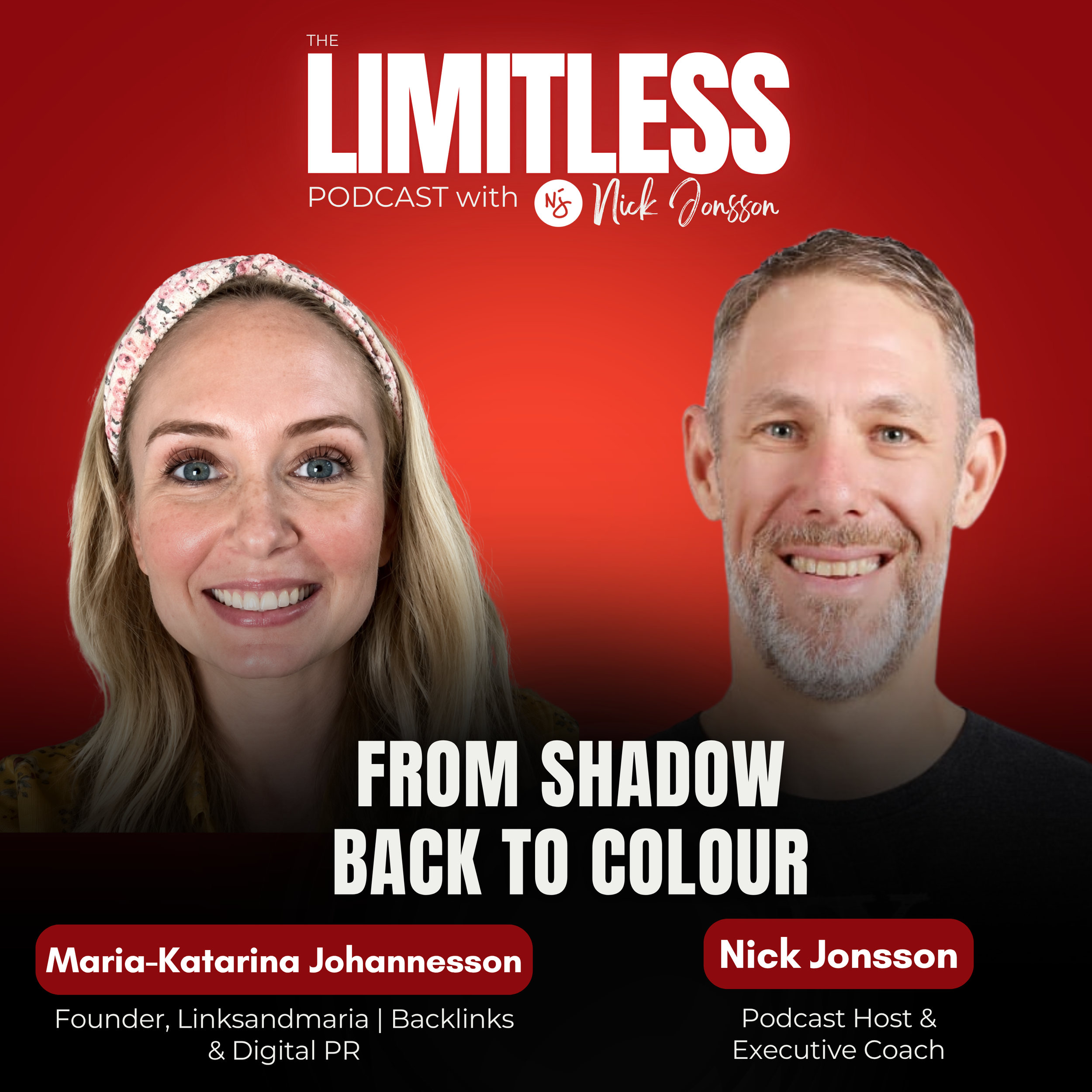
Episode 342: Maria-Katarina Johannesson - From Shadow Back To Colour
She went to a mindfulness coach the way a capable person approaches any problem: asking for tactics. She did not get any. What she got instead was the slow, unwelcome work of noticing what sorrow actually feels like in the body.
Maria-Katarina Johannesson runs Links & Maria from Stockholm, building backlinks and digital PR for businesses that want to be chosen rather than merely seen. Six years ago, a relationship ended with no warning. One day the person she had built her life around decided he was done.
The loss was not the hard part. The hard part was that she had no idea where he ended and she began — she was the relationship, as she puts it — so when he said he did not want her, it landed as the world not wanting her.
She calls the place she went into the maze, and she is precise about why that word fits. It was not somewhere she was trying to escape. She had stopped believing there was a way out, and concluded it was simply where she belonged. The world carried on in colour while she moved through it as a shadow, functioning at work, present to no one.
Nobody knew. Her explanation is unsentimental: grief is heavy, people are busy, and she does not blame anyone for not wanting to know.
"try to trust the pain enough. To be able to walk through it."
For anyone functioning perfectly well on the outside who has not told a single person.
👇 Connect with Maria-Katarina Johannesson:
Episode Transcript
Host: Nick Jonsson
Guest: Maria-Katarina Johannesson, Founder, Links and Maria
Nick Jonsson: Welcome back to another episode of the Limitless Podcast. Today I'm very excited, because I'm visiting Sweden and we have a guest with us from Stockholm. We have Maria-Katarina Johannesson, of Links and Maria. She's with us today to talk a little about her life. We're going to dig into some parts that may be a little painful, and while we can learn something from those, it's of course about how she came out of it and what the listeners can learn from her experience. Hi Maria, how are you?
Maria-Katarina Johannesson: Hi, thank you for having me, fellow Swede. I'm excited to be here.
Nick Jonsson: I'm very excited to be visiting the capital today. I'm dialling in from a little further south; I spend my summers down in Kalmar, in southern Sweden, so I'm not too far away from you.
Maria-Katarina Johannesson: I love Kalmar, by the way. It's a great place.
Nick Jonsson: It's a nice summer town. I don't fancy it too much in the winter, it's pretty dark and cold, but the summer is fantastic.
Maria-Katarina Johannesson: Yeah, that's true.
Nick Jonsson: So maybe we can start by sharing a little about what you do in your business, and who you're supporting these days, Maria.
Maria-Katarina Johannesson: Absolutely. As you mentioned in the introduction, I go by Links and Maria. What I do is help businesses that want to get visibility, but that also want to be selected. And I do this by building relevant, effective backlinks.
For those of your listeners who may not be that familiar with what that is: they're essentially digital high fives, as I like to say. It's another brand, another website, saying, "Hey, I want to be associated with your business, your website." So it's about getting that external validation.
Nick Jonsson: And how important are these backlinks for SEO?
Maria-Katarina Johannesson: They're very important, and as with the whole industry, some people are going to disagree with that statement and some are going to agree with it. But if we take a step back and look at the current state of things, we can see that with AI, it takes a split second to produce content. It goes so quickly. So the differentiator is really going to be backlinks, but also standing out: personality, knowing who you are, really knowing what your audience wants, and then tying that all together.
That's also why I really like the digital PR approach, where you try to make something newsworthy, exciting, even controversial, and tie it into what is going on in that specific niche, business or industry.
Nick Jonsson: And when we're sharing content online, it is indeed so easy to spit out a lot of content. How important is it also to be real and authentic?
Maria-Katarina Johannesson: I'm actually so happy you asked me that question, because people are just so tired of getting bombarded with AI content. You can tell, even on LinkedIn. I know you're very active on LinkedIn, and I've noticed it on your comments too. When people comment, you can easily detect when somebody isn't genuine.
I think in general we are craving authenticity, being able to relate to another human being, getting those hearts into the mix. Because we can talk about the data, and being effective, and AI, all we want, but at the end of the day, I believe that you are your relationships, and that people do business with people they like.
Nick Jonsson: We are fully aligned here. I know that you also speak on some of these topics. You talk about the identity gap, you talk about feeling the fear and doing it anyway, and I love the Swedish saying too, the word lagom. Those are some of the talking points I found when I read about you. How do they serve you if you want to come across authentically online?
Maria-Katarina Johannesson: Thank you for mentioning that. For me, I try to walk the talk, not just say "be authentic" or "be your true self", because everybody can say that. I really try to practise what I preach.
A couple of months ago I became a mum, and that has been fantastic. It's my first child. But it's also been very confusing, challenging and hard, in terms of identity: creating a new identity, leaving my old self behind in a way, and in the middle of that trying to understand where my business fits into all of this, and what my true self actually is.
And on lagom, just for your international listeners: the concept of lagom is about not being too much and not being too little. It's being in this safe middle. You don't want to stand out, you don't want to offend anybody, you just want to be very safe.
For me, with the background I come from, I think I've lived that sort of life, and I just think it doesn't serve me. I don't want to pretend. I'm fine if anybody doesn't like my vibe. That's cool. But I have to honour myself, if that makes sense.
Nick Jonsson: It makes complete sense. It sounds like you've done a lot of work on yourself and come a long way, so we can surely learn a lot from you. Have there been tough times in your life? When we communicated offline, I understood that you've gone through some challenging parts. Can you take us there, if it's not too painful, Maria?
Maria-Katarina Johannesson: Yeah, for sure. One big thing that has been very challenging for me was a bad breakup. How long ago is it now? I think it's five years, or six years, maybe. And this breakup happened completely out of the blue.
Now, in retrospect, when I think about it, I can understand that, no, actually, it didn't happen out of the blue. But at that point in my life, six years ago, I was shocked. I had created this life for myself with this other person, and all of a sudden this person decides, "I don't want to do this anymore, and see you never." And that was it. I was completely shocked. I did not expect it at all.
Nick Jonsson: And how did you feel when that happened? What went through your mind?
Maria-Katarina Johannesson: Honestly, I felt like I was going to die. That is the true answer. I know that maybe sounds strange. I guess your listeners are probably somewhat emotionally mature, or at least interested in these topics, so I think they would understand.
But I had built my life around this person. Who I was was so intertwined with this person that there was no separation between him and me. It was just us. So when he said, essentially, "I don't want you anymore," it was almost as if the world didn't want me anymore, if that makes sense.
Nick Jonsson: And how long did you stay with those thoughts?
Maria-Katarina Johannesson: In the beginning, I would say the first three months, it was just constant. Because this happened out of the blue, I just could not process it.
I remember at the time, I had a friend who asked me, "Do you think that in a few years' time you'll look back at this situation and ask yourself whether this is the best thing that could ever have happened to you?" At the time, I remember thinking, "You're crazy. How can you say that?" But now, when I have walked through the pain, when I have attended to the sorrow, when I have really practised active listening, I can see what she was talking about.
Nick Jonsson: It's interesting; when we look back, we have a different perspective once we're through it. I also read that you spoke about unworthiness. Can you share how you felt about your worth at that time?
Maria-Katarina Johannesson: For me there was no difference between who I was and what the relationship was. I was the relationship. So when the relationship ended… that's why I used the word die, because that's how it felt. The relationship died.
And I felt that I got trapped in this maze. I think I wrote that to you earlier, but that's really the best way I can describe it: being trapped in this very narrow maze. Most of the time, I think humans want to get out of the maze. We want to find the way out. But I was so confused, so lost, basically suffering from an identity crisis, that I felt there wasn't even a way out of the maze. I felt it was pretty much my destiny to be there.
Nick Jonsson: And what is life like when you're trapped inside a maze?
Maria-Katarina Johannesson: You feel… I was going to use the word poor, but not poor in terms of finances, of money. It's more that your soul feels so dry. It's hard to breathe. You cannot attend to your sorrow.
It's like you're always stuck in this cause-and-effect state: "What is actually happening? How can I get out?" Or you're stuck in the "there's nothing to do, let me just lie down" state.
Essentially, it's a very lonely place to be. You can see the world happening outside, but it's like the world is in colour and you are just a shadow, black and white.
Nick Jonsson: And as you were going through that, trapped in that maze, how did it affect your other relationships, your work and the other people in your life?
Maria-Katarina Johannesson: That's a very good question. The honest answer is that I was so preoccupied with what had happened. I was in denial. I did not want to accept the reality. I was so preoccupied by it, thinking, "No, this cannot be happening to me," although it obviously had happened.
So I was not able to be present, not in the situation I was in with the bad breakup, but also not in my other relationships or my work situation. The best way I can describe it is almost like being a ghost floating around. A very strange concept of time, and just looking for ways to… almost wanting a time machine. I did not want to accept reality.
Nick Jonsson: That sounds like a very tough place to be. Thinking about people out there, do you think there are many people going through this kind of maze secretly, without us ever knowing?
Maria-Katarina Johannesson: Yes. And to go back to what we talked about earlier with AI, I know it may not be the most straightforward comparison, but bear with me: I think we are wired to want the quick fix. As with AI, write a blog post or whatever in two seconds. We want to cure our heartache in one second, or we want to evolve and become the next superhuman in five minutes.
I think we just have to show a lot of compassion to ourselves about the fact that being a human being is an ongoing process. It's not like other processes, where there's a clear start and finish. You constantly have to attend to what's happening inside of you. How does that make you feel? And really try to work without so much judgement. Does that make sense?
Nick Jonsson: Absolutely. And I believe you're right. I also went through my tough time, and I remember that no one on the outside found out. I think I was hiding behind a smile. It's easy to brush people off; people don't really dig that deep, is what I found. Is that what you experienced as well?
Maria-Katarina Johannesson: Yes, and I think people also didn't want to know, because people are so busy. I don't blame them. I just think that on a societal level we're so caught up in our own lives: we have our kids, and they need things, and what are we going to have for dinner, and work, and when are we going to have a vacation? And then to deal with somebody who's trapped in a maze of feelings of unworthiness… it's heavy.
That's why I believe we should talk about these things earlier, in school: talk about mindfulness, about the value of honouring your feelings. Not always, "How can I get rid of my sorrow? How can I get rid of my anger?" but just naming it: this is how I feel, this is what's going on. And really doing what we can to remove as much judgement as possible.
Nick Jonsson: I like that. And how did you get out of it? Was there one moment when you managed to break free?
Maria-Katarina Johannesson: One big change for me was meeting my current mindfulness coach. I've been with her ever since.
When I came to her, I was actually still very much in denial. I remember asking her, "Can you please help me, give me some tactics on how I should handle this?" And she just looked at me. I remember it so well, because I was thinking, "Yes, tactics!"
What we have practised, and still practise to this day, is incorporating not only what's happening in my mind, but also the body. What's happening in the body as we talk about something, as you experience a feeling? If you're experiencing the feeling of sorrow, how is that in your body? How does it feel? Any sensations? That has been huge for me.
But also being able to dare, really dare, and it's been so hard, to trust the pain enough to be able to walk through it.
Nick Jonsson: So your first step out of it was a mindfulness coach, and I'm happy to hear you're still working together. That's wonderful. Any tips you can give to listeners? If someone is listening who's going through a difficult time, or who might even be in that maze of unworthiness, what would you recommend they do?
Maria-Katarina Johannesson: My recommendation would be: when you experience that overwhelming sense of sorrow or unworthiness, it doesn't matter if you're left-handed or right-handed, place your hand on your heart, take a deep breath, and tell yourself, even say it out loud: "This belongs."
Nick Jonsson: And that helped you?
Maria-Katarina Johannesson: Yes. The reason this was hell for me, I think, has so much to do with the fact that I resisted it. The moment I stopped resisting so much, things started to soften.
Nick Jonsson: So you came out of that maze working with your mindfulness coach. Was it a quick way back, or can you tell us a bit about how the healing worked?
Maria-Katarina Johannesson: No, it was not quick, and I think that was good for me. Whatever you're doing, I think it's important to have a context: a dancing class, or mindfulness, or a therapist or a coach. A context where you allow yourself to let things take time. That's your sacred space.
Because these things, I call them things, but the human mind and heart, don't have a clear start and end date. It's an ongoing process. It's something we constantly have to nurture, and attend to, and show compassion and respect to.
And if we zoom out a little, that's also when you can show real belonging and attend to other people. Because, like I said at the beginning, you are your relationships.
Nick Jonsson: And during that time, besides the mindfulness, were there other habits or practices you learned that became part of your recovery?
Maria-Katarina Johannesson: A big thing for me was actually hanging out more with kids: friends' children and my neighbour's kids. I used to babysit them.
Because what I started to observe was that kids don't label feelings. It's not, "Oh, now you're sad, oh, that's wrong," or "I feel upset, oh, shame on you." It's just ebb and flow. Now this happened, and now this happened.
Being around kids really taught me how to stay in the present and take a step back from the judging aspect of things, to really nurture that little soul we all have inside of us. We can learn so much from children, in my opinion.
Nick Jonsson: And today you're living the life you've been hoping and dreaming for, I would hope. What is your life like now, Maria?
Maria-Katarina Johannesson: Absolutely. I have my beautiful little daughter. She turned seven months a couple of weeks ago, and I'm constantly reminded, with the help of my child, of how important it is to be in the moment.
I get to live in this beautiful city, although I do like Kalmar too, so let's have that for the record. I can do what I love. Like I explained at the beginning, my niche is backlinks, helping brands stand out and be the selected one. But I also do that from a very human perspective, with the heart at the centre.
That's very important to me. I do love my Excel, my data, my tables, all the technical things. But I am a human first. That's just who I am, and especially after the work I've been doing with my mindfulness teacher, I cannot remove that part of myself. So I try to use it in my business as well, as, I guess you could call it, a unique selling point. I don't really view it like that; it's just who I am.
Nick Jonsson: And if you compare the Maria of today with the Maria back then, going through that challenging time, what would you say is the biggest difference?
Maria-Katarina Johannesson: The biggest difference is that I am more willing to just sit with whatever is. And not try to get rid of what is.
Nick Jonsson: And throughout this journey, who are you becoming? Thinking about the future, who are you becoming, Maria?
Maria-Katarina Johannesson: I love that question. Who am I becoming? I am becoming a person who is going to be more engaged in her communities. Who is always going to honour hearts. Who is going to have a great, successful business, but never get too obsessed with the money side of things, and always prioritise relationships. And who always keeps in mind that you never know what another person is experiencing. So always, always lead with compassion.
Nick Jonsson: Beautiful. And what would you say to someone listening today who has those feelings, who is simply saying to themselves, "I'm not enough"? What would you tell them?
Maria-Katarina Johannesson: Go out and hang out with kids. Really. I mean that. I say it a bit as a joke, but I do mean it: they are great teachers.
It's so easy to feel that you're trapped inside your head, in the maze, and it's such a lonely place to be. You have to do what you can. I know that today there are so many great online coaches, and I know you're one of them. There are so many options online, so even if it's just going to Reddit or whatever, just reach out to someone.
That is, I would say, the most important thing: start small. Because you cannot expect yourself to do a whole intervention. You have to take one baby step at a time.
Nick Jonsson: I like that. One step at a time. And finally, Maria, if someone is listening and wants to connect with you to learn more about the work you do, or get some tips, what's the best way to reach you?
Maria-Katarina Johannesson: Sure. You can email me at maria@linksandmaria.com. You can also just type in "linksandmaria", as one word. Or, if you feel up for the challenge of writing a very Swedish name, you can look up Maria-Katarina Johannesson. And yes, I'm all about backlinks, digital PR and visibility, and being very human-oriented.
Nick Jonsson: Fantastic. Thank you so much, Maria, for being on the Limitless Podcast, and thanks to all the listeners as well.
Maria-Katarina Johannesson: Thank you. Bye.