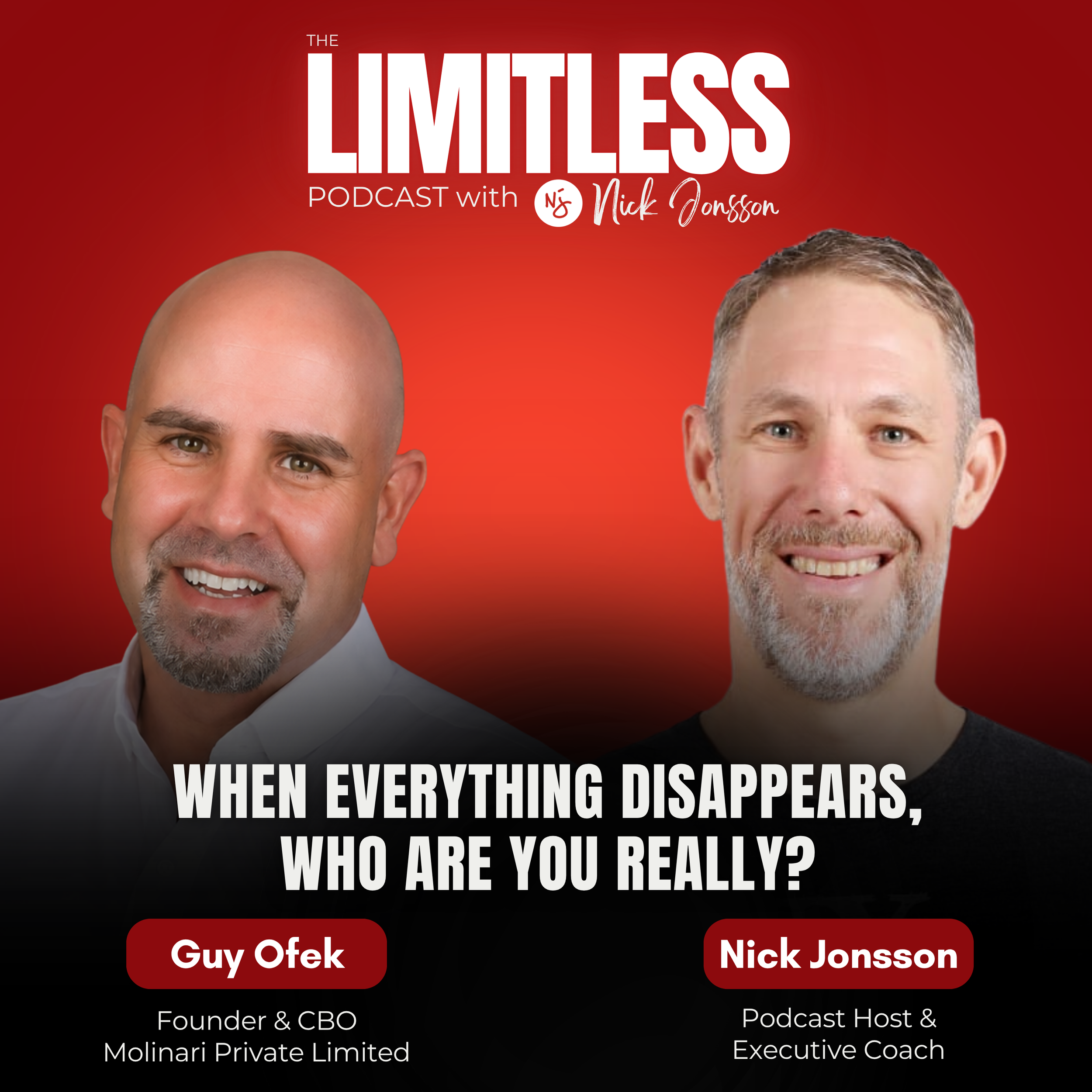
Episode 341: Guy Ofek - When Everything Disappears, Who Are You Really?
A cardiologist in Singapore told him his heart was fine and the chest pains were probably stress. He heard that as clearance to carry on.
Guy Ofek, founder and Chief Business Officer of the Singapore advisory firm Molinari, spent twenty years climbing — junior attorney in 1997, then the corporate world, then thrown into Asia — while treating a failing marriage as the ordinary cost of two careers. The warnings were not subtle. He ignored them one at a time.
The relocation to Seoul, the separation and the job loss landed close enough together to arrive as a single event. He woke in a four-bedroom apartment with nobody in it and nothing to get up for. For years he had complained about never having enough time. He had been handed all of it.
Then came the part he calls the wow moment. He went looking for someone to call and found there was nobody. An executive in title only, as he puts it — the job had been doing the work his identity should have been doing, and when the job went, so did he.
The first call he made was to a rabbi he barely knew. Not for answers. The rabbi told him to come and take a walk, and they walked through a cold Seoul morning while Guy talked. He still sees him today.
"There's not gonna be a plan. There is no recovery. It's just a step."
For anyone whose title is currently doing the work their identity should be doing.
👇 Connect with Guy Ofek:
LinkedIn https://www.linkedin.com/in/guyofek/
Molinari website https://www.molinari-sg.com/
Episode Transcript
Host: Nick Jonsson
Guest: Guy Ofek, Founder and Chief Business Officer, Molinari
Nick Jonsson: Welcome back to another episode of the Limitless Podcast. I'm very excited today. We have with us Guy Ofek. He's the CBO and founder of Molinari. Guy, a warm welcome to you. How are you today?
Guy Ofek: Thank you very much for having me. I know you're very much in demand, so I appreciate the time.
Nick Jonsson: Well, these are important conversations to have, and we're going to go really deep today. Guy, I've known you for some time, but today's conversation will hopefully be a bit deeper and more meaningful than any we've had before. Are you ready for that?
Guy Ofek: Absolutely, let's do that. And thank you again for allowing me this, because this started a chain reaction, as a result of which I'm now signing up for an interesting academic course at NUS, and I might also start writing my own book, in order to reflect on exactly the kind of things we're going to talk about today: the things that triggered everything I am today.
Nick Jonsson: Fantastic, Guy. What we're really going to look at today is the difference between building, or rebuilding, a career, and building a life. When we checked in beforehand, you said that rebuilding a life, rather than a career, was much more important to you. Can you start there and elaborate?
Guy Ofek: Yes. The story takes us back a good number of years, because I started my career back in 1997 as a young, junior attorney. I then pivoted about six or seven years later into the corporate world, which very quickly threw me into Asia. Like many others, I started climbing the career ladder, which then brought me a relocation to Singapore.
Somewhere along the line, challenges and cracks started appearing. But of course, like many others, I disregarded the signs, which were very, very clear: in the marriage and the relationship, and in my own health, at a certain point in 2013. I kept on moving and running, from Singapore to Seoul, until one grey day, my world basically came to a standstill.
I realised that everything I'd been working for, all the identities I used to have, all the success, the career, the achievements, whatever I thought I had, was just a facade. It was something that could be taken away and disappear, literally overnight. So that was a challenging, difficult period, but, as with anything else, it builds us, right?
Nick Jonsson: Thank you for being so open and vulnerable, Guy. If it's not too painful to go back there, maybe you can share in a little more detail what you had in your life by then, and what it was that you lost at that time.
Guy Ofek: It's a long story, and I'm not sure we have all the time in the world. But as I said, the first sign was a challenging relationship with my dear first wife, which I took as a necessary evil. We were both chasing our careers, raising children, travelling. It's normal to have some conflicts and issues: seeing therapists here, therapists in Seoul.
And then health came in. I was sitting in a cardiologist's office here in Singapore, complaining about pains in my chest. He did all the checks and said, "Well, the good news is your heart is okay. I think it's stress." I took that as a good sign: yes, I'm clear to go, I'm clear to continue the rat race. I did not stop to think, what does that mean?
I continued on. Relocation. Relocation is a tough thing. We moved to Korea, the relationship continued suffering. New role, new team, new boss, new everything, and you keep hammering away at it. Until the relationship could not take it any longer, and we decided to part ways. I said, okay, we'll take it as it comes, we're still strong.
I left the house and lived by myself. My wife and kids moved at a certain point. And then I found myself one fine morning in my swanky, as I call it, apartment in Mapo-gu, getting up early.
I'd had a dream that night, which was quite interesting. I normally don't dream. I was on a tightrope. I was high up, and in the way you can only experience in dreams, there was actual horror: looking down into darkness, knowing that you're very high up, you're alone, you're not moving. There's obviously no net underneath. And I was not in a circus; it felt like it was a real thing. Just the rope, and the understanding that I'm in a dangerous situation. Thankfully, I did not fall. You don't fall in that dream. But then I woke up.
And in that little apartment, everything stood still, because I remember lying on my back, hands to the side. I was alone in this big four-bedroom apartment. All of a sudden, I realised that I didn't have anything to get up for, because the family had left, I'd lost my job, I had no partner at that time, I had no obligations, no meetings.
The feeling, all of a sudden, was this: you always complain that you have no time, that you're chasing, that you're juggling too many balls. And lo and behold, the universe said, "You know what, okay, let's reboot. Let's reset. Let's clear everything. And we'll give you what you allegedly wanted. Now you have all the time in the world. You have nothing to get out of bed for."
So that was, as you can understand, a freaky, shocking sort of moment, because everything came to a total halt. From a point where you're travelling, you're a busy executive, you're living on planes, you're landing back home, you have kids, you're a daily father, you have commitments to the family… and all of a sudden, complete and utter silence. Nothing. Zero.
And the problem was that I was thinking, "Okay, so let's go and meet a friend." There was no one. No close friends. So the thing you articulate very well in your own book, executive loneliness, was exactly that. Only I was an executive in title, and I had nothing. I'd lost my title, lost my family, lost any relationship. That was a "wow" kind of moment, for me at least.
Nick Jonsson: Yeah, wow. There's a lot of loss there at one go. Your relationship, your work, being away as an expat from friends, all those moves to new places, never rooting yourself anywhere. And if you think about all that loss, Guy, what was it that disappeared first? Was it your motivation to get out of bed, the relationship, the meaning of life, your identity, your faith, or something else? What was the first thing to go?
Guy Ofek: It took some time to process and to understand. Today, looking back, I know that it was the identity.
From an early age, I built myself in a way, in a world that is driving us, to get love through our achievements, through what we provide. I defined myself by how well I managed to succeed and achieve and climb that ladder.
I call that period the River Man, because today I know there are three versions of Guy. That period was the River Man, because life, to me, was a river. I saw life as: people are born and they jump from the banks into the river, and then the river basically takes all of us along the same route. We go the same way, from kindergarten to school, from university to, let's say, national service, career, marriage, mortgage, kids, two dogs, and the end. Everything is the same.
Agency, the ability to choose, the ability to direct, never occurred to me. I thought the only thing we need to work on is how fast we move in the river, towards whatever destinations there are.
So the first thing that occurred to me was: okay, there's no more title, no more achievements, no more responsibility, no more nothing. What is left? What are you? Who are you? When all of that became extinct, and there was silence for a moment, you start thinking, "Okay, so now what?"
Nick Jonsson: So the identity was the first to go. You described that luxury four-bedroom apartment. If identity was what left you at the time, Guy, what did that luxury apartment represent to you before that emptiness?
Guy Ofek: It represented my need to show the world that I'd made it, that I'm worth something, that I have value. "Look at me, look at me." It was to satisfy my own ego. It was to have, as I call it. I was a hungry man in front of a very full plate, because on paper I was successful, I was achieving, I had all the nice things in the world.
But when all of a sudden you take my mask away, I am nothing. That apartment meant nothing. It was not mine. The fancy car in the parking lot was mortgaged to the bank. They took my job, they took my family, they took my kids, and I knew that they were all better off.
But again, that was how I imagined it: thinking that you probably manifested something to the universe, and the universe answered. The universe said, "My friend, this is not your calling. Let me course correct. Let me reboot. Let's start from the beginning."
I 100% see it that way now, instead of just looking at going up. That was the achieving part, because to me life is divided into three: there's the learning, there's the achieving, and there's the meaning, which is the state I'm in now. That moment was really the end of the achieving. And from there, one fine grey, dark day, everything collapsed.
That was the thing that disappeared: the meaning, the who-I-am. I thought I knew who I was, and by the way, I liked it, I enjoyed it. For many years, when I wore that suit, literally, I thought, "I'm good, I'm happy, I'm proud, I have a backbone, I work for a big company, this is who I am. I travel, I sit in that plane, I go to that lounge." That's the person.
And that was nothing. That was something that can be taken away in the blink of an eye. It means nothing. I did not know it, but all of a sudden, when you strip me of it, I realised: okay, what am I left with?
Nick Jonsson: So how did you start your rebuild? What was the first little step you took towards recovery, towards coming back from that space?
Guy Ofek: It's a good question. Thinking back: I was born and raised in Israel, and while I'm Jewish by birth, because I was born to a Jewish mother, I'm not practising. I'm not an Orthodox Jew. But in Seoul, there was a rabbi.
I had not been a man who would call a rabbi. My Jewishness, as I call it, in those years, was a fact about me. It was like my passport. It wasn't something I cared much about, or thought much about, or used.
But a person in free fall reaches out. And I found myself calling that rabbi, one fine day. You can call it the universe, or intuition, or the fact that there was no one else, because there were no other friends you could have a beer with and talk to and cry to.
I want to tell you what this kind, nice man, with whom, by the way, I'm still in contact, did. Because it taught me, I think, the first true thing I learned after that morning. And I'd like to say that this is not a dramatic story. It's not like he fixed me. He didn't give me the 10 steps I needed to take, or the magic solution. And he didn't say, "It will all come good, everything will be fine, don't worry."
The only thing I heard on the other end of the line was a very happy, positive person saying, "Guy, good to hear from you. I haven't seen you for a while. So why don't you come over, and we'll take a walk."
And that's what we did. Again, I had nothing to do. I took the car and drove, and I met him, and as always, he gave me a good hug, and he said, "Walk with me, we need to go here and there."
On that walk, wrapped up in our coats, on a cold morning, and Seoul is a cold place, that walk allowed me to speak, partly to myself and partly to him, sharing what had happened and what I felt: the wife is gone, and so on.
Fast forward, and looking back now, that taught me that in that situation, when you don't have anything, there are very few things you can do, but they are critical. You can always walk. You can take the first step. And nobody is blocking you from doing that. Just walk. Walk it over, go out, breathe. Start a process.
I don't know if he did it on purpose or not, but looking back, that walk together left a feeling in me that I wanted to see the man again. So I used to come back. And then I used the time to look at the scriptures, to do some religious rituals that I felt I wanted to do, that were serving me. Step by step, reconnecting with my heritage, with my religion, with this person, one to one.
That served me. It gave me a kind of confidence: someone sees me as a person. He doesn't care what I do, he doesn't care where I live, he doesn't care what I earn, he doesn't care what my air miles status is. Completely irrelevant. He sees the man, the person in front of him. And he appreciates what the man is doing, that the man is sharing his time. That was, I think, the first step for me to start getting into some motion.
Nick Jonsson: Guy, that first step is a very important step, and it's something I also talk about: asking for help. Many of us are reluctant to do it. You did reach out, and you did ask for help. What would you say to all the listeners who are perhaps struggling, but who also struggle to ask for help, who are really scared to pick up that phone and call someone?
Guy Ofek: Well, first of all, that's a good question. I don't consider myself an expert in this situation. But if I think about it, first, I wouldn't tell them, "Things happen for a reason, it will be fine." I've come to distrust those sentences, because I know that when I revisit it in my mind, that man who was there on the bed, lying there, really hopeless… if I'd told him, "It's going to be fine, you're going to recover, you're going to find a new job, you will be happy, trust in that," he wouldn't have believed me. He wouldn't have known where to even begin.
I would tell them something I would have believed that morning, from a man who had been there. That, to me, is the part that matters: when everything is gone, whatever bit is left, that is the real you. So in order to find the diamond in the rough, in order to find the wreckage of the ship, or whatever, you need to go deep.
As painful as it is, and it is difficult and painful, there is some bright angle to this situation. It's difficult to see it from where you are now, where it's hurting and it's raw and it's an open wound.
I would tell them that the smallest, truest thing I know is that your body is going to stand up before you are ready. It will have the capacity to take that first step. And that's okay, let it do that. There's not going to be a plan. There is no recovery plan. It's just a step. It's small enough to seem possible, and it's secretly the whole thing. That is the plan: the ability to say, "I'm going. I don't know where, I don't know what, but I'm moving." And you can. It's a small, small little thing.
Nick Jonsson: And if you look back on that incident, that moment when you woke up, the reset or the collapse, whatever we call it, do you think it was necessary in order to become the person you are today?
Guy Ofek: I think so. Because if we're not faced with an alternative, we never know there is a higher plane. We never know there's a better version.
When I was a lawyer, I remember very well waking up in the morning, getting up with my suit and tie and going to my little Mazda, knowing that I was happy to do what I was doing. When I moved to corporate and did sort of the same thing, I looked back and said, "Wow, I'm far happier now. This is much better, because of A, B and C."
If that life of corporate rat race had not somehow disappeared, if I'd stayed in my family and relationship and this and that, there would be no space to grow, to develop. That individual, the River Man, that Guy version 1.0, would not have become the Guy version 2.0 who stumbled and fell and got bruised and lost his identity and was lost and needed to reinvent himself and discover who he is. There would be no trigger to do that.
So in a way, it had to happen. But I think life gives us opportunities to grow and develop. And if we are smart, and hopefully strong enough mentally, we're able to see and accept and see beyond the current suffering. It's like what you do in your Ironmans: when it's hard and difficult, you think about the next step, and the next step, just another step and another kilometre, I'll get there, I'll get there. Eventually you say, "Okay, that's it, we did it." But in that process, it's tough, it's hard, you don't see the end, and you think, "Oh, maybe I won't be able to do it." But we believe we can. So I think it had to happen, in a way.
Nick Jonsson: So you took that first step, you met with the rabbi, you went for a walk, and you're still in touch with him today. What else did you do to rebuild your life, in terms of getting out of that loneliness, rebuilding relationships and the other parts of your life, Guy?
Guy Ofek: There are multiple things that have happened ever since. First of all, I reached out to the few people I could. I reached out to a friend in the industry and told him, "Hey, I lost my job," and that got me my first job right after. It was nothing big, it was very small, but it was, "Okay, I'm kind of back in employment."
And then I reached out to a former female colleague, and one conversation led to another, and I found myself in discussion with the regional MD of a big Swiss conglomerate. Again, I'd like to tell you the success and hero story, but it took six or seven months before he came back and we started discussing. And then I landed the biggest position I'd ever had. So, fantastic, we're back on track.
But that was really about getting me into a process of learning that agency is important. You need to act, you need to be intentional, you need to aim, you need to know what you want, and you can execute, because you're no longer the River Man. The river doesn't take you. You need to choose. Do you stay here? Do you go back to Singapore? Do you go to a third country? Do you go to Israel? Which company? What is your position? Where are you aiming?
That gradually came into my mind, together with a couple of personal development programmes I did. I did the Hoffman Process in Australia around 2018, and I did a Tony Robbins session, which reminded me that we become who we spend time with. I understood that I was dying in Seoul, because I didn't have any close friends, any people to draw courage from, to learn from, to look up to, to develop with.
That's when the thought came: okay, you have to leave. What do you do? Let's go back to Singapore. How do you relocate to Singapore? I did it on my own. The company did not send me. I had an employment pass here, and I relocated myself. I planned and executed everything on my own. So all of a sudden, I became very intentional, very proactive about myself.
And in the process, interestingly enough, what I call the graduation came while I was in Singapore, after COVID. I lost my job again. That was a whole different story in terms of the way I looked at it, the way I understood it: okay, now how do we deal with it? What do I have? I have me. I can rely on me. I survived. I did it in a foreign country, and now Singapore is partly home. I'll be fine. And sure enough, three or four months later I was back in the game. So I felt very, very good about it.
The thing was, during COVID I was locked down like everybody else here in my apartment. We could not go out, we could not socialise. Again I had nobody in my nice apartment in Singapore. The silence came back. And all of a sudden it sent me from 2020 back to 2015, and I said, "Oh, here it comes again."
And then, luckily for me, I'd learned to speak with colleagues and friends. A colleague in India, the managing director of the subsidiary, told me, "Guy, you're still allowed to walk. You're still allowed to cycle." And that clicked. I said, "Yes, you're correct." I took myself out and walked, and that regained it for me again.
This is how we rebound. This is how we are able to come back. You can't just say, "The government says stay at home," and be very obedient and stay at home while you're losing your mind. Go out. Walk. See the sun. See people. You don't even have to interact. Cycle. You're allowed to do that. It's okay.
That brought back the sanity, and that was when I knew: okay, I'm gaining new capabilities and skills that are helping me become better and better at what I do.
Nick Jonsson: Fantastic. That sounds great, and I love that for the second time, it was about getting out there and moving the body. That's something I talk about a lot with people, and it doesn't matter what it is: cycling, walking, getting out in nature, connecting with our source. What I also heard from you is that you moved away from life happening to you, into taking charge of your life, and that it was those simple steps that were the start. And if we look at your work today, you work with founders and boards. What has that taught you about the meaning of life and about identity?
Guy Ofek: That's a whole different thing. Ever since I did the Tony Robbins work, I've had three pillars for my life, and these are the three elements that guide everything I do. They are really my North Star: growth, love and contribution.
Growth, because personally, professionally, whatever, if we don't move, if we don't grow, we die. It's the law of nature. So I now try to make sure that I learn, that I read, that I develop, because that feeds my soul.
Love, because once I was alone in that grey, dark morning, I realised, fast forward later in that Hoffman session, that there is something in me that craves love, that I need it. But while I had been a people pleaser previously, I realised there are other ways to get love: to do things for others, to be of service to others, to support others' journeys, to give from what you have. You don't have to be a people pleaser. There are other ways to gain the love you want and crave, and that's okay. And love is the reason we're here.
The third is contribution. There is something in contributing, in volunteering, in donating, in helping your fellow man, that somehow enriches me. I couldn't explain it, and it's still a little bit of a mystery that I'm figuring out even now. Some friends say it's age, I don't know.
Three years ago, when I left corporate, under that pillar of contribution came the need to volunteer in my community, to do some ocean cleanups, to support founders doing ventures around sustainability. And from there I realised that by lending a hand and helping others rise, opening the doors of my network, sharing my experience, I get a lot of positive feeling. I feel that I'm being useful to my community and to my fellow man.
And I thought, that can also be something you turn into a mechanism to put bread on your table, so why not? They say if you love what you do, you never work a day in your life. I love helping, I love deploying my network, I love supporting, I love doing everything I can for other people. So why not? This is not a chore, this really fills me up.
So whether it's at board level, or from an advisory level to startups, or even being there fractionally on the ground, this is me helping. It's not that I'm looking for a title, and it's not that I'm looking to make millions. None of that is important. This is the journey of: let's work together, and let's leave this world a better place.
Which, again, takes me back to my Jewish heritage, which, as you may know, has a principle called Tikkun Olam, which literally in Hebrew means fixing the world. It's one of the commandments for Jewish people, to leave this world a better place. That's one of the things I'm trying to do today. Again, not from an Orthodox religious standpoint. But if everybody does something small, we'll have a much, much nicer planet to be on. So why not?
Nick Jonsson: Fantastic, Guy. Thank you so much for your inspiration, and for sharing the challenges you went through in your life. I say we all go through our ups and downs, the rollercoaster of life, and thank you for sharing some simple tips for how you got out of it, and how to rebuild a life full of identity, connection and health. I want to thank you for coming on the Limitless show today, Guy, and thanks to all the listeners as well. I wish you a great rest of the week, and thank you so much for the inspiration.
Guy Ofek: Thank you very much, Nick. Pleasure.