Psychological Safety Speaker & Team Workshops Singapore | Nick Jonsson
Psychological Safety Speaker and Team Workshops in Singapore
The most damaging information in an organisation is often not what leaders hear. It is what employees decide not to say.
A concern remains unraised. A mistake is hidden. A junior employee sees a risk but stays silent. A team member has a different idea but decides it is safer to agree. These moments can affect innovation, safety, decision-making, trust, employee engagement and customer experience.
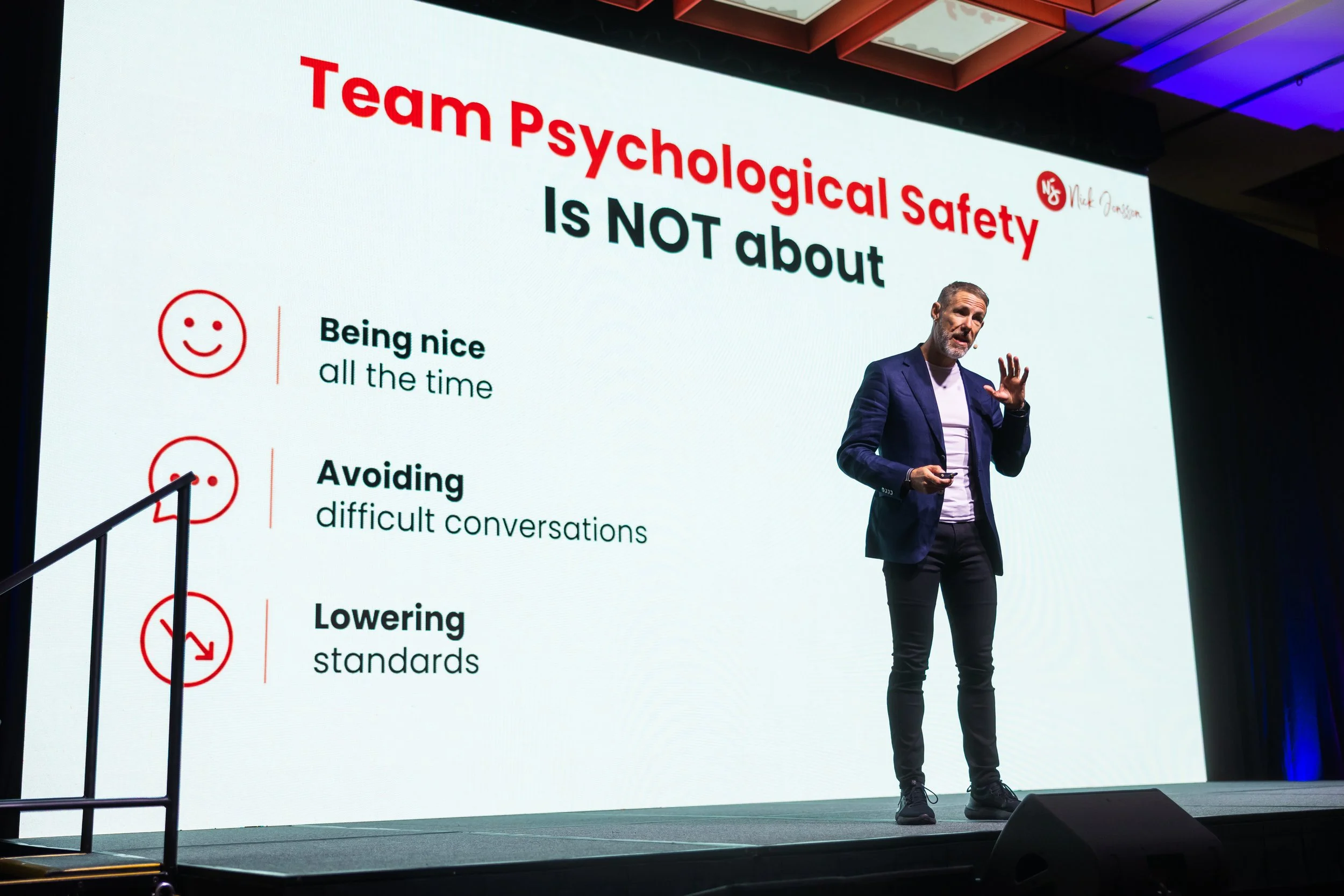
Psychological safety creates the conditions for people to speak honestly, ask for help, admit mistakes, challenge ideas and contribute without fear of humiliation or punishment. It is not about lowering standards or avoiding accountability. It is about enabling candid communication so teams can learn and perform at a higher level.
Nick Jonsson is a Certified Team Psychological Safety Practitioner, global keynote speaker, executive coach, counsellor and psychotherapist. Through keynotes, leadership masterclasses, team assessments and facilitated workshops, he helps organisations in Singapore and internationally move from silence and surface harmony toward trust, constructive challenge and sustainable high performance.
What Is Team Psychological Safety?
Psychological safety is commonly understood as a shared belief that a team is safe for interpersonal risk-taking. In practical terms, it answers a critical question: can people say what needs to be said here?
In a psychologically safe team, people are more willing to:
· Raise concerns before they become larger problems
· Admit an honest mistake and learn from it
· Ask for help without being seen as incapable
· Offer a different perspective or challenge an assumption
· Give and receive candid feedback
· Contribute ideas regardless of rank, personality or background
· Discuss difficult issues rather than allowing silence to grow
Psychological safety does not guarantee agreement, comfort or the absence of conflict. Strong teams can disagree vigorously. The difference is that the disagreement remains respectful and useful, and people are not punished for contributing in good faith.
Why Psychological Safety Matters for Business Performance
When people remain silent, leaders make decisions with incomplete information. Problems travel upward slowly. Teams repeat avoidable mistakes. Innovation declines because people learn that taking a risk is not worth the interpersonal cost.
When people feel safe enough to speak, organisations are better positioned to:
· Identify risks and operational problems earlier
· Learn faster from mistakes
· Improve collaboration across roles and hierarchy
· Invite more diverse thinking into decisions
· Increase employee involvement and ownership
· Strengthen trust between leaders and teams
· Protect safety, quality, reputation and customer experience
· Adapt more effectively during uncertainty and change
This is why psychological safety should not be treated as a soft or purely cultural topic. It is a condition that supports learning, execution and performance.
The Surprising Lesson From High-Performing Teams
One of the most counterintuitive findings in psychological-safety research is that strong teams may report more mistakes, not fewer. That does not necessarily mean they perform worse. It may mean that people feel safer acknowledging what happened.
A low number of reported problems can create false confidence. Silence can make a team look effective while important risks remain hidden. Leaders therefore need to look beyond the number of issues reported and ask whether employees genuinely believe they can raise concerns without damaging their standing.
The leadership response is decisive. When someone brings bad news, challenges an idea or admits an error, the reaction teaches the entire team whether speaking up is truly safe.
Seven Elements of Team Psychological Safety
Nick and his wife and business partner, Dona Amelia, are certified practitioners of the Team.As.One methodology. The approach assesses psychological safety across seven practical elements:
1. Reaction to mistakes: whether honest mistakes are treated as opportunities for learning or reasons for blame.
2. Dealing with issues: whether people can raise problems openly and early.
3. Embracing diversity: whether different perspectives and identities are genuinely welcomed.
4. Taking risks: whether thoughtful interpersonal and professional risk-taking is possible.
5. Asking for help: whether support can be requested without loss of status.
6. Mutual support: whether team members help one another rather than undermine each other.
7. Appreciation: whether people’s skills, contributions and strengths are recognised and used.
These elements move psychological safety from an abstract idea into observable team experience. They also help leaders identify where targeted behaviour change is most needed.
From Measurement to Sustainable Change
A keynote or workshop can create insight and common language, but lasting change requires application. Depending on the organisation’s needs, Nick and Dona can support a journey that includes:
· An anonymous Team Psychological Safety assessment
· Quantitative scores and qualitative team feedback
· A report across the seven elements
· Leadership debriefs and priority identification
· A facilitated team workshop using real workplace situations
· Practical team agreements, behaviours and rituals
· Leadership coaching and follow-up sessions
· Reassessment to review progress over time
This approach enables teams to begin with evidence rather than assumption. Leaders can see where safety is strong, where silence is likely and which behaviours will have the greatest impact.
Four Leadership Behaviours That Build Psychological Safety
Be curious
Ask more than you tell. Questions such as “What are we missing?” and “What concerns have we not discussed?” make space for information that may otherwise remain hidden.
Be humble
Admit when you do not know and acknowledge your own mistakes. Leadership humility reduces the pressure on everyone else to appear perfect.
Recognise courage
Thank people for speaking up, especially when the information is difficult to hear. The first response determines whether they and others will speak again.
Create inclusion
Invite quieter, junior and less represented voices into the discussion. Do not confuse airtime with insight or seniority with accuracy.
Psychological Safety at Marina Bay Sands
In August 2026, Nick facilitated a Team Psychological Safety masterclass for leaders at the Marina Bay Sands Learning Festival - Leadership Edition in Singapore. The session focused on Building Psychological Safety and Care for People to Drive Results.
Leaders explored where silence appears in teams, the organisational cost of information not being shared and the everyday behaviours that influence whether employees speak up. The discussion connected psychological safety with guest experience, safety, innovation, teamwork, trust, engagement, reputation and performance.
Participants concluded by identifying one leadership behaviour they would intentionally practise over the following 30 days. The emphasis was simple: culture is not created only by stated values. It is created by how leaders repeatedly respond in real moments.
Keynotes, Masterclasses and Team Workshops
Psychological safety programmes can be customised for the organisation’s context, audience, desired outcomes and available time.
· Conference keynote: an engaging introduction connecting psychological safety with leadership and business performance.
· Leadership masterclass: an interactive session examining silence, hierarchy, mistakes and the behaviours that build trust.
· Team workshop: a facilitated experience using assessment findings, team dialogue and practical agreements.
· Executive-team session: a focused intervention for senior teams that need more candid challenge, trust and alignment.
· Multi-session transformation: assessment, diagnosis, leadership development, team coaching and reassessment over three to six months.
Topics Can Include
· The cost of organisational silence
· Speaking up across hierarchy
· Leadership reactions to mistakes and bad news
· Trust, vulnerability and accountability
· Psychological safety and high performance
· Inclusive leadership and quieter voices
· Learning behaviours and constructive challenge
· Difficult conversations, feedback and conflict
· Employee experience and customer experience
· Practical team rituals that sustain change
Why Work With Nick Jonsson?
· Certified Team Psychological Safety Practitioner
· Trained in the Team.As.One assessment and development methodology
· Global keynote speaker and experienced leadership facilitator
· Executive coach with ICF PCC and master-coach credentials
· Counsellor and psychotherapist bringing depth to human behaviour and group dynamics
· Author of the international bestseller Executive Loneliness
· Global Gurus Top 30 Coach in 2026
· Experience delivering to senior leaders and international organisations
· Based in Singapore and available across Asia and globally
Nick’s work combines research-informed frameworks with lived experience, practical leadership behaviour and an ability to create conversations in which people participate honestly. Dona Amelia is also available as a facilitator, and programmes can be delivered individually or together depending on the organisation’s needs.
Frequently Asked Questions
Is psychological safety the same as being nice?
No. Psychological safety enables honest conversation, disagreement, accountability and learning. It does not require leaders to avoid difficult feedback or lower performance standards.
Can psychological safety be measured?
Yes. An anonymous team assessment can capture quantitative and qualitative evidence across seven elements, creating a useful baseline for discussion, action and later reassessment.
Who should attend a psychological safety workshop?
Programmes can be designed for executive teams, people leaders, intact teams, cross-functional groups, HR and learning leaders, or broader conference audiences.
Can the programme be customised?
Yes. The examples, exercises, duration and desired outcomes can be adapted to the organisation’s sector, leadership environment, current challenges and level of seniority.
Does Nick deliver outside Singapore?
Yes. Keynotes, workshops and team programmes are available in Singapore, across Asia and internationally, with in-person and selected virtual formats.
Bring Psychological Safety to Your Organisation
If your organisation wants people to raise risks earlier, collaborate more openly, challenge ideas constructively and learn faster from mistakes, psychological safety is an important place to begin.
Contact Nick Jonsson to discuss a psychological safety keynote, leadership masterclass, team assessment or customised workshop in Singapore or internationally.
CALL TO ACTION: ENQUIRE ABOUT A PSYCHOLOGICAL SAFETY PROGRAMME
Or follow Nick on LinkedIn for weekly insights on coaching, leadership, wellbeing, and performance.