

When Life Sends Signs, You're on the Right Path: Nick Jonsson on Not Waiting Until the Final Year

When Life Sends Signs, You're on the Right Path
A powerful keynote on finding your purpose, recognizing life's turning points, living authentically and creating a Limitless Life — before it's too late.
Presented by Nick Jonsson | Royal Caribbean, Quantum of the Seas | French Polynesia, Tahiti | October 2026
What if life has been sending you signs all along?
Have you ever met someone at precisely the right moment in your life?
Perhaps you read a book that changed how you saw the world. A conversation stayed with you for years. An unexpected opportunity appeared just when you were questioning your direction.
Or perhaps you experienced something painful that, looking back, became the beginning of an entirely different chapter.
What if these moments weren't simply things that happened to you?
What if they were invitations to stop, reflect and reconsider the direction of your life?
In his keynote When Life Sends Signs, You're on the Right Path, international keynote speaker, executive coach, author, psychotherapist and counsellor Nick Jonsson explores the encounters, choices and turning points that can help us reconnect with who we are and what matters most.
Drawing on his own journey from corporate success to burnout, depression and recovery, Nick shares how one particular encounter — with internationally recognized executive coach John Mattone — challenged his understanding of success, purpose, relationships and the life he wanted to live.
The presentation combines personal storytelling, leadership lessons, coaching exercises and practical tools, including the Life Compass, the Wheel of Life and the Limitless Life Assessment.
Its central question is simple:
Why wait until the final year of your life to become the person you truly want to be?
A special keynote aboard Quantum of the Seas in French Polynesia
In October 2026, Nick delivered a seven-part enrichment speaker series aboard Royal Caribbean's Quantum of the Seas during its transpacific voyage from Los Angeles across the Pacific toward French Polynesia.
The final presentation, When Life Sends Signs, You're on the Right Path, brought together the major lessons of the preceding six talks.
Throughout the series, guests explored resilience, personal transformation, purpose, gratitude, meaningful relationships, daily habits and the legacy we create through our choices.
The final keynote invited the audience to bring those lessons together and examine a bigger question:
Are we actually living the life we want to live?
Rather than offering another formula for professional success, Nick challenged the audience to reflect on their personal values, important relationships, unfinished conversations, forgotten passions and the experiences they still hope to have.
The presentation concluded with a memorable 100th Birthday Celebration exercise, a personal reflection about Nick's relationship with his son, and an emotional contribution from his wife, Dona Amelia.
For Nick, this seventh talk was not simply the conclusion of a speaking engagement. It represented many of the lessons he had learned through rebuilding his own life.
1. What does it mean when life sends you signs?
We often associate signs with extraordinary events.
But many of life's most meaningful turning points begin with ordinary experiences.
A conversation with a stranger. An unexpected invitation. A book recommendation. A new friendship. A decision to join a community or try an unfamiliar activity.
Sometimes the significance of an experience only becomes apparent years later.
During his keynote, Nick invited the audience to think about moments when they felt they had encountered someone or something for a reason.
He asked them to consider whether they had ever watched a television programme, read a book or met a person who opened a new door in their lives.
The idea is not that every coincidence contains a hidden message or that every unexpected event guarantees we are moving in the right direction.
Rather, it is about developing the self-awareness to recognize opportunities that align with our values, curiosity and personal growth.
A meaningful sign may be something that makes us ask a different question.
It may challenge a belief we have held for decades.
It may remind us of a passion we abandoned.
Or it may encourage us to make a change we have been postponing.
Five ways to recognize meaningful turning points
Pay attention to what creates energy. Notice the people, activities and environments that make you feel engaged and alive.
Be curious about unexpected opportunities. An invitation or conversation may reveal something worth exploring.
Reflect on recurring interests. The subjects and activities you repeatedly return to may offer clues about your values and purpose.
Notice discomfort as well as excitement. Sometimes the realization that something no longer fits is an important invitation to change.
Take action rather than waiting for certainty. A small experiment can tell you more than months of overthinking.
Recognizing signs does not require abandoning rational judgment. It means combining reflection, curiosity and deliberate action.
The most important question is not whether an experience was destined to happen.
It is what we choose to do with it.
2. The encounter with John Mattone that changed Nick's perspective

Nick's journey toward a more intentional life was strongly influenced by his experience studying with executive coach John Mattone.
Through that experience, Nick encountered Mattone's account of working with Steve Jobs, the co-founder of Apple.
At first, Nick expected to learn about extraordinary business performance, leadership, ambition and innovation.
What stayed with him was something far more personal: the importance of relationships, character and the human being behind the professional achievements.
Steve Jobs remains one of the most recognizable business leaders in modern history.
He helped build a company that transformed personal computing, music, smartphones and the way people interact with technology.
He was also known for his intensity, demanding standards and uncompromising approach to work.
During the keynote, Nick retold John Mattone's account of Jobs confronting his mortality and reconsidering aspects of his personal and professional life.
As Nick explained the story, the lessons he drew from it concerned three areas: repairing family relationships, becoming a better husband and improving the way one leads and treats other people.
These were not simply questions about becoming a more effective CEO.
They were questions about becoming a better human being.
Why wait until the final year?
One of the strongest moments in the keynote came when Nick reflected on the implications of that story.
Why should someone need a life-threatening diagnosis before reconsidering how they treat their family?
Why wait until time is running out before apologizing, reconnecting with people or discovering what truly matters?
Why postpone personal growth until professional ambition has finally been satisfied?
Nick began asking those questions of himself.
Rather than treating the story as an interesting lesson about a famous entrepreneur, he decided to act.
He pursued John Mattone's coaching programme and began exploring his own purpose, values, relationships and personal identity.
That decision became part of a much larger process of transformation.
The leadership lesson: Achievement and fulfilment are not the same thing
Professional success can bring financial security, recognition, influence and opportunities.
There is nothing inherently wrong with ambition or achievement.
But success in one part of life does not automatically create fulfilment in every other part.
A person may be financially successful and emotionally disconnected.
A leader may be respected professionally but absent from family life.
Someone may spend decades building a career only to discover that the activities and relationships they once loved have gradually disappeared.
The answer is not to abandon ambition.
It is to broaden our definition of success.
Success can include meaningful work, strong relationships, physical wellbeing, emotional health, contribution, enjoyment and a sense of purpose.
The goal is to build a life in which professional achievements support our wellbeing rather than consistently come at its expense.
3. Be less impressive. Be more real.
For much of his earlier career, Nick pursued the external markers of success.
Corporate titles. Targets. Professional recognition. The appearance of confidence.
He wanted to meet expectations and demonstrate that he was capable.
Yet behind the professional image, he was increasingly disconnected from himself.
He struggled to acknowledge difficulties, ask for support or admit that his life was becoming unmanageable.
As he explained during the audience Q&A, he was working hard to appear successful on the outside while experiencing significant challenges internally.
Over time, the pressure contributed to isolation, deteriorating wellbeing and a major personal breakdown.
He lost important parts of the life he had worked so hard to build.
His recovery required him to reconsider not only what he wanted to achieve, but who he wanted to become.
Authenticity is not the opposite of ambition
Authentic leadership does not mean giving up on goals, standards or accountability.
It means being willing to acknowledge that leaders are human.
They experience uncertainty, stress, mistakes, emotional challenges and moments when they need help.
Authenticity allows people to communicate more openly, build trust and create relationships that are not entirely dependent on performance.
For Nick, this became one of the central lessons of his transformation:
Be less impressive.
Be more real.
The invitation is not to stop achieving.
It is to stop believing that we must always appear successful, strong and in control to deserve respect, connection or belonging.
4. Rediscover who you were before the world told you who to become
One of the most practical and revealing parts of Nick's coaching journey involved looking back at his childhood.
During his training with John Mattone, he was encouraged to reflect on the person he had been before the expectations of school, employers, society and professional life became dominant.
What had he naturally enjoyed?
What made him curious?
Which activities came easily?
What did he love before he began worrying about achievement, recognition and other people's approval?
Initially, Nick found these questions surprisingly difficult.
He had spent so many years focused on the future that he had lost touch with parts of his past.
The childhood photographs that reopened forgotten memories
Nick contacted his mother in Sweden and asked her to help him rediscover his childhood.
She began collecting photographs, memories and stories from relatives and friends.
This was especially meaningful because the family had experienced a house fire, and many childhood possessions and photographs had been lost.
Nevertheless, his mother was able to gather surviving images and reconstruct memories that had faded over time.
Nick also revisited places in Sweden where he had grown up.
Walking through familiar neighbourhoods helped him reconnect with the young boy he once was.
It was not simply an exercise in nostalgia.
It was a way of understanding the interests, qualities and experiences that had shaped him before adult responsibilities took over.
Reconnecting with cycling and sport
Through this process, Nick rediscovered his connection with cycling and physical activity.
Today, endurance sport and IRONMAN triathlon are important parts of his life.
They provide far more than fitness.
They create opportunities for friendship, community, challenge, discipline, personal growth and time away from professional responsibilities.
For Nick, cycling can also provide a sense of freedom and an opportunity to recharge.
What began as a childhood interest became part of his adult wellbeing and identity.
A practical exercise: Reconnect with your younger self
Think about the person you were before professional responsibilities became central to your life.
Ask yourself:
What did I naturally enjoy as a child?
Which activities made me lose track of time?
What did people say I was naturally good at?
Which interests have I abandoned because I became too busy?
What childhood passion could I reconnect with today?
Who could help me remember parts of my early life?
You might speak with a parent, sibling, childhood friend or former classmate.
You could revisit an old neighbourhood, look through photographs or return to an activity you once enjoyed.
The purpose is not to recreate your childhood.
It is to rediscover aspects of yourself that may still have a meaningful place in your life today.
5. How to find your purpose in life
Finding purpose is often presented as a search for one extraordinary calling.
Nick takes a different approach.
He believes people can have multiple purposes across different stages and areas of life.
A person may find purpose through family, meaningful work, volunteering, sport, mentoring, learning, creativity, community involvement or helping others.
These purposes can evolve.
The activities that gave someone meaning at 25 may be different from those that matter most at 65.
The challenge is not necessarily to discover one permanent answer.
It is to remain curious about what makes life meaningful.
Seven questions to help you discover your purpose
These questions reflect the exercises Nick explored during his keynote and coaching journey.
1. What have you always been naturally good at?
Think about abilities that come relatively easily to you, including skills others frequently ask you to share.
2. What activities make you lose track of time?
Consider the experiences that fully absorb your attention and leave you feeling energized.
3. Which life experiences have shaped you most deeply?
Reflect on challenges, achievements, losses, relationships and turning points that have influenced who you are.
4. What problems do you feel called to help others solve?
Think about the difficulties you notice in the world and where you feel motivated to contribute.
5. What would you continue doing without recognition or payment?
Explore the activities you value independently of status, income or applause.
6. What impact do you want to have on others?
Consider the difference you hope to make in your family, workplace, community or wider society.
7. What do you want your life to stand for?
Look beyond your job title and achievements. What values and contributions do you hope people will remember?
Nick's personal life purpose

After a long process of reflection and refinement, Nick developed the following purpose statement:
"Empowering people to build a Limitless Life through Vulnerability & Holistic Wellbeing."
Nick Jonsson — Personal Life Purpose
This purpose connects his work as an executive coach, speaker, psychotherapist, counsellor and author.
It reflects his experience of struggling behind a mask of success and discovering the importance of asking for help, building meaningful connections and addressing wellbeing across different areas of life.
It also guides the way he works with clients.
His intention is to create environments where people feel safe enough to discuss their challenges openly, explore what matters to them and take practical steps toward meaningful change.
Purpose is not just a statement
During the presentation, Nick emphasized that writing a purpose statement is only the beginning.
"The purpose is not a slogan. It's not just something we put there. We have to also actually do it."
A purpose statement becomes useful when it influences decisions.
It can help us choose how we spend our time, which opportunities to pursue, which relationships to invest in and which commitments no longer fit.
Purpose gives direction.
But we still need tools to help us stay aligned with it.
6. The Life Compass: A practical tool for living in alignment

Purpose gives us direction. The Life Compass helps us stay aligned.
Nick developed the Life Compass as a practical reflection tool to help people connect their purpose with everyday choices.
It is designed to make personal priorities visible rather than leaving them as vague intentions.
The framework encourages reflection on four important elements.
Your North Star: Life purpose
At the centre of the compass is your personal sense of purpose.
What are you working toward?
What gives your life meaning?
What kind of person do you want to become?
Your purpose provides an overall direction against which important choices can be evaluated.
Your core values
Values represent the principles you want to live by.
They might include honesty, authenticity, compassion, service, courage, learning, family or connection.
The important question is not simply which values sound attractive.
It is whether your daily actions reflect them.
For example, someone who identifies family as a core value but consistently sacrifices family time for work may discover a gap between their intentions and behaviour.
Your core people
Relationships play a major role in wellbeing.
The Life Compass encourages people to identify those who provide encouragement, connection, positive energy and meaningful support.
Who helps you become your best self?
Who do you want to spend more time with?
Who might need more of your attention?
Nick encourages people to identify five important individuals they want to prioritize.
This does not mean excluding others. It means becoming more intentional about nurturing the relationships that matter.
Your core activities
These are the activities that contribute to your energy, fulfilment and wellbeing.
For Nick, they include endurance sport, meaningful conversations, personal development and helping others.
For someone else, they might include gardening, music, walking, painting, volunteering, travel or spending time with grandchildren.
The aim is to make space for activities that enrich your life rather than allowing every available hour to be consumed by obligations.
How to use your Life Compass
Once you have identified your purpose, values, important people and energizing activities, use them as a guide when making decisions.
Before accepting a major commitment, ask:
Does this align with my purpose?
Does it reflect my values?
Will it strengthen or weaken important relationships?
Will it support my wellbeing?
Does it move me toward the life I want to build?
The Life Compass is not intended to eliminate uncertainty.
It is a way to make decisions with greater self-awareness.
7. The Wheel of Life and Limitless Life Assessment: Seeing the bigger picture
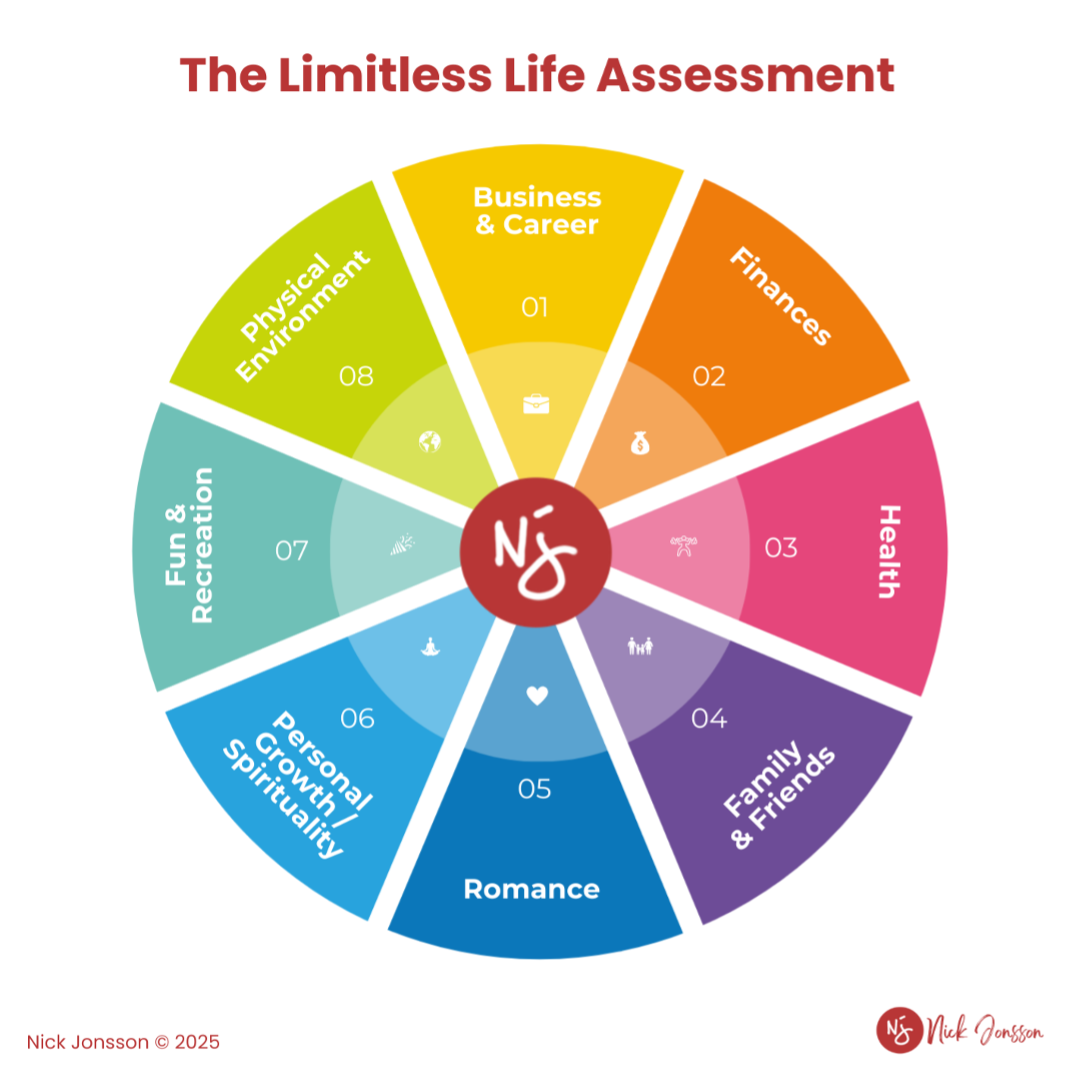
The Life Compass helps us stay aligned. The Wheel of Life helps us see the bigger picture.
Many people become highly successful in one area of life while gradually neglecting others.
Work may consume most of their attention.
Physical health may deteriorate.
Friendships may fade.
Relationships may become strained.
Personal interests may disappear.
The Wheel of Life is a coaching tool that helps individuals examine satisfaction across different dimensions of their lives.
Nick uses this approach through his Limitless Life Assessment.
The aim is to create greater awareness of where life is going well and where change may be needed.
The eight areas of the Limitless Life Assessment
Business & Career
Meaning, satisfaction and progress in professional life.
Finances
Financial wellbeing, security and confidence.
Health
Physical, mental and emotional wellbeing.
Family & Friends
The quality of personal relationships and social connection.
Romance
Intimacy, partnership and relationship fulfilment.
Personal Growth, Contribution & Spirituality
Learning, meaning, contribution and inner development.
Fun & Recreation
Enjoyment, hobbies, leisure and opportunities to recharge.
Physical Environment
The quality and suitability of the places where you live and work.
Try a simplified Life Wheel assessment
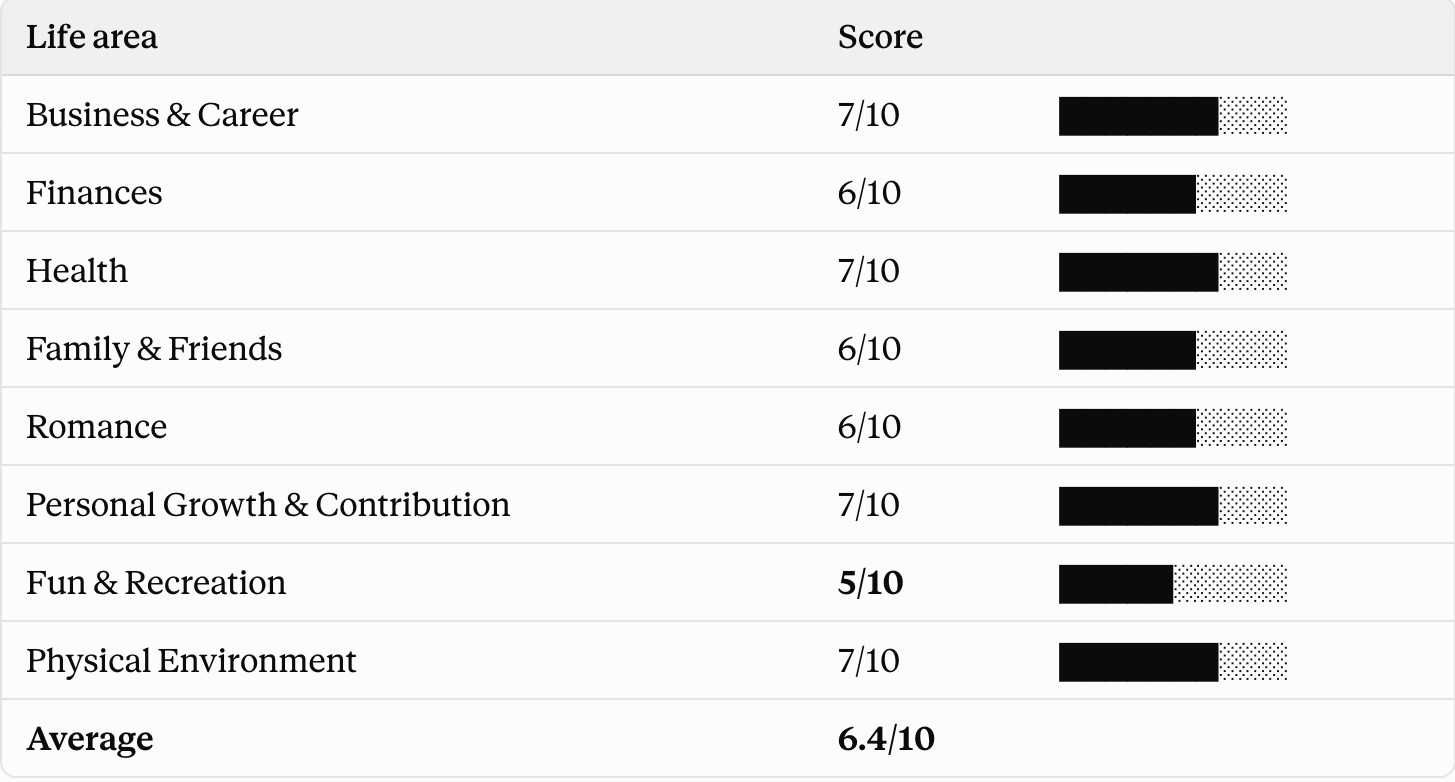
Rate your current satisfaction in each area from 1 to 10. This interactive exercise is a simplified illustration; Nick's original Limitless Life Assessment can be provided separately.
Your Life Wheel - Adjust each area to reflect how satisfied you feel today.
Your reflection
Your lowest-rated area is Fun & Recreation. What one realistic action could help improve your satisfaction in this area over the next 30 days?
These are subjective reflection scores, not a clinical or validated wellbeing measure. The average is descriptive, not a measure of overall life quality.
From awareness to action
The value of the exercise comes from what happens after the assessment.
First, identify the areas where you are most satisfied.
Then examine the areas that need attention.
Consider the gap between your current situation and where you would like to be.
Choose realistic goals that can help you move forward.
For example, someone who rates family relationships poorly may decide to schedule a regular conversation or shared activity.
Someone who feels disconnected from recreation may return to a forgotten hobby.
Someone dissatisfied with physical health may begin with regular walking, improved sleep or appropriate professional support.
The objective is not to achieve a perfect score in every area.
It is to create a more intentional and sustainable balance that reflects your circumstances and priorities.
8. The 100th Birthday Celebration: What do you want people to say about you?

Near the conclusion of his final keynote, Nick invited the audience to participate in an unusual celebration.
The familiar Happy Birthday song began playing.
Then he asked everyone to imagine that they were celebrating their 100th birthday.
The room was filled with family, friends and people who had been important throughout their lives.
There was no need to worry about the cost of the party.
Everyone they wanted to see had been invited.
And now, one by one, those people were standing up to speak.
They were sharing memories, expressing gratitude and describing the difference the birthday guest had made in their lives.
The five questions that change your perspective
Nick invited the audience to reflect:
What would you want the people closest to you to say about you?
How would you want them to describe the way you made them feel?
What would you want your life to have stood for?
What would you be most proud of as you listened to their stories?
Based on those answers, what would you do differently starting today?
This exercise invites us to look at life from the perspective of its final chapters.
Instead of asking only what we want to accomplish, we begin asking what we want our lives to mean.
Instead of focusing exclusively on what we want to own, we think about the relationships we want to nurture.
Instead of postponing important decisions, we consider what we can change now.
"I wasn't always there, but I learned to show up."
Nick then shared his own reflection.
"I wasn't always there, but I learned to show up."
This statement carried a deeply personal meaning.
During the most difficult years of his life, Nick experienced severe mental health challenges, depression and personal breakdown.
He described a period of approximately three years when he was absent from his son's life.
Looking back, he does not pretend that those years never happened.
He recognizes the pain, the missed opportunities and the impact of his struggles.
But he also believes that the past does not have to determine the entire future.
He wants his son to know that he learned, changed and made the effort to become more present.
He wants the people in his life to remember not simply his professional achievements, but the way he eventually learned to show up for others.
This is what makes the 100th Birthday exercise so powerful.
It moves the conversation away from abstract goals and toward the people whose lives are affected by our everyday choices.
Your worst chapter does not have to become your final chapter
Nick also reflected on his journey from chasing success behind a professional mask to living more openly and authentically.
He hopes people will recognize that he learned from his mistakes and used difficult experiences to help others.
This is an important message for anyone who feels regret about earlier decisions.
You cannot rewrite the past.
But you can take responsibility for your actions, repair what can be repaired and choose how to live from this point forward.
The next chapter can be different.
9. A personal moment with Dona Amelia

One of the most touching moments in the presentation occurred when Nick invited his wife, Dona Amelia, to share her reflections.
Dona had accompanied Nick throughout the voyage and supported him during the seven-part speaking series.
She also knew the story behind the public presentations.
She had witnessed his transformation and the work required to rebuild his life.
When invited to speak, Dona expressed her gratitude for their relationship and described how watching Nick change had inspired her own personal growth.
She also shared her hope that, at her own 100th birthday celebration, her family would recognize how deeply she loved them and how much she had tried to do for them.
Her contribution reinforced the keynote's central message.
A meaningful life is not simply about what we achieve individually.
It is also about how we grow together, support each other and contribute to the wellbeing of the people around us.
Relationships require understanding, not sameness
Earlier in the presentation, Nick had described how he and Dona have different personalities.
Nick is an introvert who sometimes needs quiet time to recharge.
Dona is more extroverted and gains energy from being around people.
During a stop in Hawaii, Dona wanted to explore Honolulu and visit museums, while Nick chose to spend time alone, enjoying the hotel and recharging.
Rather than viewing those differences as a problem, they had learned to respect each other's needs.
For Nick, that is an example of self-awareness and relationship wellbeing.
Healthy relationships do not require people to have identical personalities or preferences.
They require communication, understanding, respect and a willingness to support one another.
10. Holistic wellbeing: Why success must include the whole person
During the audience Q&A, a guest asked Nick to explain the meaning of holistic in everyday language.
Nick described holistic wellbeing through three closely connected dimensions:
Physical health
Movement, fitness, sleep, nutrition and caring for the body.
Mental health
Emotional wellbeing, self-awareness, resilience and seeking support when needed.
Social health
Meaningful relationships, belonging, connection and the ability to ask for help.
These areas are interconnected.
A person experiencing prolonged stress may struggle to sleep.
Poor sleep can affect concentration, energy and emotional regulation.
Isolation may make difficult experiences harder to manage.
Relationship problems can influence professional performance.
Likewise, positive changes in one area can support progress in others.
Why we cannot leave our emotions at the office door
Nick recalled an older approach to workplace culture in which employees were often expected to leave their personal problems at home.
He challenged that assumption.
Human beings cannot simply separate their emotions from their professional responsibilities.
Someone who has experienced a family conflict, slept poorly or is dealing with significant personal difficulties may find it harder to concentrate or perform at their usual level.
Holistic leadership recognizes this reality.
It encourages leaders to understand the whole person while maintaining appropriate professional boundaries, responsibilities and accountability.
It also encourages individuals to take responsibility for their own wellbeing and seek support when necessary.
What holistic leadership looks like in practice
Holistic leadership can include creating psychologically safer conversations, encouraging healthy boundaries, supporting meaningful connections, recognizing signs of excessive stress and acknowledging that sustainable performance depends on more than professional skill.
It also means looking honestly at how leadership responsibilities affect personal relationships, health and life outside work.
The objective is not to turn managers into therapists.
It is to create working environments where people can perform effectively without feeling compelled to hide every difficulty behind an image of constant strength.
11. The five steps to holistic leadership and a Limitless Life
Across his seven-talk series, Nick revisited the five principles that helped him transform his own life.
These principles also form the foundation of his wider holistic leadership philosophy.
1
Surrender — Let go of what no longer serves you
Transformation begins with honest self-reflection. What habits, behaviours, beliefs or coping mechanisms are preventing you from living well? For Nick, surrender involved acknowledging his difficulties and making substantial changes to his lifestyle and relationship with alcohol.
2
Purpose — Discover what gives your life meaning
Move beyond simply meeting external expectations. Explore your interests, values, abilities and the difference you want to make. Purpose provides direction and helps you evaluate opportunities.
3
Connection — Build meaningful relationships
Remove the mask of constant self-sufficiency. Develop authentic relationships, participate in supportive communities and become more comfortable asking for help. Connection is central to Nick's work on executive loneliness and personal wellbeing.
4
Goals — Create direction across your whole life
Set meaningful goals beyond professional achievement. Consider health, relationships, finances, recreation, personal growth and the other areas that contribute to your overall quality of life.
5
Discipline — Turn intentions into consistent action
Sustainable change requires ongoing practice, supportive routines and accountability. Discipline is not about doing everything alone. It is about creating systems and relationships that help you follow through.
Together, these five steps provide a practical foundation for personal transformation and holistic leadership.
They are not presented as a guaranteed solution to every challenge.
They are principles Nick developed from his lived experience and his work helping others navigate difficult transitions.
12. How do you know when you are on the right path in life?
Being on the right path does not mean everything will go according to plan.
There will still be setbacks, difficult decisions, disappointments and periods of uncertainty.
Nick experienced this personally.
During his keynote, he described how his darkest years eventually became a turning point in his life.
At the time, he could not have imagined the life he would later build.
He was struggling with depression, alcohol addiction, isolation and the loss of important relationships.
Yet through recovery, connection, support and sustained personal change, he gradually developed a new direction.
Today, he works with others facing challenges of their own.
His experiences have become part of his purpose.
Six signs you may be moving in the right direction
You are becoming more authentic. You feel less pressure to impress others and more comfortable being yourself.
Your choices increasingly reflect your values. You are spending more time on what genuinely matters.
You are developing meaningful relationships. You feel more connected and are willing to give and receive support.
You have a clearer sense of purpose. You understand why your goals matter, not just what you want to achieve.
You are taking responsibility for your wellbeing. You recognize the importance of physical, mental and social health.
You are willing to grow through challenges. Difficult experiences become opportunities for reflection and learning, even when they remain painful.
None of these signs guarantees a particular outcome.
But together, they can indicate that you are living with greater intention.
The difference between drifting and designing your life
Without reflection, it is easy to follow routines and expectations that no longer fit.
We may continue pursuing goals simply because we have always pursued them.
We may spend time on activities that no longer bring us satisfaction.
We may postpone important conversations because there never seems to be a convenient moment.
Living intentionally means examining those patterns.
It means asking whether the direction of our lives reflects our current priorities.
And it means having the courage to make adjustments.
13. When personal transformation becomes a source of hope for others
One of the most meaningful outcomes of the seven-part enrichment series was the feedback Nick received from guests aboard Quantum of the Seas.
For Nick, speaking is not simply about delivering information or motivating an audience for an hour.
It is about encouraging people to reflect on their lives, reconnect with what matters and take practical steps toward positive change.
A handwritten message from Jeannette
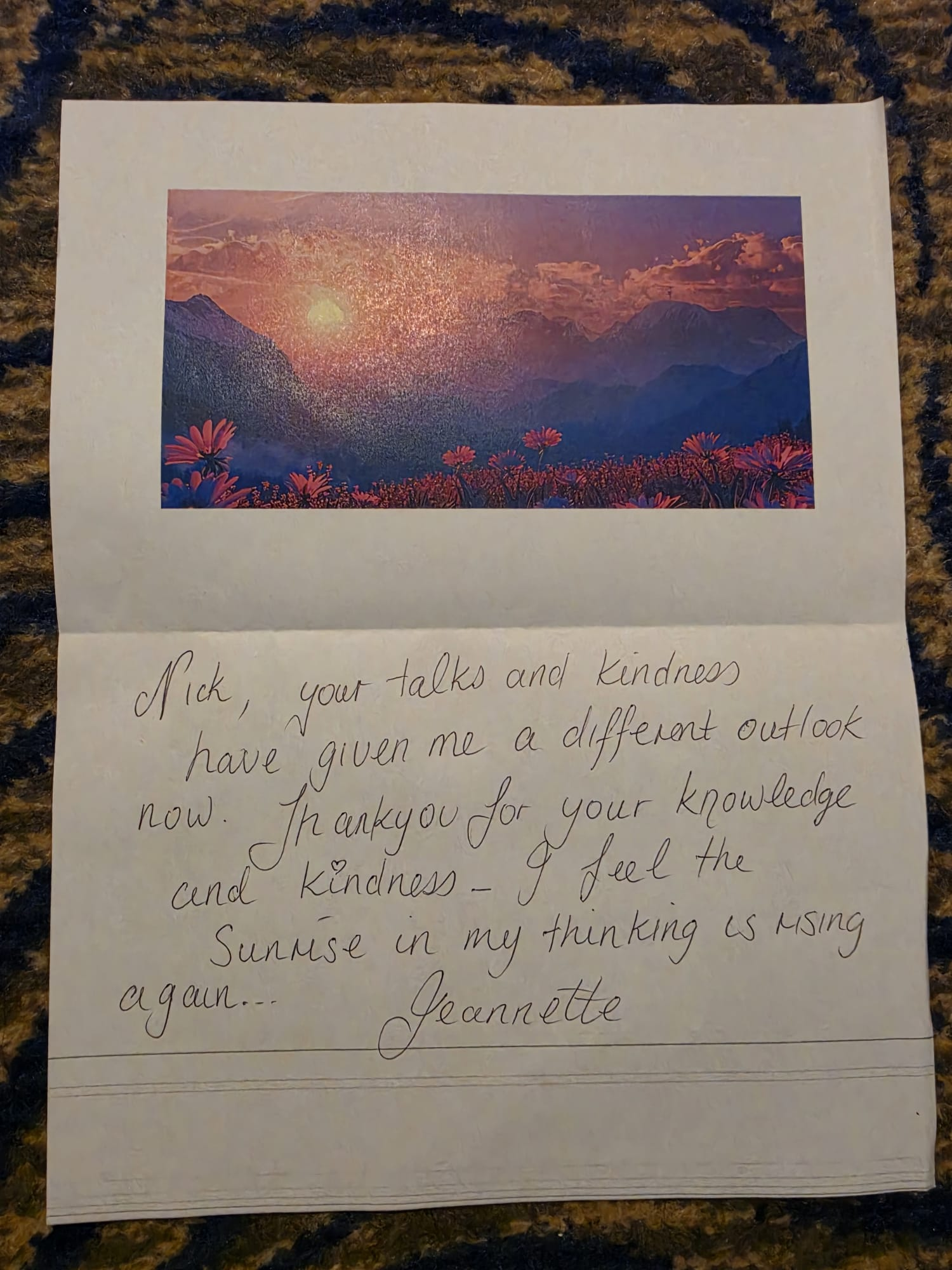
A personal note received during the transpacific cruise
"Nick, your talks and kindness have given me a different outlook now."
Jeannette's handwritten message thanked Nick for his knowledge and kindness and described a renewed sense of hope, using the image of a sunrise in her thinking.
The message was accompanied by a beautiful image of a sunrise over a mountain landscape.
It was a fitting reflection of the presentation's central theme: sometimes an experience or conversation helps us see life from a different perspective.
Designer instruction: Display the original photograph of Jeannette's handwritten note here, with her permission. Suggested alt text: “Handwritten thank-you card from cruise guest Jeannette describing how Nick Jonsson's talks helped her develop a new outlook on life.”
A professional endorsement from a hospitality industry leader
Another guest, with more than three decades of experience in hospitality, shared the following testimonial:
"With over 30 years of experience in the hospitality industry, I have attended numerous presentations and professional development programs. The enrichment series presented by Niklas (Nick) Jonsson on improving personal and professional performance during my transpacific cruise stands out as one of the most exceptional and impactful speaker-led programs I have experienced.
Nick combined practical insights with real-life examples of both successes and failures, making his message relatable, engaging, and inspiring. His approach encouraged me to reassess my own life's direction, refine the way I approach new projects, and establish clear, achievable goals.
What truly distinguishes Nick was his ability to demonstrate not only what is possible, but also how to take the necessary steps to turn aspirations into reality. His methods are practical, actionable, and relevant at any stage of life or career.
I highly recommend Nick Jonsson to any organization or audience seeking an engaging and insightful speaker who can inspire meaningful personal growth, professional development, and positive change."
Audience testimonial — Royal Caribbean transpacific enrichment series, October 2026
This feedback reflects an important aspect of Nick's approach.
His presentations combine personal vulnerability with practical tools.
Rather than suggesting that meaningful change happens through inspiration alone, he encourages audiences to translate reflection into achievable goals, supportive habits and deliberate action.
14. What the audience asked: Real questions from the final keynote
The final presentation concluded with an audience Q&A.
Two questions in particular connected directly with the wider themes of the series.
What caused Nick's depression, and how did he recover?
Nick explained that he had spent years pursuing professional success while concealing his difficulties.
He described the pressure to meet corporate expectations, the fear of admitting that he was struggling and his reluctance to ask for help.
As his circumstances deteriorated, he became increasingly isolated.
His physical health, relationships and emotional wellbeing suffered.
Recovery was not a single moment or a simple decision to become positive.
It involved acknowledging his difficulties, accepting help, changing harmful behaviours, rebuilding connections and developing a more sustainable approach to life.
His story illustrates the dangers of allowing professional identity to become disconnected from personal wellbeing.
It also demonstrates that recovery and meaningful change are possible, although every person's circumstances and needs are different.
What does holistic wellbeing mean in simple terms?
Holistic wellbeing means considering the whole person rather than focusing on only one dimension of life.
Physical health, mental wellbeing, relationships, work, purpose and lifestyle can influence one another.
For example, someone who is physically fit but chronically isolated may still struggle with wellbeing.
A financially successful executive experiencing prolonged emotional distress may not feel fulfilled.
Holistic wellbeing encourages us to recognize these connections and make choices that support a healthier overall life.
It also recognizes that some challenges require appropriate professional support.
15. Frequently asked questions about life's signs, purpose and holistic leadership
These questions are designed to help readers find practical answers and explore the themes of Nick's keynote in greater depth.
What does it mean when life sends you signs?
It refers to experiences, encounters or realizations that prompt you to reconsider your direction. These may include unexpected opportunities, meaningful conversations, personal challenges or renewed interests. Their significance often comes from how you interpret and act on them.
How do I know whether I am on the right path in life?
Consider whether your daily choices align with your values, purpose, relationships and wellbeing. Being on the right path does not mean avoiding challenges. It means developing a clearer sense of direction and making choices that reflect what matters to you.
Can meeting someone unexpectedly change your life?
Yes. Meaningful relationships and conversations can introduce new perspectives, opportunities and ways of thinking. Nick's experience with John Mattone illustrates how an encounter can encourage deeper reflection and personal change.
Why do some people feel lost despite being successful?
External achievement does not necessarily satisfy emotional, relational or personal needs. Someone may achieve professional goals while neglecting health, relationships, recreation or purpose. Examining the whole life can help reveal these gaps.
How can I discover my purpose after 50?
Begin by exploring your values, interests, natural abilities and meaningful experiences. Consider what you enjoy, what you want to contribute and which activities you may have neglected. Purpose can evolve throughout life, including during retirement and later adulthood.
Is it too late to change your life at 60 or 70?
No. People can develop new interests, relationships, routines and sources of meaning at many stages of life. The possibilities will depend on individual circumstances, but age alone does not eliminate opportunities for personal growth.
Can you have more than one life purpose?
Yes. Purpose does not have to be limited to a single career or calling. Someone may find meaning through family, volunteering, creative activities, sport, mentoring and community involvement. Different purposes may become more important at different stages of life.
How do childhood interests help reveal adult purpose?
Childhood interests can offer clues about activities that once felt natural, enjoyable or meaningful. Revisiting them may help reconnect people with neglected parts of their identity, although not every childhood interest needs to become an adult goal.

What is a Life Compass?
A Life Compass is a personal reflection tool that helps people identify their purpose, core values, important relationships and energizing activities. These elements can be used to evaluate decisions and create greater alignment between intentions and everyday behaviour.
What is the Wheel of Life?
The Wheel of Life is a coaching exercise that helps individuals reflect on their satisfaction across different areas of life. It provides a visual overview of strengths, gaps and potential priorities for change.
What is the Limitless Life Assessment?
Nick Jonsson's Limitless Life Assessment is his approach to examining eight important areas of life, including career, finances, health, relationships, personal growth, recreation and environment. It helps people identify priorities and set meaningful goals.
What is holistic leadership?
Holistic leadership is an approach that recognizes the connection between professional performance, physical wellbeing, mental health, social relationships and personal purpose. It encourages sustainable performance without overlooking the human needs of leaders and teams.
Why is vulnerability important in leadership?
Appropriate vulnerability can help leaders communicate authentically, acknowledge uncertainty and create greater trust. It does not mean sharing every personal difficulty at work. It means being honest and human while maintaining sound judgment and professional boundaries.
What is executive loneliness?
Executive loneliness refers to the isolation that leaders may experience because of their responsibilities, perceived expectations or limited opportunities for honest conversation. It can affect people even when they are surrounded by colleagues and professional contacts.
How can leaders prevent burnout?
Helpful approaches may include reviewing workloads, maintaining boundaries, seeking support, prioritizing sleep and physical health, strengthening relationships and addressing workplace conditions that contribute to excessive stress. Persistent symptoms should be discussed with an appropriate healthcare professional.
Why are relationships important for a meaningful life?
Relationships can provide belonging, emotional support, companionship and opportunities to contribute to others. Strong connections are an important component of wellbeing, although the number and type of relationships people need can vary.
What is the 100th Birthday exercise?
It is a reflection exercise in which you imagine celebrating your 100th birthday while loved ones describe the impact you have had on their lives. The exercise encourages you to consider your values, relationships, legacy and what you may want to change today.
How can I stop postponing important life changes?
Identify one meaningful priority, define a manageable first step and choose when you will act. Sharing your intention with a trusted person or coach can provide support and accountability. You do not need a complete life plan before beginning.
What does "be less impressive, be more real" mean?
It means placing greater value on authenticity, meaningful relationships and personal integrity rather than constantly trying to appear successful or flawless. It encourages people to pursue achievement without losing connection with themselves and others.
Can difficult experiences become turning points?
They can, although not every difficult experience leads to growth or has a positive meaning. With appropriate support, reflection and time, some people discover new priorities, strengths or directions following adversity.
How can I reconnect with myself after years of focusing on work?
Reflect on your values, revisit interests, spend time with supportive people and examine how your daily routine affects your wellbeing. Tools such as the Life Compass and Wheel of Life can help make priorities clearer.
What can I do today to begin living a more meaningful life?
Choose one action that reflects an important value. It might be calling someone you care about, asking for help, returning to an enjoyable activity, apologizing for a mistake or making time for your health.
What makes Nick Jonsson's keynote different from a traditional motivational talk?
Nick combines his personal experiences of corporate leadership, burnout and recovery with coaching frameworks and reflection exercises. His approach emphasizes practical application rather than inspiration alone.
Is this keynote suitable for corporate leadership events?
Yes. Its themes are relevant to executives, leadership teams and organizations exploring authentic leadership, wellbeing, purpose, sustainable performance and personal transformation. The content can be adapted to different audiences and event formats.
Can the keynote be adapted for retirement or later-life audiences?
Yes. Themes such as rediscovering purpose, reconnecting with interests, maintaining relationships and reflecting on legacy can be particularly relevant to people approaching retirement or exploring a new life chapter.
Does Nick Jonsson offer workshops based on these concepts?
Yes. Nick's coaching and facilitation work includes purpose exploration, holistic leadership, personal reflection, team development and wellbeing. Workshop formats and scope can be discussed according to the needs of the organization or group.
Book Nick Jonsson for your next leadership event

When Life Sends Signs, You're on the Right Path can be delivered as an inspirational keynote or adapted into a more interactive session.
The presentation is particularly relevant for leadership conferences, executive retreats, corporate wellbeing events, professional associations, personal development programmes and audiences navigating significant life transitions.
Nick brings together lived experience, professional coaching expertise and practical tools to help audiences think differently about success, purpose and the choices that shape their lives.
Key audience takeaways
Participants are invited to:
Reconsider their personal definition of success.
Identify the values and relationships that matter most.
Explore their purpose and reconnect with forgotten interests.
Understand the relationship between achievement and holistic wellbeing.
Use practical reflection tools to identify priorities.
Recognize meaningful opportunities for personal growth.
Take one concrete step toward a more intentional life.
About Nick Jonsson
Nick Jonsson is an international keynote speaker, executive coach, author, psychotherapist and counsellor whose work focuses on executive loneliness, authentic leadership, psychological safety, resilience and holistic wellbeing.
He is the author of the international bestseller Executive Loneliness and holds professional coaching and counselling qualifications, including ICF Professional Certified Coach (PCC), Certified Master Coach (CMC) and a Postgraduate Diploma in Counselling and Psychotherapy.
Drawing on his own journey from corporate leadership through personal crisis and recovery, Nick helps individuals and organizations explore what it means to achieve success without sacrificing connection, purpose or wellbeing.
His personal mission is:
Empowering people to build a Limitless Life through Vulnerability & Holistic Wellbeing.
For keynote speaking, executive coaching, team facilitation and workshop enquiries, visit nickjonsson.com or email nick@nickjonsson.com.
Bring this keynote to your next event
Explore how Nick can adapt the presentation for your audience, leadership team or organization.
Enquire about booking Nick
A final reflection: Don't wait for the final year
There is something powerful about imagining the end of life while we still have time to make changes.
We begin to see our priorities differently.
Professional achievements remain meaningful, but so do the people we love.
Goals matter, but so does our health.
Ambition matters, but so do connection, purpose and the way we treat others.
We cannot control every event or guarantee how our lives will unfold.
But we can choose how we respond to the opportunities and challenges in front of us.
We can reconnect with someone.
We can ask for help.
We can return to an old passion.
We can begin repairing a relationship.
We can make time for what matters.
And we can begin today.
Don't wait until the final year of your life to start living the life you truly want.
Or follow Nick on LinkedIn for weekly insights on coaching, leadership, wellbeing, and performance.