Psychological Safety at Work: Why a Quiet Team Is Not a High-Performing Team
Inside Nick Jonsson's ARTDO International webinar on building a culture where every voice matters
What happens when someone sees a problem but does not feel safe enough to say something?
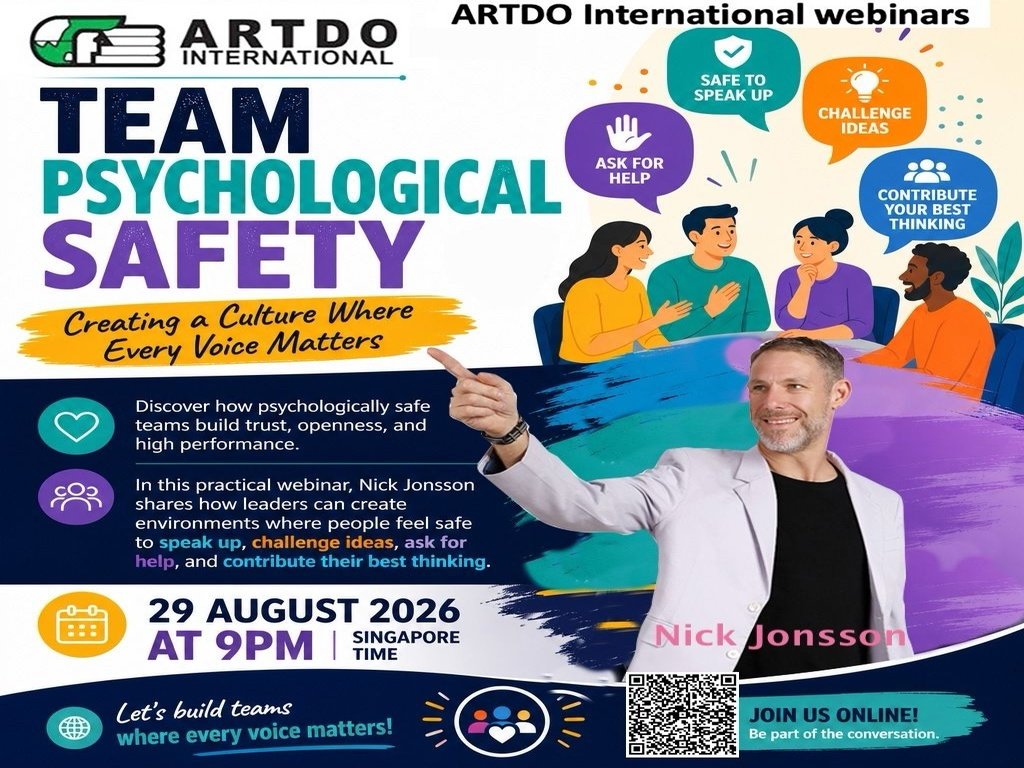
On 29 August 2026, international speaker and Certified Team Psychological Safety Practitioner Nick Jonsson led an interactive ARTDO International webinar titled Team Psychological Safety: Creating a Culture Where Every Voice Matters.
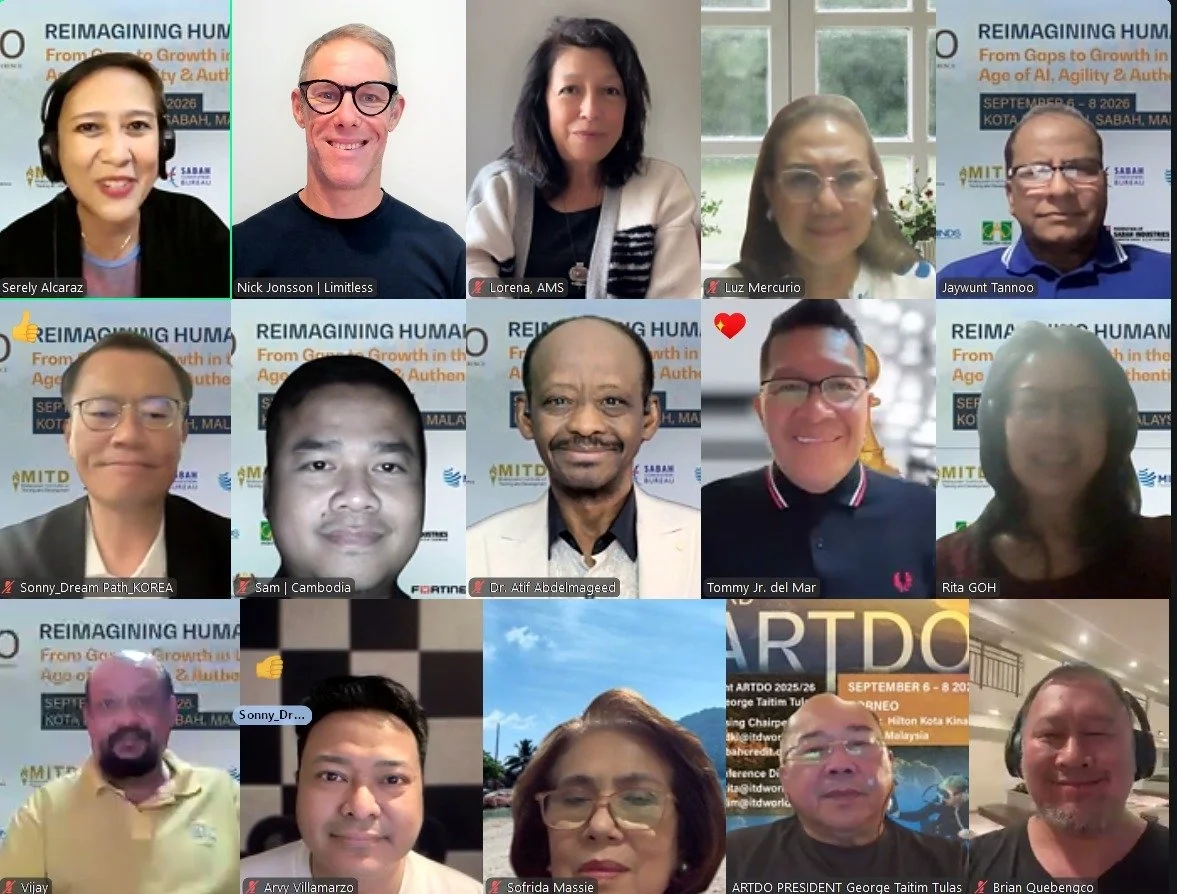
The virtual session brought together leaders, trainers and organisational development professionals from around the world, with participants joining from Singapore, Malaysia, Mauritius, Cambodia, the Philippines and South Korea.
Drawing on leadership research, organisational examples and deeply personal stories, Nick explored how psychologically safe teams build trust, raise concerns earlier, challenge ideas constructively and learn from their mistakes.
The central message was blunt. The most damaging information in an organisation is usually not what leaders hear. It is what people decide not to say.
Psychological Safety Is Not About Being Nice
Nick opened by dismantling the most common misunderstanding about the term.
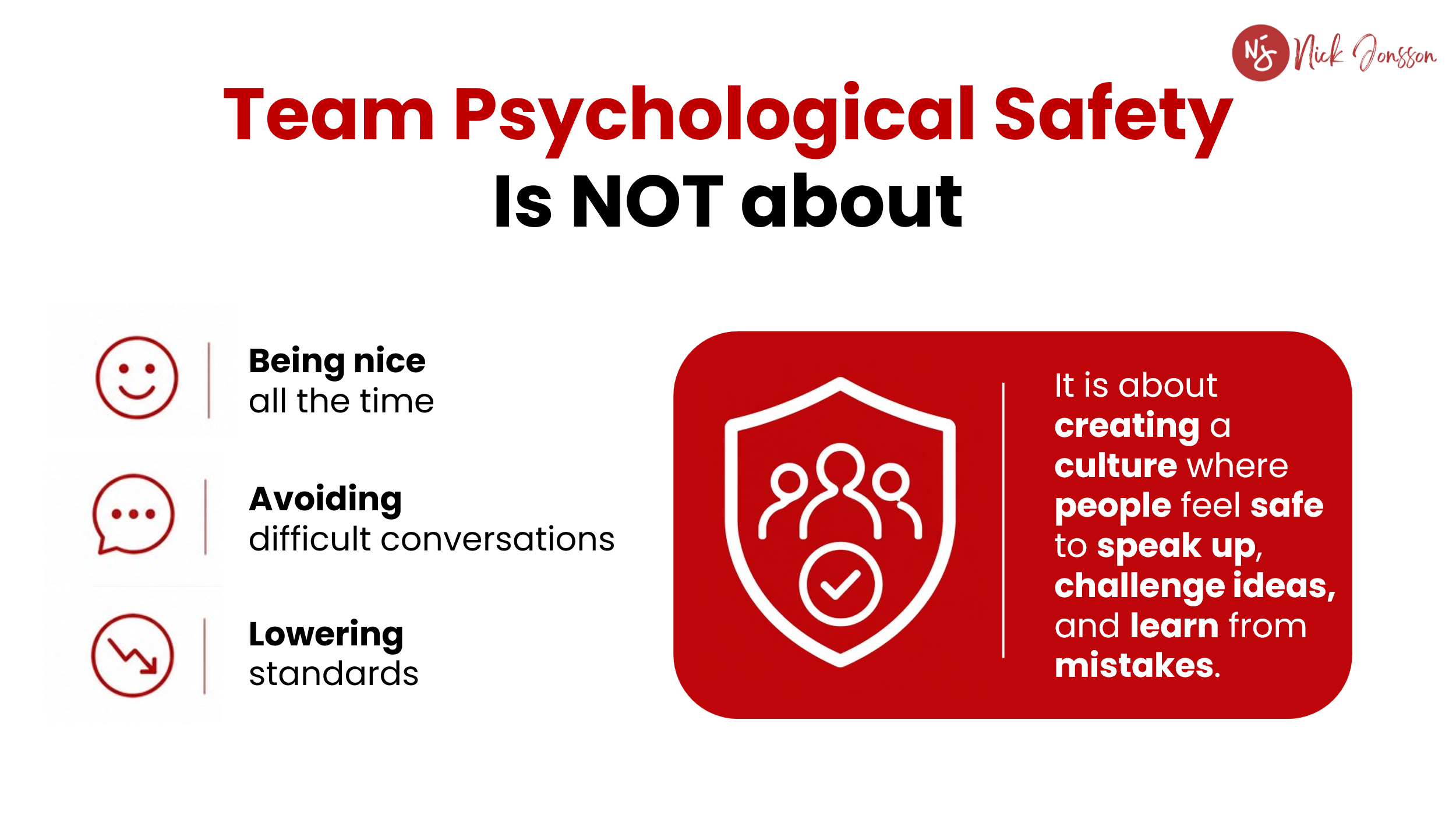
Psychological safety is not about being pleasant all the time. It is not about avoiding difficult conversations. And it does not mean lowering standards or softening accountability.
Team psychological safety means creating an environment in which people feel safe to do seven things:
• Speak up when something does not look right
• Challenge an idea without attacking the person behind it
• Admit an honest mistake before it becomes a larger problem
• Ask for help without being seen as incapable
• Contribute ideas regardless of rank or seniority
• Learn openly from setbacks
• Bring their best thinking to the team
When participants were asked what psychological safety meant to them, their answers included the ability to communicate without worry, a safe space, being brave, building trust, and the freedom to speak up without fear of being reprimanded.
Those answers established an important distinction. Psychological safety is not the absence of challenge. It creates the conditions for more honest, more useful and more accountable challenge.
Why High-Performing Teams Report More Mistakes
One of the most counterintuitive findings Nick shared came from the research of Amy Edmondson, the Harvard Business School professor who introduced the concept of team psychological safety.
While studying medical teams, Edmondson initially found that the stronger teams appeared to make more mistakes. The important word turned out to be reported.
The high-performing teams were not making more errors. Their members felt safe enough to acknowledge and record them.
Instead of hiding a problem out of fear, they treated it as information the team could learn from. Issues surfaced early, while they were still small enough to fix.
The implication for leaders is uncomfortable. A quiet team is not automatically a high-performing team.
Silence can look like harmony. It can just as easily mean people have learned that questioning a decision, admitting uncertainty or delivering bad news carries too much personal risk.
The Hidden Cost of Organisational Silence
Nick connected psychological safety directly to business performance, risk, innovation and leadership in a period of rapid technological change.
When employees do not feel safe to speak up, the consequences compound:
• Leaders make decisions on incomplete information
• Operational risks stay hidden
• Mistakes are concealed rather than examined
• Teams repeat preventable failures
• Junior and quieter voices are overlooked
• Innovation declines because people stop experimenting
• Problems reach leadership only once they are serious
• Employees disengage, then leave
The danger is often greatest in successful organisations with strong hierarchies. Past success reinforces the belief that senior leaders must have the right answers, while the people closest to the work spot emerging risks and stay quiet about them.
With artificial intelligence accelerating change across every industry, Nick warned that organisations run on fear and rigid command-and-control leadership may not be able to learn fast enough to keep up.
"If we have fear in a team and people do not dare to try, we are going to be left behind," he told participants.
From Executive Isolation to Human Connection
Nick's perspective on this subject reaches well beyond research and leadership theory.
During his earlier corporate career he looked successful from the outside while becoming steadily more isolated. He stopped asking for help, avoided difficult conversations, and lived through the destructive consequences of silence in both his professional and personal life.
His recovery began when he found environments where people spoke openly, admitted mistakes, asked for help and supported one another without judgment.
Those experiences shaped his conviction that psychological safety is not confined to the workplace. The same principles shape families, communities and personal relationships.
He linked the topic to the third step in his 5 Steps to Holistic Leadership framework: Connection.
Healthy performance depends on relationships where honest conversation is possible. Leaders build those relationships by being human, acknowledging uncertainty, taking responsibility, and demonstrating that asking for support is a strength rather than a weakness.
Rebuilding Trust Through Ownership
During the question-and-answer session, a participant asked Nick how he had rebuilt his relationship with his son after the two became disconnected while living in Singapore and Sweden.
Nick explained that the turning point came when he stopped defending the past and took responsibility for his part in it.
He apologised, sought professional guidance, and entered his son's world by playing Minecraft online with him for several hours every weekend. Consistent presence gradually replaced distance, and the trust returned.
Today the two are close and speak openly about difficult things.
The story illustrated a wider leadership principle. Trust is rarely restored by a single statement. It is rebuilt through ownership followed by consistent action.
One participant described it as a fantastic turnaround and a powerful example of connection in practice.
The Seven Elements of Team Psychological Safety
As a certified Team.As.One practitioner, Nick introduced seven elements that move psychological safety from an abstract idea into something observable and measurable.
Reaction to mistakes. Are honest mistakes treated as opportunities to learn, or as reasons to assign blame?
Dealing with issues. Can problems be raised openly before they turn into crises?
Embracing diversity. Are different backgrounds, identities and perspectives genuinely welcomed?
Taking risks. Can people experiment, challenge established thinking and put forward new ideas?
Asking for help. Can team members request support without losing status?
Mutual support. Do colleagues actively help one another succeed?
Appreciation. Are people's strengths and contributions recognised and put to use?
Each element can be assessed through quantitative scoring and qualitative feedback. The results show leaders where psychological safety is genuinely strong, where silence may be setting in, and which specific behaviours need attention.
What Participants Committed To
Rather than closing on theory, Nick asked every participant to name one behaviour they would start practising immediately.
The commitments included:
• Listening without judgment
• Letting others speak before the leader does
• Owning mistakes and using them to improve
• Showing more sincere appreciation
• Becoming more mindful of how they react when something goes wrong
• Asking quieter people for their opinion
• Giving team members a genuine opportunity to contribute
• Speaking up rather than waiting too long
One participant committed to asking for the view of a colleague who had stayed silent through an entire meeting.
Nick's observation was that the quietest person in the room may well be holding the solution. The leader's job is to create the conditions in which that person feels safe enough to offer it.
Questions Leaders Asked
What are the early signs that a team lacks psychological safety?
Silence is the clearest warning sign.
When nobody challenges a proposal, raises a concern or asks for clarification, leaders tend to read the absence of disagreement as agreement. The better instinct is curiosity about what is not being said.
Can psychological safety coexist with high accountability?
Yes, and the two reinforce one another when handled well.
People remain fully responsible for their performance and behaviour, but honest mistakes are handled professionally and used for learning. When leaders respond calmly and constructively, employees report problems early rather than concealing them until they become crises.
Why do senior leaders find it so difficult to ask for help?
Many believe their position requires them to have every answer, and fear that asking for support will make colleagues question their competence.
Nick encouraged leaders to deflate the ego around the role and let people contribute. Asking for help builds connection and signals that collaboration is genuinely valued.
What can a directive leader change immediately?
Start with ownership.
A leader can acknowledge having been overly directive, tell the team they want to move towards a more open and coaching-oriented approach, and then explicitly invite colleagues to challenge them and hold them to it.
Psychological safety grows when the invitation to speak up is backed by how the leader reacts the first time somebody actually does.
Can a manager build safety under a command-and-control senior leader?
A manager can build meaningful psychological safety inside their own team, even where the wider culture stays hierarchical.
Organisation-wide change, however, needs senior leaders to model vulnerability, admit mistakes and welcome challenge. Without that example from the top, speaking up across the hierarchy stays risky.
An International Conversation
The ARTDO International session closed with an active question-and-answer discussion and clear appreciation from participants and organisers.
Attendees described it as an inspiring session, a very engaging and relevant topic, and a presentation that was rich despite its concise format. ARTDO International thanked Nick for his time, his openness and his continued contribution to their international learning community.
The response reflects something characteristic of Nick's work as a psychological safety speaker. He combines research and organisational frameworks with lived experience, practical leadership behaviour, and honest conversation that pulls audiences into the discussion rather than leaving them as spectators.
Bring Team Psychological Safety to Your Organisation
Nick Jonsson is a global keynote speaker, Certified Team Psychological Safety Practitioner, executive coach, counsellor and psychotherapist, and founder of Limitless Executive Solutions.
He works with organisations in Singapore, across Asia and internationally through conference keynotes, leadership masterclasses, interactive team workshops, executive team sessions, Team Psychological Safety assessments, leadership coaching with facilitated debriefs, and multi-session team development programmes.
Programmes are built around the issues that matter to the organisation: silence, how leaders react to mistakes, speaking up across hierarchy, trust, vulnerability, accountability, innovation, employee engagement and sustainable high performance.
If your organisation needs people to raise risks earlier, challenge ideas constructively and bring their best thinking to work, get in touch to discuss a psychological safety keynote, webinar, assessment or team workshop.
Or follow Nick on LinkedIn for weekly insights on coaching, leadership, wellbeing, and performance.