

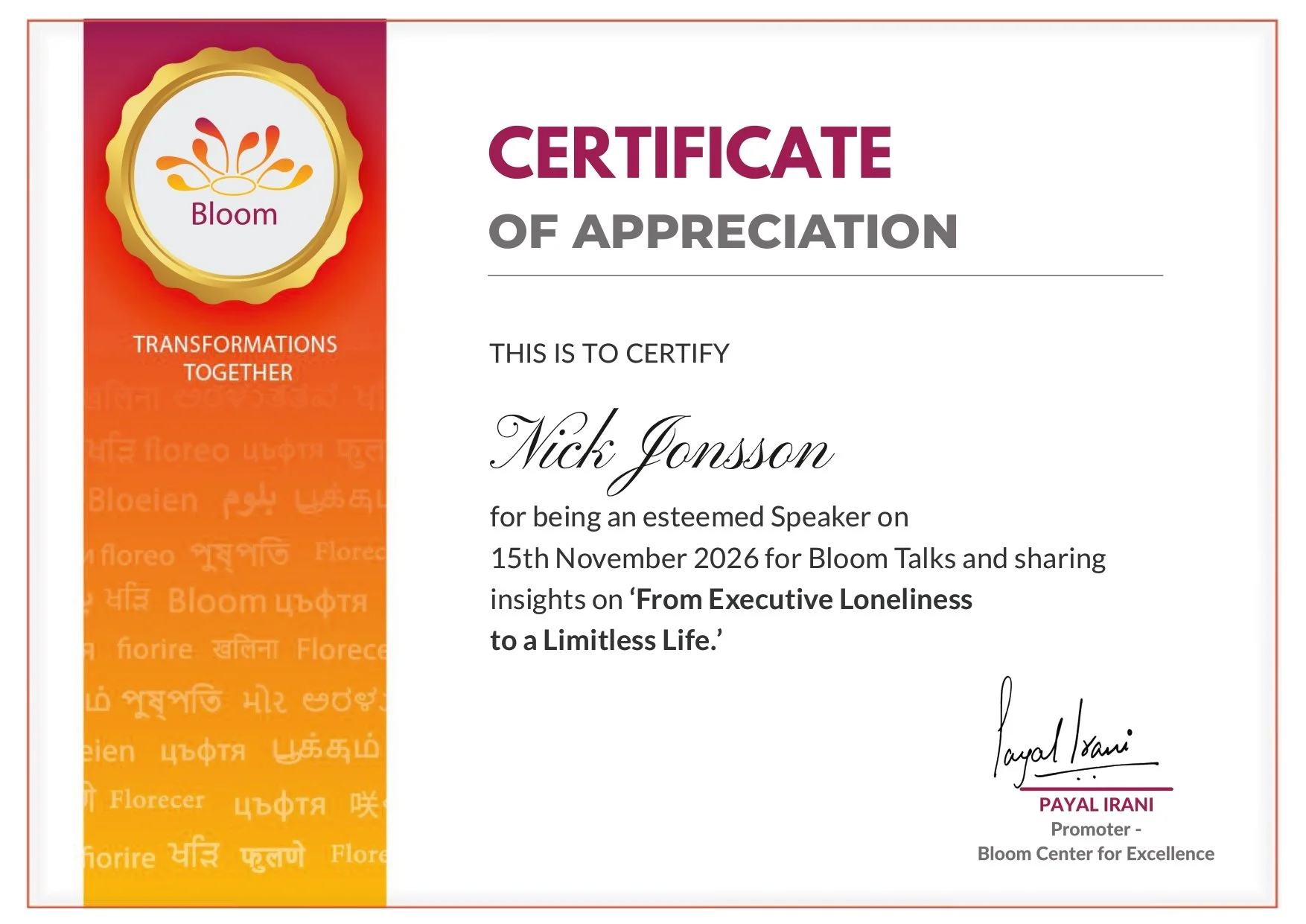
Bloom Talk Show – India, Episode 325 | Sunday, 15 November 2026
You can reach the top of your career, manage thousands of employees, sit on company boards and still feel completely alone.
What happens when professional success comes at the expense of your physical health, mental wellbeing and personal relationships?
Why do so many people struggle to admit mistakes, ask for help or speak openly about their challenges?
And in a world increasingly disrupted by artificial intelligence, how can we protect our careers, develop meaningful human connections and build more fulfilling lives?
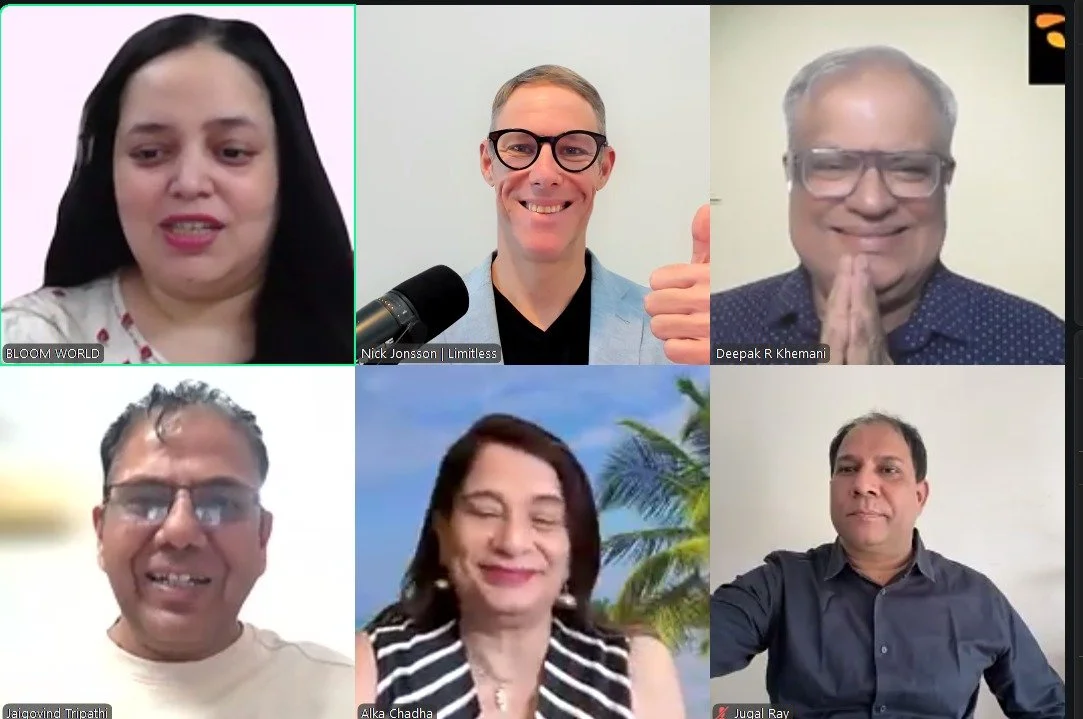
These were among the questions explored when Swedish international keynote speaker, bestselling author, executive coach and psychotherapist Nick Jonsson joined host Deepak Khemani for the 325th edition of the Sunday Bloom Talk Show, Transformations Together, on 15 November 2026.
During the conversation, Nick shared his journey from growing up in a working-class family in Sweden to holding senior executive positions across Asia, including managing 72 hospitals and clinics with approximately 1,400 employees in Indonesia.
He spoke openly about the consequences of relentless ambition, executive loneliness, unhealthy coping mechanisms and the pressure to appear successful while struggling internally.
The discussion also explored psychological safety, toxic leadership, career uncertainty, artificial intelligence, personal transformation and the importance of human connection.
Drawing on his corporate leadership experience and personal journey, Nick challenged conventional assumptions about success and the responsibilities leaders have toward themselves and others.
THE HIDDEN REALITY OF EXECUTIVE LONELINESS
Why Loneliness Is Not Limited to the Top of an Organization
We often hear the expression that it is lonely at the top.
But is loneliness really something experienced only by CEOs and senior executives?
During the Bloom Talk Show, Nick explained that executive loneliness can affect people throughout an organization.
It can affect a managing director responsible for thousands of employees.
It can affect a middle manager trying to meet demanding targets.
It can affect a young professional who feels unable to question a decision or ask a colleague for support.
Executive loneliness is not simply about being physically alone.
It can arise when people feel disconnected from colleagues, peers and managers, or when they are afraid to admit mistakes, raise concerns or acknowledge that they need help.
Nick's understanding of executive loneliness emerged through reflection on his own corporate career.
At the height of his professional journey, he had held positions including general manager, managing director, general director and chairman, alongside board-level responsibilities.
Yet behind the achievements, he was struggling.
"I did everything to just look as good as I could on the outside while I was internally collapsing."
He described how he avoided vulnerability, did not ask for help and felt unable to acknowledge mistakes openly.
Looking back, he recognized that his determination to maintain a successful professional image had come at the expense of his own wellbeing.
The experience led him to question whether the traditional idea of loneliness at the top captured the full problem.
His conclusion was that executive loneliness is not defined by seniority.
It is connected to the absence of authentic relationships, openness and the confidence to seek support.
The question is not simply how many people surround us at work, but whether we feel safe enough to be honest with them.
WHEN AMBITION COMES AT THE EXPENSE OF WELLBEING
The Importance of Balancing Performance With Physical, Mental and Social Health
Nick grew up in a working-class family in Sweden.
His father worked in construction, and Nick's first job was as a construction painter.
From an early age, he developed a strong belief in hard work.
If he wanted something, he had to work for it.
That mentality followed him through his education in Australia and into the corporate world.
He worked hard to earn scholarships, achieve strong academic results, meet performance targets and secure promotions.
He also immersed himself in personal development and goal-setting philosophies.
During the interview, Nick spoke about studying Brian Tracy's work, travelling internationally to attend his events and helping bring him to Vietnam.
He also described attending Tony Robbins events and embracing the energy and motivation associated with setting ambitious goals.
Combined with his strong work ethic, these influences reinforced his determination to push himself further.
But eventually, that approach became unsustainable.
"So I drove so hard, but that drove me over the cliff eventually."
Nick emphasized that setting challenging goals, maintaining motivation and pursuing professional success are not inherently negative.
The problem arises when achievement comes at the expense of physical health, mental health and social wellbeing.
He also reflected on how excessive ambition can affect colleagues.
When leaders become completely focused on reaching their objectives, they may push through organizations like bulldozers, overlooking the needs and wellbeing of those around them.
His message was that ambition must be balanced with a more sustainable approach to leadership.
High performance should not require people to sacrifice their health or their ability to build meaningful relationships.
PSYCHOLOGICAL SAFETY: WHY LEADERS MUST LEAD BY EXAMPLE
Creating Environments Where People Feel Safe to Speak Up
One of the central themes of the conversation was psychological safety.
Deepak asked why individuals and organizations often wait until someone experiences serious difficulties before recognizing that support is needed.
Nick responded by emphasizing the responsibility of leaders.
Leadership, he explained, is not limited to corporate executives.
People lead organizations, communities, clubs, associations and families.
Wherever we hold a leadership position, we have an opportunity to influence how others behave.
One of the most important ways to do that is by acknowledging our mistakes.
When leaders make an error, they can choose to hide it, deny responsibility or protect their image.
Alternatively, they can acknowledge what happened and explain how they intend to correct it.
Nick argued that this behaviour helps demonstrate that leaders are human.
It also encourages others to feel safer acknowledging their own mistakes.
Rather than hiding errors or struggling with them in isolation, individuals may become more willing to speak openly and learn from the experience.
Mistakes can then be reframed as feedback and learning opportunities.
Nick illustrated this through examples from healthcare and aviation.
In hospitals, a nurse may hesitate to challenge a doctor's decision because of professional hierarchy.
In aviation, a copilot may be reluctant to question a pilot, even when concerned about a potential danger.
These examples demonstrate why people must feel able to raise concerns, regardless of their position.
Psychological safety is not simply about making people feel comfortable.
It can be essential to communication, learning and preventing serious mistakes.
Nick encouraged listeners to consider their own responsibilities as leaders.
"Where am I a leader and how can I lead by example, by showing some vulnerability and admitting to my mistakes?"
The message was clear: leaders who want others to speak openly must first demonstrate that honesty and vulnerability are acceptable.
TOXIC LEADERSHIP AND THE NEED FOR CHANGE
What Happens When Leaders Protect Their Positions Instead of Supporting Others?
During the discussion, Deepak raised the issue of people in positions of authority who resist being challenged or feel threatened by the development of others.
Some leaders may discourage employees from progressing.
Others may believe that their seniority makes them untouchable.
Nick acknowledged that these behaviours are not limited to particular countries or industries.
They represent a wider leadership challenge.
He also connected this issue to the disruption taking place across organizations, particularly through artificial intelligence.
Businesses that once appeared stable are being challenged.
Professional roles that once seemed secure are changing.
Traditional assumptions about organizational structures and leadership are increasingly being questioned.
Nick suggested that this is an important time to challenge established ways of working.
For individuals experiencing unhealthy leadership environments, he discussed the possibility of leaving an organization or seeking external support through mentors and coaches.
The wider message was that employees should not simply assume that harmful leadership behaviour must be tolerated indefinitely.
Personal development, professional relationships and external guidance can provide additional perspectives and opportunities.
CAREER SECURITY IN THE AGE OF ARTIFICIAL INTELLIGENCE
Why We Cannot Depend Entirely on One Employer
Artificial intelligence and organizational restructuring are transforming the employment landscape.
During the interview, Deepak described how employees can sometimes lose their jobs with very little warning.
Nick responded by sharing his own experiences of unexpected career disruption.
On one occasion, he lost a position following conflict with a manager.
Although difficulties existed, he had not expected his employment to end so suddenly.
On another occasion, he had spent five years performing well in an organization when the company was acquired and his position became redundant.
During those five years, he had devoted himself to his work.
He had not updated his CV.
He had not maintained his professional network.
And when his employment ended, he found himself unprepared.
The experience had significant consequences for his personal and professional life.
Looking back, Nick challenged the traditional expectation that employers will necessarily provide lifelong career security.
He referred to the days when someone might work for the same company for 40 years and receive a gold watch in recognition of their loyalty.
He argued that people should no longer assume such arrangements will protect them.
Instead, he encouraged individuals to take responsibility for building their own professional resilience.
This means maintaining relationships beyond a current employer.
Participating in professional associations and communities.
Developing additional skills.
Exploring different opportunities and potential income streams.
And remaining prepared for unexpected changes.
Nick described these connections and opportunities as a form of personal life insurance.
The important lesson is to develop your professional network and capabilities before you urgently need them.

FINDING YOUR UNIQUE VALUE IN A WORLD CHANGED BY AI
What Can Human Experience Offer That Technology Cannot Easily Replace?
As artificial intelligence becomes more sophisticated, many traditional professional services are facing disruption.
Deepak raised concerns about the future of consulting and asked what individuals could do to remain relevant.
Nick's response focused on the unique value of personal experience.
He believes that everyone has developed skills, knowledge and insights through their individual life journey.
Sometimes these strengths come from professional achievements.
Sometimes they come from overcoming difficult personal experiences.
Nick used his own journey as an example.
For much of his corporate career, he avoided vulnerability and protected himself emotionally.
After confronting those patterns and changing his approach to life, he was able to use his experience to help others.
He also discussed his former relationship with alcohol.
During his corporate career, he often used alcohol after work as a way of coping with difficult emotions.
Instead of having challenging conversations or addressing what was troubling him, he would go to a bar for drinks to relax and temporarily escape those feelings.
Looking back, he questioned why he had used alcohol rather than seeking meaningful support.
Today, his lived experience contributes to his ability to support individuals facing similar challenges.
He encouraged listeners to consider the difficulties they have overcome and whether those experiences might allow them to help others.
Nick acknowledged that artificial intelligence will change many aspects of professional life.
However, he also emphasized that people continue to value genuine human support.
"People still want to hold the hand of a real human being to go through some things."
The conversation highlighted the continuing importance of human connection, lived experience and the ability to support others through meaningful challenges.
WHY REAL EXPERIENCE MATTERS
Learning From People Who Have Walked the Path
The conversation also explored the growing number of people offering coaching, mentoring and personal development advice online.
Deepak questioned how individuals can identify professionals who have genuine experience rather than relying solely on marketing claims or impressive titles.
Nick responded with a practical analogy.
If he wanted to learn to swim, he would choose a swimming coach who could actually swim.
He would want to learn from someone who understood the activity through experience.
The same principle applies when seeking guidance in other areas of life.
Relevant expertise, professional knowledge and lived experience all contribute to the value someone can offer.
For Nick, this combination has become central to his work as a speaker, coach and psychotherapist.
His professional experience provides an understanding of leadership challenges.
His personal journey provides insight into vulnerability, recovery and transformation.
And his professional training supports the work he does with individuals and organizations.
THE PERSON BEHIND THE PROFESSIONAL TITLES
Speaker, Coach, Psychotherapist — and Endurance Athlete
During the interview, Deepak asked Nick an interesting question.
Of all his professional identities — international speaker, author, coach and psychotherapist — which one best represents the real Nick?
Nick's answer was his passion for triathlon.
He described how endurance sport has become an important part of his identity.
He travels internationally to compete in triathlons and has represented Sweden at world championship level.
Long-distance triathlon involves swimming, cycling and running, with a full-distance Ironman consisting of a 3.8-kilometre swim, a 180-kilometre cycle and a marathon.
For Nick, training provides much more than physical exercise.
It gives him time alone with his thoughts.
Long sessions of swimming, cycling and running allow him to reflect and reconnect with himself.
He described the experience as a form of meditation.
At the same time, endurance sport provides opportunities for human connection.
He trains with other athletes, participates in events and travels internationally.
Sport therefore supports both personal reflection and relationships with others.
Professionally, Nick explained that he has developed four complementary areas of work.
The first is international keynote speaking.
He described his enjoyment of speaking at conferences and referred to his recent opening and closing keynote presentations at CIO100 in Bengaluru, India.
The second is leadership workshops and training programmes, including his trademarked Five Steps to Holistic Leadership framework.
The third is executive and life coaching.
The fourth is psychotherapy and counselling, supporting people experiencing challenges such as addiction, burnout, depression and divorce.
Nick explained that he finds fulfilment in balancing these four professional activities.
His approach also reflects the earlier discussion about building a portfolio of skills and opportunities rather than relying entirely on one professional role.
FROM PERSONAL STRUGGLES TO IRONMAN
How Small Goals Led to Extraordinary Physical Transformation
Deepak asked Nick what motivates people to pursue demanding endurance challenges such as Ironman triathlons.
Nick explained that his journey began approximately 15 years earlier.
At that time, he was around 30 kilograms heavier than he is today.
He described struggling with low energy, difficulty getting out of bed and recurring periods of depression.
He had experienced significant weight gain twice during his life.
Eventually, he reached a point where he wanted to change.
He began setting manageable fitness goals.
First, a five-kilometre run.
Then a ten-kilometre run.
As he achieved each milestone, he became more confident about setting larger goals.
One day, he watched a video of the Ironman World Championship in Hawaii.
Seeing the athletes compete inspired him.
He decided that he wanted to experience that challenge himself.
He engaged a coach and began working toward the goal over several years.
Through consistent training and progressively more demanding challenges, he developed his endurance and physical fitness.
For Nick, the journey was deeply personal.
It was not primarily about impressing others.
It was about discovering what he could achieve through determination, coaching and sustained effort.
The experience also gave him an understanding of what it feels like to reach a high level of physical fitness.
His story demonstrated how small, achievable goals can gradually develop into significant personal transformation.
WHAT WOULD NICK TELL HIS YOUNGER SELF?
Reflections on Health, Choices and Regret
Deepak asked Nick what he would tell himself if he could go back 25 years.
Nick explained that he has relatively few regrets.
Even the difficult experiences he has lived through have contributed to his personal journey.
However, he identified one decision he wishes he could change.
Smoking cigarettes.
Growing up in Sweden, he was surrounded by adults who smoked.
His parents and other members of the older generation smoked in homes and cars.
As a teenager, he associated smoking with adulthood.
He began experimenting with cigarettes around the age of 14 or 15.
Although he stopped smoking approximately 20 years ago, he described still experiencing a morning cough that he associates with his earlier smoking.
Looking back, he wishes he had never started.
The discussion highlighted how decisions made early in life can have lasting consequences.
It also reflected Nick's broader approach to his personal history.
While he recognizes mistakes and unhealthy choices, he also accepts that those experiences have shaped the person he has become.
THERE ARE NO SHORTCUTS TO LIFE EXPERIENCE
Taking Calculated Risks and Learning From Mistakes
Toward the end of the available conversation, Deepak asked what Nick would say to younger people who admire his achievements without understanding the difficulties he experienced along the way.
Nick emphasized the importance of living life, taking calculated risks and learning through experience.
He explained that people often need to make their own mistakes to develop understanding and judgment.
There are lessons that can be shared through mentoring, coaching and education.
But ultimately, individuals still need to take responsibility for their own journeys.
Nick also discussed his work mentoring emerging professional speakers through the Asia Professional Speakers Singapore association.
He described sharing his experience and answering questions while allowing others to discover their own approaches.
He applies a similar philosophy as a father.
With a teenage son, Nick explained that he tries to remain available for guidance rather than constantly telling him what to do.
His belief is that people learn through experience, reflection and the consequences of their choices.
Growth requires the willingness to take risks, make mistakes, ask questions and continue learning.
KEY TAKEAWAYS FROM BLOOM TALK SHOW #325
Eight Lessons on Leadership, Vulnerability and Personal Transformation
1. Executive Loneliness Can Affect Anyone
Loneliness is not restricted to CEOs or senior executives. It can affect people at any organizational level when they feel unable to connect authentically, raise concerns or ask for support.
2. Ambition Must Be Balanced With Wellbeing
Professional success and ambitious goals can be valuable, but they should not consistently come at the expense of physical health, mental health or relationships.
3. Vulnerability Is an Important Leadership Behaviour
When leaders acknowledge mistakes and demonstrate that they are human, they can encourage others to speak more openly.
4. Psychological Safety Supports Better Communication
People need to feel able to question decisions, raise concerns and admit mistakes, particularly in environments where errors can have serious consequences.
5. Career Security Requires Personal Responsibility
Maintaining professional networks, developing skills and exploring opportunities beyond one employer can help individuals prepare for unexpected career disruption.
6. Human Experience Remains Valuable in the Age of AI
Technology may change how people work, but lived experience, genuine relationships and human support continue to offer meaningful value.
7. Personal Transformation Can Begin With Small Goals
Nick's journey from significant weight gain and poor fitness to international triathlon competition demonstrates how progressively challenging goals, coaching and consistent effort can support change.
8. Learning Requires Experience
Taking calculated risks, making mistakes, seeking guidance and remaining open to personal growth are important parts of building a meaningful life.
ABOUT NICK JONSSON
International Keynote Speaker | Bestselling Author | Executive Coach | Psychotherapist
Nick Jonsson is a Swedish international keynote speaker, bestselling author, executive coach and psychotherapist whose work focuses on executive loneliness, vulnerability, psychological safety, human connection and sustainable high performance.
Born in Sweden and educated in Australia, Nick has spent more than two decades living and working across Asia, including Vietnam, Indonesia, Thailand and Singapore.
His international corporate career included senior executive and board-level positions, with responsibility for complex organizations and large teams.
His personal experiences with executive loneliness, burnout and unhealthy coping mechanisms inspired a significant transformation in his life and professional direction.
Nick is the bestselling author of Executive Loneliness and the creator of the trademarked Five Steps to Holistic Leadership framework.
He works internationally through keynote presentations, executive coaching, leadership workshops, psychotherapy and counselling.
An accomplished endurance athlete, Nick has represented Sweden in international triathlon competition.
His work combines professional expertise, corporate leadership experience and lived personal transformation to help individuals and organizations develop healthier approaches to leadership, connection and performance.
ABOUT THE BLOOM TALK SHOW
Transformations Together — Episode 325
On Sunday, 15 November 2026, Nick Jonsson appeared as a featured guest on the 325th edition of the Sunday Bloom Talk Show.
The episode, titled From Executive Loneliness to a Limitless Life, was hosted by Deepak Khemani, Co-Founder of Bloom, with Payal Irani, Founder and CEO of Bloom, featured as co-host.
The Bloom Talk Show brings together speakers, trainers, coaches, athletes, professionals and individuals from different backgrounds to share experiences and insights.
During the programme, Deepak explained that the show had welcomed guests representing all seven continents, including Antarctica.
The 325th episode continued that tradition of international learning and conversation.
Nick joined the live online session from Phuket, Thailand, sharing his experiences with an international audience.
The discussion focused on executive loneliness, leadership vulnerability, psychological safety, career uncertainty, artificial intelligence, human connection and personal transformation.
REFLECTION QUESTIONS
What Does This Conversation Mean for You?
The discussion raises important questions for leaders, entrepreneurs, professionals and anyone navigating change.
Do I feel comfortable admitting mistakes at work?
Can I ask my manager or colleagues for help without fear of judgment?
Am I pursuing professional goals at the expense of my physical or mental wellbeing?
Am I maintaining relationships and professional opportunities beyond my current employer?
What unique skills or experiences could allow me to help others?
How am I preparing myself for changes brought about by artificial intelligence?
What unhealthy patterns might be preventing me from living a more fulfilling life?
Am I creating an environment where others feel safe speaking openly?
What personal goal could I begin working toward today?
How can I become more intentional about the relationships and connections in my life?
Meaningful change often begins by asking ourselves questions that challenge our existing assumptions.
BRING THIS CONVERSATION TO YOUR ORGANIZATION
Executive Loneliness, Psychological Safety and Sustainable High Performance
The themes explored during Bloom Talk Show #325 are highly relevant to organizations navigating increasing complexity, technological disruption and changing expectations of leadership.
Nick Jonsson works with international organizations, leadership teams, entrepreneurs and professional associations through keynote presentations, executive coaching and leadership workshops.
His work explores the human challenges behind professional achievement and how leaders can develop healthier, more connected and sustainable approaches to performance.
Key areas of expertise include:
Executive Loneliness and the Hidden Challenges of Leadership
Vulnerability and Authentic Leadership
Psychological Safety and High-Performing Teams
Holistic Leadership and Sustainable Performance
Human Connection in the Age of Artificial Intelligence
Leadership Resilience and Personal Transformation
The Five Steps to Holistic Leadership
Whether speaking at an international conference, facilitating an executive workshop or supporting leaders through individual coaching, Nick brings together extensive corporate experience, professional expertise and personal insight.
Explore keynote speaking, leadership workshops and executive coaching with Nick Jonsson.
Website: https://www.nickjonsson.com
LinkedIn: https://www.linkedin.com/in/nick-jonsson/
FINAL REFLECTION
From Executive Loneliness to a Limitless Life
Professional success can open extraordinary doors.
It can create opportunities, financial security, recognition and influence.
But success does not automatically protect us from loneliness, burnout, unhealthy habits or unexpected change.
The conversation between Nick Jonsson and Deepak Khemani reminds us that leadership involves more than meeting targets and achieving results.
It involves recognizing our limitations.
Acknowledging mistakes.
Creating environments where others feel safe to speak.
Developing meaningful relationships.
Taking responsibility for our careers and wellbeing.
And remaining willing to learn and change throughout our lives.
Nick's journey demonstrates that personal transformation is possible, even after significant professional and personal challenges.
His experience also highlights the importance of balancing ambition with health, relationships and human connection.
We can pursue meaningful goals without losing sight of our wellbeing.
We can lead with responsibility while acknowledging that we are human.
And we can continue growing by learning from our experiences, supporting others and remaining open to change.
From Executive Loneliness to a Limitless Life — Bloom Talk Show, Episode 325, 15 November 2026.
Nick Jonsson
International Keynote Speaker | Bestselling Author | Executive Coach | Psychotherapist
Or follow Nick on LinkedIn for weekly insights on coaching, leadership, wellbeing, and performance.