


International keynote speaker Nick Jonsson returns to the Business Executive Network Vietnam, sharing practical lessons on resilience, courage, human connection and holistic leadership with business leaders from Ho Chi Minh City (Saigon), Hanoi and Da Nang.
Vietnam | 30 October 2026
In a business environment shaped by constant change, digital transformation and increasing leadership demands, resilience has become an essential leadership capability. But how can executives develop the courage to embrace change while protecting their personal wellbeing, relationships and sense of purpose?
These questions were at the heart of Resilience and Courage: Leading Through Change, an interactive online leadership workshop delivered by international keynote speaker, bestselling author, executive coach and psychotherapist Nick Jonsson to members of the Business Executive Network Vietnam on Friday, 30 October 2026.
Business leaders from Ho Chi Minh City (Saigon), Hanoi and Da Nang joined the virtual event, bringing together executives from across Vietnam to explore how resilience, courage and human connection can support effective leadership during uncertain and disruptive times.
The session marked Jonsson's second engagement with the network, combining his personal journey of transformation, international executive leadership experience and practical Five Steps to Holistic Leadership framework.
Rather than treating resilience simply as the ability to withstand pressure, the presentation explored how leaders can develop sustainable resilience through self-awareness, purpose, meaningful relationships, clear goals and consistent daily action.
Why Resilience and Courage Matter in Leadership Today
Change is an unavoidable part of business leadership. Technological disruption, shifting market conditions, organizational transformation and growing expectations place significant demands on executives.
While leaders are often expected to project confidence and provide answers, they may also experience uncertainty, isolation and pressure behind the scenes.
This creates an important leadership challenge: how can executives remain effective through change without neglecting their own wellbeing?
Jonsson's approach to holistic leadership recognizes that professional performance cannot be separated from personal wellbeing.
His framework integrates physical health, mental health, emotional health, psychological health, social wellbeing and resilience with professional responsibilities.
The central message is that sustainable leadership requires attention to the whole person, not simply business results.
Resilience is not only about enduring difficult circumstances. It is also about having the courage to acknowledge challenges, seek support, adapt and take meaningful action.
From Personal Adversity to Holistic Leadership
One of the defining elements of Jonsson's speaking engagements is his willingness to share his own experiences of professional success, personal adversity and recovery.
Having built an international executive career, including significant experience in Asia and Vietnam, Jonsson understands the pressures that can accompany leadership responsibilities.
His personal journey has included confronting addiction, loneliness and the consequences of living under the weight of external expectations.
These experiences ultimately helped reshape his understanding of success and inspired his work supporting executives, entrepreneurs and individuals seeking greater purpose, connection and wellbeing.
Today, as the bestselling author of Executive Loneliness, an executive coach, psychotherapist and Ironman athlete, Jonsson draws on these experiences to demonstrate that personal transformation is possible even after significant setbacks.
His story also challenges a common assumption about leadership: that strength means always appearing confident, independent and in control.
Instead, his approach emphasizes vulnerability, self-awareness, connection and the courage to ask for help.
The Five Steps to Holistic Leadership: A Roadmap for Leading Through Change
A central part of the Vietnam presentation was Jonsson's Five Steps to Holistic Leadership framework.
The roadmap offers leaders a practical way to examine their lives, strengthen resilience and translate personal insights into meaningful action.
1. Surrender: Let Go of What Is Holding You Back
The first step is surrender.
In leadership, surrender does not mean giving up. It means recognizing when existing beliefs, behaviors or habits are no longer serving us.
For executives, this might include perfectionism, the need to control every outcome, reluctance to delegate or the belief that asking for help demonstrates weakness.
Jonsson's presentation highlighted the principle:
"A problem shared is a problem halved."
Acknowledging a challenge can be the beginning of positive change.
The reflection question posed to participants was:
What is one belief or habit holding you back?
By identifying what needs to change, leaders can create space for healthier decisions and new possibilities.
2. Purpose: Rediscover What Gives Life Meaning
The second step focuses on purpose.
Professional achievement can provide recognition, financial security and opportunity. However, external success does not automatically create personal fulfillment.
Leaders may spend years pursuing organizational targets or the expectations of others without considering what truly matters to them.
Jonsson's presentation encouraged participants to reflect on their personal motivations, values and sources of meaning.
Among the questions explored were:
Do you know your life purpose?
What did you love to do as a child?
What gives your life meaning?
Purpose provides direction during uncertainty. When leaders understand what matters most, they are better positioned to make decisions aligned with their values rather than reacting only to external pressures.
3. Connection: Build Resilience Through Relationships
The third step is connection, a particularly important theme in Jonsson's work on executive loneliness and psychological safety.
Leadership can sometimes become an isolating experience.
Executives may feel responsible for supporting everyone around them while struggling to find spaces where they can speak openly about their own concerns.
Yet resilience is not developed through independence alone.
Meaningful relationships, supportive communities, mentoring and the willingness to seek help can all contribute to emotional wellbeing and more sustainable leadership.
Jonsson's presentation reinforced the message that asking for help is a strength.
Connection also extends beyond professional networks to family, friendships, colleagues and the relationship individuals have with themselves.
Participants were invited to consider:
Are there any unresolved relationships in your life that you need to heal or strengthen?
For organizations, this principle connects directly to psychological safety: creating environments where people feel able to speak up, ask questions, acknowledge difficulties and contribute without unnecessary fear.
4. Goals: Align Professional Ambition with Personal Wellbeing
The fourth step translates reflection into direction.
Many executives have clearly defined professional targets, financial objectives and performance indicators.
However, personal goals relating to health, relationships, emotional wellbeing and fulfillment may receive considerably less attention.
Jonsson introduced his Limitless Life Framework, a self-assessment approach designed to help individuals evaluate different areas of their lives.
The process encourages participants to:
Rate their current satisfaction across key life domains on a scale of 1 to 10.
Identify their desired level of satisfaction.
Recognize the gaps between their current and desired circumstances.
Consider meaningful goals that could improve their overall quality of life.
The framework helps leaders look beyond professional performance and consider how different aspects of life influence one another.
A key reflection question was:
What is one goal that would have the biggest positive impact on your professional and personal life?
The objective is not simply to achieve more, but to pursue goals that support a more balanced and meaningful life.
5. Discipline: Turn Courage into Consistent Action
The final step is discipline.
Resilience and personal transformation rarely result from a single decision or inspirational moment.
They develop through repeated actions, accountability and sustainable habits.
Jonsson drew on his experiences in endurance sport, including Ironman triathlons, to illustrate the importance of consistency, preparation and perseverance.
Large ambitions can become overwhelming when viewed only as distant outcomes.
Breaking them into manageable steps makes progress more achievable.
Whether improving physical health, strengthening relationships, developing leadership skills or navigating organizational change, small actions repeated consistently can create meaningful long-term results.
The closing reflection was:
What daily discipline will help you achieve your goals?
Together, the five steps provide a practical roadmap:
Surrender → Purpose → Connection → Goals → Discipline
Human Connection as a Foundation for Resilient Organizations
Beyond individual leadership development, the presentation highlighted the importance of relationships in building resilience.
In workplaces undergoing change, employees may experience uncertainty about expectations, responsibilities, technology and their future roles.
Leaders who encourage open communication, demonstrate empathy and create psychologically safer environments can help teams navigate these challenges more constructively.
This is particularly relevant in increasingly digital and distributed workplaces, where technological connectivity does not always translate into meaningful human connection.
Jonsson's holistic leadership approach encourages executives to recognize that organizational resilience begins with people.
Building trust, encouraging honest conversations and supporting wellbeing are not separate from effective leadership. They are important foundations for it.
Five-Star Feedback from Business Executive Network Vietnam
Following the workshop, Victor Burrill of the Business Executive Network Vietnam shared a five-star Google review recognizing Jonsson's contribution to the executive community.
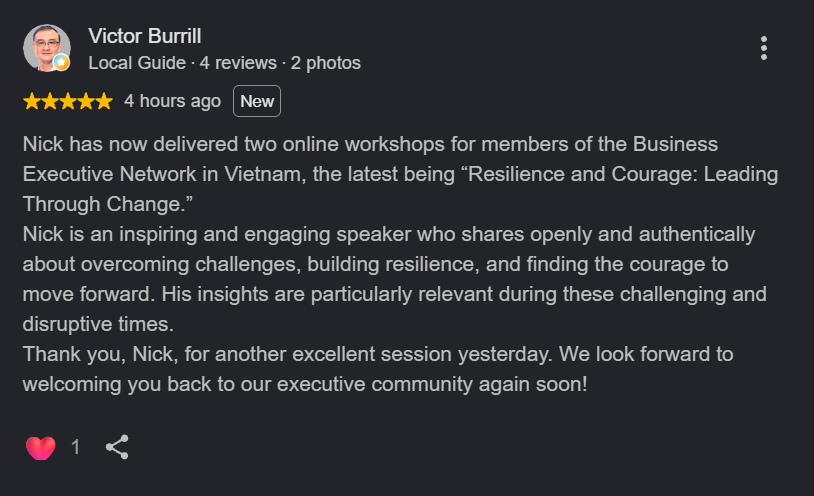
Burrill confirmed that this was Jonsson's second online workshop for the network and highlighted the relevance of his message during challenging and disruptive times.
"Nick is an inspiring and engaging speaker who shares openly and authentically about overcoming challenges, building resilience, and finding the courage to move forward. His insights are particularly relevant during these challenging and disruptive times."
Burrill also thanked Jonsson for another excellent session and expressed the network's interest in welcoming him back to its executive community.
The feedback underscores the value of leadership development that combines practical frameworks with authentic personal experiences, particularly during periods of uncertainty and change.
[IMAGE 4: INSERT THE ORIGINAL FIVE-STAR GOOGLE REVIEW SCREENSHOT FROM VICTOR BURRILL HERE. Display the full screenshot, including his name, five-star rating and complete testimonial. Suggested caption: "Five-star Google review from Victor Burrill following Nick Jonsson's second online leadership workshop for the Business Executive Network Vietnam, October 2026."]
The Future of Leadership Requires More Than Professional Success
As businesses navigate accelerating change, resilience and courage are increasingly relevant to leadership development.
However, resilience should not be understood simply as expecting individuals to tolerate ever-increasing pressure.
Sustainable leadership also requires healthy boundaries, supportive relationships, meaningful purpose and organizational environments that recognize human needs.
The Five Steps to Holistic Leadership provide a framework for leaders seeking to strengthen both professional effectiveness and personal wellbeing.
The broader message of Resilience and Courage: Leading Through Change is that leadership transformation begins with self-awareness and continues through purposeful, consistent action.
Leading through change is not about having every answer. It is about developing the courage, connection and discipline to move forward, even when the path is uncertain.
About Nick Jonsson
Nick Jonsson is an international keynote speaker, TEDx speaker, bestselling author, executive coach and psychotherapist specializing in holistic leadership, executive loneliness, resilience, psychological safety and human connection.
He is the author of Executive Loneliness and founder of Limitless Executive Solutions, supporting leaders and organizations in developing sustainable performance, personal wellbeing and stronger human connections.
Drawing on his international executive career, personal transformation and experiences as an Ironman athlete, Jonsson delivers keynotes, workshops and executive development programs for corporate audiences and leadership communities internationally.
His signature Five Steps to Holistic Leadership framework focuses on Surrender, Purpose, Connection, Goals and Discipline.
Website: https://www.nickjonsson.com
LinkedIn: https://www.linkedin.com/in/nick-jonsson/
Life Assessment: https://lifeassessment.nickjonsson.com
Frequently Asked Questions
What was Nick Jonsson's keynote for the Business Executive Network Vietnam about?
Nick Jonsson delivered Resilience and Courage: Leading Through Change on 30 October 2026. The online leadership workshop explored resilience, courage, personal transformation and his Five Steps to Holistic Leadership framework, helping business executives reflect on how to navigate change while maintaining personal wellbeing and professional effectiveness.
Which cities in Vietnam were represented at the leadership workshop?
Business leaders from Ho Chi Minh City (Saigon), Hanoi and Da Nang joined the virtual Business Executive Network Vietnam workshop on 30 October 2026.
What are the Five Steps to Holistic Leadership?
Nick Jonsson's five steps are Surrender, Purpose, Connection, Goals and Discipline. The framework encourages leaders to let go of limiting habits, identify meaningful purpose, strengthen relationships, establish balanced goals and develop consistent habits that support sustainable leadership.
Why is resilience important for business executives?
Resilience helps executives respond constructively to uncertainty, setbacks and organizational change. Sustainable resilience also involves maintaining wellbeing, building supportive relationships, adapting to new circumstances and recognizing when help is needed.
How can leaders develop courage during organizational change?
Leaders can develop courage by acknowledging uncertainty, examining limiting beliefs, communicating openly, seeking support, making values-based decisions and taking manageable steps toward meaningful goals.
What is the connection between holistic leadership and psychological safety?
Holistic leadership considers the wellbeing of leaders and employees alongside professional responsibilities. Psychological safety supports this approach by encouraging environments where individuals can raise concerns, ask questions, acknowledge mistakes and contribute openly.
What is executive loneliness, and how does it affect leadership?
Executive loneliness refers to the isolation that leaders may experience despite holding senior positions or having extensive professional networks. It can limit opportunities for honest conversations and emotional support, making meaningful relationships and trusted support networks especially important.
Does Nick Jonsson deliver leadership keynotes and workshops for organizations in Vietnam and Asia?
Yes. Nick Jonsson has delivered two online workshops for the Business Executive Network Vietnam, including Resilience and Courage: Leading Through Change in October 2026. His speaking and executive development work addresses holistic leadership, resilience, psychological safety, executive loneliness and human connection.
Or follow Nick on LinkedIn for weekly insights on coaching, leadership, wellbeing, and performance.