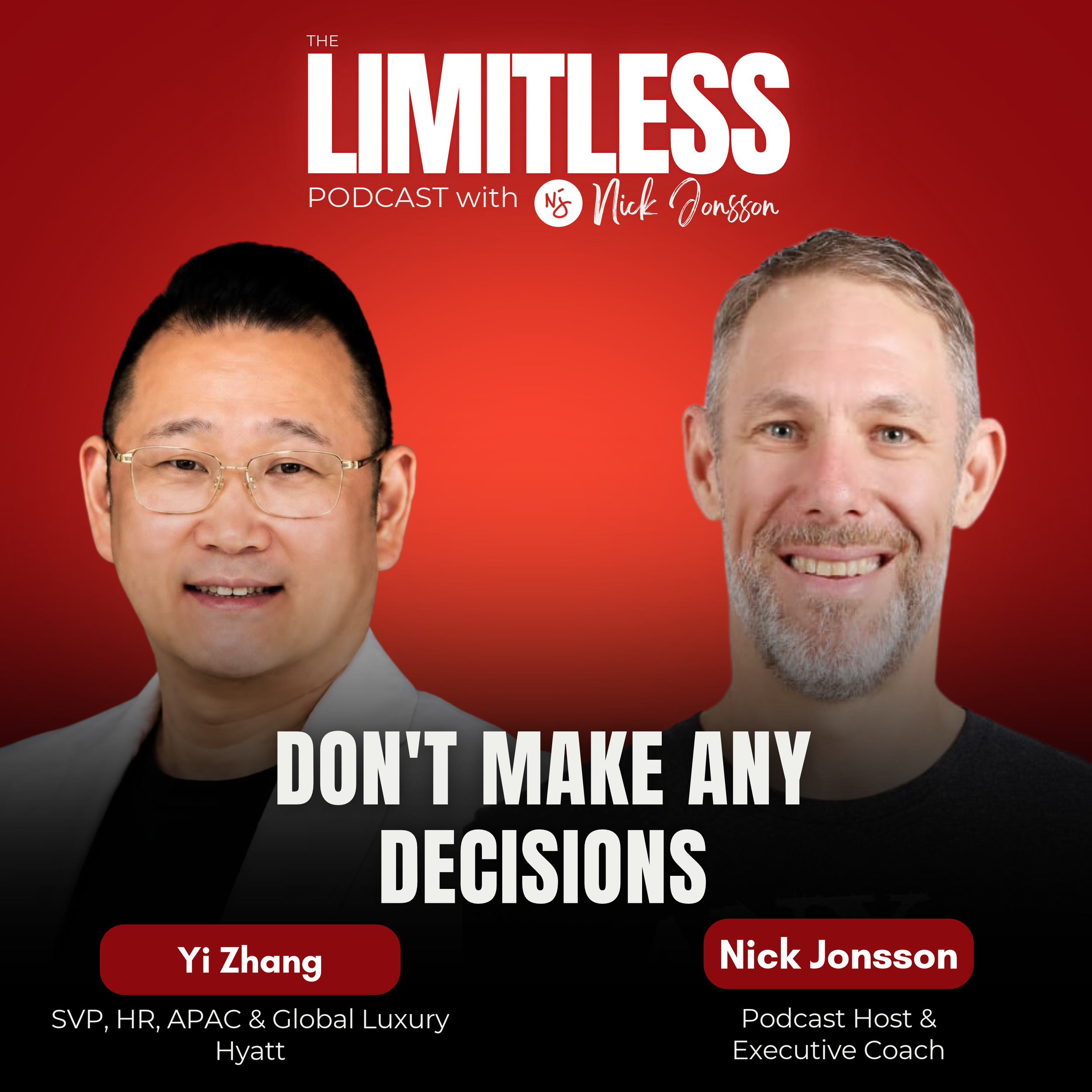
Ask a senior executive who looks after them and you expect an answer about boundaries, or sleep, or finally switching off. His answer was about other people — and that tells you most of what you need to know about how he runs HR for 260 hotels.
Yi Zhang is Senior Vice President of Human Resources, Asia Pacific at Hyatt, with more than 1,500 HR colleagues across the region, and a career that ran through Schneider Electric, Tory Burch and Richemont before this. Earlier this year Hyatt was named one of the Best Workplaces in Asia by Great Place to Work. His view on that is unusually unsentimental: it was a result, not a target.
What makes this conversation worth your time is how specific he is about things most leaders only gesture at. Psychological safety, for him, is not a programme. It is what he calls micro-messaging — small signals repeated until people believe them. Every email he sends carries a link to his calendar, so anyone in the region can book him directly. If he is busy he will say so and find another slot. The point is that nobody has to wonder whether they are allowed to ask.
Then there is what his team did about expertise. Rather than attempt to train 260 HR directors into compensation specialists, they built an internal tool: upload the salary survey and it surfaces who sits above or below range, and who should be raised within the budget available. He is enthusiastic about automating that work, and equally firm about where it stops.
"Leadership is about people. Probably management, it's about a task. So tasks can be replaced by AI, but a human cannot be replaced by AI."
For anyone being told to automate faster while quietly wondering what will be left for them to do.
👇 Connect with Yi Zhang:
LinkedIn https://www.linkedin.com/in/allofr/
Explore more episodes here: https://www.nickjonsson.com
Episode Transcript
Nick Jonsson: Today we have Yi with us. He's the Senior Vice President of HR, Asia Pacific, at the global luxury brand Hyatt. So Yi, a warm welcome to you. How are you today?
Yi Zhang: Good, I'm doing well. Thank you so much for inviting me, Nick.
Nick Jonsson: I know you've spent over two decades in HR and worked across many industries, and today you lead HR across Asia Pacific for Hyatt. I wanted to throw us right into the conversation. You've been looking after people. Your job is to take care of the culture and look after the people. But who's looking after you?
Yi Zhang: First of all, I'd start with my leaders, my team, and the people I work with. The reason my leader brought me in is that they believed I had the cultural match to Hyatt. What is Hyatt culture? We care for people so they can be their best, and people are genuine about this value and demonstrate it day to day.
When I joined the company, my feeling was of being taken care of by my leaders. Normally when a newcomer joins a new workplace, they're asked to deliver results immediately. But when I joined Hyatt, which was very different from what I had in the past, my leader actually told me: spend time understanding people, connect with people, instead of just making decisions. You need to connect with everyone. Before you know this place, please do not make any decisions. Please do not make any judgements.
So my leader gave me a really good period of time to connect with people. For example, every week I spent four hours, in 30-minute slots, just connecting with people I had never met: general managers, chefs, executive chefs, HR team members. That helped me really understand what the culture is and how people walk the talk every day. So I feel I was very well taken care of.
In the same way, my team supported me during my onboarding, and I also had a buddy in the team. Everybody at Hyatt was very welcoming, very warm. They embraced me even though I'm from a different industry. They're willing to learn and willing to try new things, so I feel very passionate about this workplace. That's why I'm still very happy, four years on at Hyatt.
Nick Jonsson: Fantastic. And you know what I love, Yi? When I ask you about your wellbeing, your reply is about connection. It's about social health, whereas many people would answer about physical health or mental health. But you choose social, and connection. Why so?
Yi Zhang: First of all, I truly believe that although in HR philosophy we talk about work-life balance, the real balance is different from person to person, which means the real balance probably doesn't exist. Nowadays it's more about work-life integration. Whenever you can work, whenever you want to work, whenever you are willing to work, you have the opportunity to work, but you also have the choice to stop, to move into a new environment, change your mind, and have a fresh perspective. And that comes from the connections, from the people you work with, who embrace the way you work and the person you are.
That's the place I could find, through social connection, through networks. You're working with totally different people, but they are so welcoming of the way you work and the way you feel comfortable working. That's Hyatt, and that's why I'm very happy every day. Even when there's a business challenge, I'm confident to handle it because of the people I work with.
Nick Jonsson: I think that is so beautiful. Many of us have seen the study that came out of Harvard, the Robert Waldinger study, where they followed people to find out what makes a good life. The conclusion is that it's healthy relationships. And indeed, we spend so much time working that if we don't get that right, if we don't have the right people in the culture, how can we excel?
Yi Zhang: Right. Imagine every day after I wake up, if I felt so frustrated about going to the workplace, working with people I don't like to work with, it would be terrible. Definitely, I wouldn't be able to deliver. So I'm so glad, so lucky, to be at Hyatt, which is a great workplace where everybody is genuine, everybody walks the talk, and everybody is happy to connect and to support.
Nick Jonsson: I want to congratulate you again on the Best Workplaces in Asia 2026 from Great Place to Work, where Hyatt's culture and care really stood out. Can you elaborate a little for the listeners? What's behind that achievement?
Yi Zhang: First of all, we are a company that is not just trying to win the award or the certification. The reason we looked into it is that we at Hyatt naturally feel very confident about the culture we have: how people work together, how people support each other, and how people grow in this workplace. We used to be very well known in the hospitality industry for how people learn and grow at Hyatt. So we thought it might be a good time to join some external events and get some exposure to the external world.
We were lucky to be certified in some countries first, big countries like China, and a happy place like Thailand. They started to join Great Place to Work and they were certified. But as a whole, when the survey reached out to colleagues in the region, we were surprised to receive this award, the Best Workplaces in Asia. It's a recognition of everybody's effort, of everyone who walked the talk and demonstrated our values, and we're so proud to share it.
So it's a result, rather than something we chased. We just naturally deliver that, you know?
Nick Jonsson: That's wonderful, and congratulations again. You've spent two decades as an HR leader. What's the hardest part of being an HR leader?
Yi Zhang: Maybe I'll start with my HR background, how I grew up as an HR professional in different industries. I had an engineering background; I studied engineering at university in France, and then I went to business school. After graduation, I joined a very big French company called Schneider Electric. They have a very advanced talent philosophy, which is to hire talent with very diverse backgrounds. For example, I'm in HR, but I have an engineering background, so I'm very quick to understand the business.
I was lucky to be offered an internship, and then I stayed at Schneider Electric for my first 10 years. Almost every year I got a different role, at country level, Asia-Pacific level, and global level, and I grew so fast with the exposure and the challenges I had every day. So I'm very confident about my HR foundation. I understand the basics, from how we hire people, how we manage budgets, how we do headcount, to talent management, global senior leader mobility, career paths in the company, and competency redesign. Those are the areas of expertise I learned over my first 10 years at Schneider Electric.
Then I had the opportunity to move to an American retail company, Tory Burch, and also to be CHRO of a Chinese company called Opple Lighting. It was the biggest competitor of a very well-known company, which I shouldn't name, and we acquired an R&D centre from them in Europe. Then I joined Richemont as HR lead for the North-East Asia region: jewellery maisons like Cartier, Van Cleef & Arpels and Buccellati, watch brands like IWC, Panerai and Vacheron Constantin, and fashion businesses like Dunhill, Montblanc and Chloé.
That was my background before Hyatt. I believe that when Hyatt made me an offer, they really looked at my background. They wanted to diversify the HR team and bring fresh perspectives and new practices. And here I am. That's my background.
Nick Jonsson: Talking about new practices, I also know you're certified in psychological first aid. What about team psychological safety? Is it just a buzzword, or is it really important that we have psychological safety in our teams?
Yi Zhang: I would say we never talk about psychological safety in the abstract. How do we do it? Psychological safety comes from the micro-messages between the leader, myself, and my team, my core team. In the region I have more than 1,500 HR colleagues for 260 hotels. So what does psychological safety mean? Whenever there's a meeting or a conversation, can people reach out to me freely? Can people give a very different opinion freely?
One example of a micro-message is in my email signature. Whenever I send out an email, there's a link for people to click and open my calendar. The philosophy is that if you want to talk to me, no matter how busy I am, you can book a slot. If I'm busy, I'll tell you I'm busy, but I'm happy to reschedule and find a proper slot so we can discuss. So anybody can reach out to me. I'm here for you. That's a micro-message: everybody can reach out to the leader with no fear and no worry about my time.
There are many micro-messages like that that we can deliver to team members, to remove their fear and let them give us different opinions. And we let them try, test and learn. That's also Hyatt culture. When there's a mistake, first of all, is it intentional or unintentional? And how do we encourage them to keep moving, learning from mistakes, but not making the same mistakes again? That's the way our team grows. That's the way I create psychological safety.
Nick Jonsson: It is indeed those leadership behaviours, how we carry them, that set the scene. And I have to say, I have felt it too. We worked on a project together, and I felt that you made yourself available despite your busy schedule. It's quite amazing that we can feel that around you, and that support really shines through. So thank you for being such an example.
I wanted to talk a little about the future. It's tough to get on a call with an HR leader without talking about technology and AI. And by the way, when I met you for the first time about nine months ago, you were the first one I saw wearing AI glasses. I went home and bought a pair afterwards, and I have them for my running, and they're fantastic. When it comes to technology, many people get scared. Where do you see AI taking us, Yi?
Yi Zhang: I'll start with the difference between human and AI that I truly believe in. No matter how smart AI becomes, no matter how important it becomes in our daily life or professional work, AI cannot create human intent. The major difference between human and AI is that humans create intent. Humans can use AI to achieve what we plan to do. Without a goal, without intent, AI cannot do anything for you.
So whether you're in HR or another profession, the most important thing is: do we understand the business? Do we have the opportunity to leverage technology to replace some of the repetitive work, and use it to achieve our intent with more efficiency, much quicker, much smarter, sometimes with a much better result, even on the same problem? That's what I see when I look at AI.
For my team, I'm so happy about, for example, Total Rewards. We used to train hotel HR teams. Imagine, for 260 hotels there are 260 HR directors. How are we going to train them? Everybody cannot be an expert. It's impossible, no matter how much training they've done. This year, we changed the idea. We used Claude Code to create a platform, built internally, for HR directors. They take the Mercer survey they've bought and upload it to our platform, and automatically you get who has a salary gap, who is above the range, who is below the range, and who deserves to be increased more based on a limited budget. That's a super easy tool for hotels to use, instead of relying on their own expertise.
Nowadays AI has become so accessible. Of course, we use enterprise AI, for example Copilot Enterprise, and also Enterprise ChatGPT. We're able to leverage that and make everybody's life easier. They become experts after using the tool, and it's much faster, more efficient, and much lower cost.
Nick Jonsson: As AI becomes more powerful, what do you think will become even more important for us as leaders and as human beings?
Yi Zhang: Every time I push for AI adoption, I tell my team, from my gut feeling, that if you use AI, it helps you improve your employability. No matter whether you work for Hyatt or somewhere else in the future, if you have that skill, your employability will be improved, and that's your value. It's about how we leverage technology to make work more efficient and more impactful. If we acquire that skill, human-machine collaboration, we increase our value in the market.
And in the end, if we are able to equip people with the knowledge and the skills, they will love to work for Hyatt longer and longer. Again, it's employability. We help individuals grow their employability.
Nick Jonsson: What do you believe leaders need to do differently in the next three to five years? It might even be hard to look that far ahead. Three to five years sounds like a long way off when we talk about AI, doesn't it?
Yi Zhang: As a leader, we still need to bear in mind that human connection, empathy and networks are the things that help us differentiate ourselves from tools, whether it's AI, advanced AI, or agents in the near future. At the end of the day, leadership is about people. Management is probably about tasks, and tasks can be replaced by AI, but a human cannot be replaced by AI. So later on, we still need to be human-centric.
Are we able to become the human glue that holds everybody together, even when they're using technology? How do we foster that? And how do we take care of people for their growth, for their new capabilities, and give them feedback so they can be better, a better human? I think that's what we need to do, no matter now or in the future.
Nick Jonsson: I fully agree with that. And what lies next for you, Yi? What is keeping you excited now at Hyatt? What projects are you working on as we wrap up the year and head into 2027?
Yi Zhang: I've already extended my scope to global luxury earlier this year. It's a new challenge. I'm also leading global general managers' projects, like how we onboard them and how we encourage their mobility. In the future, I'd like to map out the entire general manager career journey at Hyatt, and how we enable them to deliver higher performance. That's my future work. And of course, at the end it's really about talent: how we provide seamless careers based on people's willingness to grow, empower individuals to grow faster, and equip them with new skills. Those are the things I'm focusing on, and that's always my passion.
Nick Jonsson: It sounds like you have a very meaningful job, Yi. I think we're coming towards the end of the show today. Is there something I forgot to ask you, or something you want to leave with the listeners?
Yi Zhang: No, you've asked everything. I didn't prepare anything. I just opened myself to any questions. My message is that in the world of AI, humans remain at the core. That's why our judgement, human judgement, and how we maintain our core human values matter: how we connect, how we support each other, how we show our empathy as humans. These are very, very important, but scarce in an AI world. And this is the key: we still remain human. As a human resources leader, I would say the "H" always comes first. Human.
Nick Jonsson: That sounds good, and I agree. We don't want an AI resources leader, do we?
Yi Zhang: No.
Nick Jonsson: Let's stay human. Thank you so much, Yi, for coming on the show today, and thanks to all the listeners as well. Have a great rest of the week.
Yi Zhang: Thank you so much, Nick. Bye.
Nick Jonsson: Bye.