

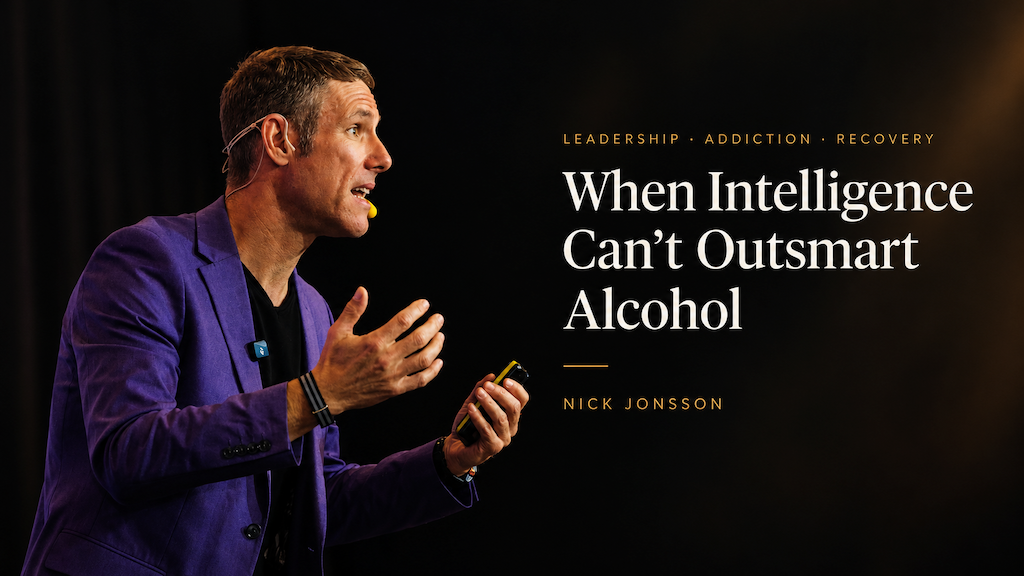
Why Highly Intelligent and Successful People Struggle to Stop Their Alcohol Consumption
By Nick Jonsson | Psychotherapist, Counsellor & Certified Sober Coach, Specializing in Addiction and Recovery
How can someone run a multimillion-dollar business, manage hundreds of employees, make complex decisions every day and still struggle to control something as seemingly simple as having another alcoholic drink?
How can a person who has overcome enormous professional challenges, built a successful career and demonstrated extraordinary discipline find themselves repeatedly breaking promises about alcohol?
And perhaps the most uncomfortable question of all:
What if the very intelligence, resilience and determination that made someone successful are also making it harder for them to recognize that they need help?
This is something I have thought about extensively throughout my own recovery journey, my work supporting people with addiction-related challenges and my experience attending more than 1,000 recovery meetings.
I have encountered CEOs, entrepreneurs, senior executives and highly accomplished professionals who can solve extraordinarily complex problems in their working lives but struggle to control or stop their alcohol consumption.
Over time, I have come to believe that there is a fascinating paradox at work.
Sometimes, the qualities that make people successful can become the very qualities that keep them trapped.
1. The Success Trap: When Resilience Works Against Us
Think about how highly successful people become successful.
They encounter problems.
They work hard, find solutions and overcome them.
Then they encounter bigger problems.
Instead of giving up, they work even harder. They become more resourceful, more disciplined and more determined.
And once again, they succeed.
Every success strengthens their confidence.
Over years and decades, they develop an extraordinary belief in their own ability to overcome challenges.
The bigger the obstacle, the more motivated they become.
Eventually, that confidence becomes part of their identity.
They are problem-solvers. They are achievers. They are people who get things done.
And in almost every area of life, this mindset serves them incredibly well.
But then alcohol becomes a problem.
Naturally, they approach it the same way they have approached every other challenge.
They decide to work harder at controlling it.
They develop strategies.
They set rules.
They make promises.
They convince themselves that if they apply enough discipline and intelligence, they will eventually solve the problem.
“Highly successful people have built incredible resilience throughout their lives. Every time they face a bigger challenge, they work harder and overcome it. That success gives them even more confidence that they can solve anything. But when it comes to alcohol, that same confidence can become a disadvantage. They believe they can outsmart alcohol too.”
— Nick Jonsson
Here is where the paradox becomes dangerous.
Alcohol dependence is not simply a problem of insufficient effort or discipline. It is a medical condition involving biological, psychological and behavioral processes.
For someone who has developed alcohol dependence, working harder at controlling their drinking may not produce the results they expect.
In fact, their determination to solve the problem independently can sometimes delay the moment when they recognize that they need a different approach.

The belief that you can overcome anything can become a problem when it prevents you from recognizing what you cannot control alone.
2. The Endless Negotiation: Trying to Outsmart Alcohol
One of the most fascinating patterns I have witnessed in recovery communities is how much effort people invest in trying to find a way to drink successfully.
They do not necessarily deny that alcohol has caused problems.
Instead, they convince themselves that the problem was the circumstances.
Perhaps they drank the wrong type of alcohol.
Perhaps they drank too quickly.
Perhaps they were with the wrong people.
Perhaps they should have eaten more.
Perhaps they simply needed better rules.
And so the negotiations begin.
I’ll only drink organic wine.
I’ll never drink alone.
I’ll never drink at home.
I’ll only drink at home, where I can control the environment.
I’ll never drink during working hours.
I’ll only drink beer, not spirits.
I’ll stop after two glasses.
I’ll only drink on weekends.
I’ll take a month off to prove I can stop whenever I want.
For some people, setting boundaries around alcohol is a perfectly reasonable personal choice.
But for someone who repeatedly loses control, these rules can become something else entirely.
They become experiments.
And every experiment carries the hope that this time, they have finally discovered the formula.
What makes this particularly challenging for intelligent people is that they may be exceptionally good at constructing convincing explanations for why the next experiment will succeed.
They analyze their previous failures, identify what they believe went wrong and develop a new strategy.
Sometimes the strategy appears to work.
They successfully moderate their drinking for a few weeks or months.
And that temporary success becomes evidence, in their own minds, that they have regained control.
Until the next time.
“Intelligent people can become very good at rationalizing their drinking. They negotiate with themselves, create new rules and convince themselves that this time they have figured it out. Sometimes they manage to control it for a while, and that gives them even more confidence. But then they lose control again, sometimes with even greater consequences.”
— Nick Jonsson
Alcoholics Anonymous Recognized This Pattern Decades Ago
This is not a new observation.
In Chapter 3 of the Alcoholics Anonymous Big Book, titled More About Alcoholism, the authors describe people repeatedly experimenting with different ways of drinking.
The chapter lists numerous strategies, including changing the type of alcohol, limiting the number of drinks, avoiding drinking alone and restricting drinking to certain times or places.
One passage captures the pattern:
“By every form of self-deception and experimentation, they will try to prove themselves exceptions to the rule.”
— Alcoholics Anonymous, Chapter 3, page 31
What strikes me about this passage is how accurately it describes something I have witnessed repeatedly.
People can spend enormous amounts of time and intellectual energy trying to find a way around their drinking problem.
They are not necessarily lacking motivation.
They may be extraordinarily motivated.
But they are directing that motivation toward proving they can continue drinking rather than honestly examining whether drinking is still working for them.
Sometimes, the smartest person in the room can become the most convincing negotiator with themselves.
And that negotiation can continue for years.
3. When Intelligence Becomes Rationalization
Intelligence is generally considered an advantage.
It allows us to understand complicated situations, anticipate consequences, evaluate risks and make informed decisions.
But understanding a problem intellectually is not the same as being able to change a deeply established behavior.
Someone can understand perfectly well that alcohol is damaging their health, relationships or reputation and still struggle to stop.
They may know the risks.
They may have experienced the consequences.
They may have promised themselves repeatedly that things will be different.
Yet they return to the same behavior.
Why?
Because addiction is not simply a failure of knowledge.
Alcohol use disorder involves brain systems associated with reward, motivation, habits and self-control. Psychological factors, emotional distress, social environments and learned behaviors can also play important roles.
For some intelligent individuals, the ability to analyze situations can become a way of avoiding uncomfortable truths.
They may explain away warning signs.
They may compare themselves with people whose drinking appears worse.
They may focus on periods when they successfully moderated their consumption rather than the occasions when they lost control.
They may convince themselves that because they are functioning well professionally, their drinking cannot be a serious problem.
And because they are articulate and persuasive, they may be particularly convincing — including to themselves.
This is why I believe intelligence can sometimes become an obstacle rather than a protective factor.
Not because intelligence causes addiction, but because intellectual confidence can make it harder to acknowledge when familiar strategies are failing.

4. The Ego Problem: When Success Makes Asking for Help Difficult
There is another dimension to this problem that I believe deserves more attention.
Ego.
Many successful executives have spent decades building an identity around competence, independence and control.
They are accustomed to being the person others turn to for answers.
They solve problems.
They make decisions.
They take responsibility.
But what happens when they become the person who needs help?
For some, that transition is incredibly difficult.
Admitting that alcohol has become a problem may feel like admitting that they have failed.
And failure is something they have spent their careers learning to overcome or avoid.
“Ego can be one of the biggest obstacles in recovery. We need to learn to deflate the ego. For someone who has built their identity around being successful and in control, admitting they need help can be incredibly difficult.”
— Nick Jonsson
Then there is shame.
And stigma.
For a CEO, the perceived consequences of acknowledging a drinking problem can feel enormous.
What will colleagues think?
What will happen to their professional reputation?
Will their family lose respect for them?
Could their career be affected?
Will people question their judgment or leadership?
The more someone has achieved, the more they may believe they have to lose.
And so they remain silent.
They continue trying to solve the problem privately.
They make new promises.
They create new rules.
And they keep struggling.
Yet the very thing they may be avoiding — vulnerability — can become an important part of recovery.
There is a profound difference between admitting defeat and acknowledging that something needs to change.
Asking for help does not mean someone is weak.
It means they are willing to be honest.
5. The High-Performing Lifestyle Can Make Things Harder
There is another challenge that successful professionals often face.
Their lifestyle.
For many CEO’s and entrepreneurs, alcohol is woven into both their professional and social worlds.
Business dinners.
Airport lounges.
Conferences.
Networking events.
Celebrations.
Music Festivals.
Client entertainment.
Golf weekends.
Ski holidays.
Destination weddings.
Funerals. Yes here too!
In many of these environments, alcohol is not merely available. It is part of the experience.
I have heard countless stories in recovery meetings about successful professionals who found themselves struggling particularly during business travel or social occasions where alcohol was readily accessible.
Someone may successfully avoid drinking during their normal working week, only to encounter a completely different environment during a conference or weekend away.
And once they start drinking, they may struggle to stop.
This creates another difficult realization.
Changing one’s relationship with alcohol may require changing aspects of one’s lifestyle.
That can mean declining invitations, leaving events earlier, choosing different environments or developing new ways of socializing.
It may also mean discovering that some relationships were built more around drinking than genuine connection.
These changes are not always easy.
But they can create space for a more authentic and sustainable way of living.

6. What Does the Research Actually Tell Us?
The relationship between intelligence and alcohol problems is scientifically complex.
Some studies have found associations between higher childhood cognitive ability and certain patterns of alcohol consumption or problematic drinking later in life.
For example, a 2008 study published in the American Journal of Public Health, titled Childhood Mental Ability and Adult Alcohol Intake and Alcohol Problems, identified associations between higher childhood mental ability and some measures of adult drinking problems.
A 2019 study, Intelligence Moderates the Relationship Between Delay Discounting Rate and Problematic Alcohol Use, explored how intelligence interacts with the tendency to prioritize immediate rewards over longer-term consequences.
However, other large studies have found that higher intelligence is associated with a lower overall risk of alcohol use disorder.
The evidence therefore does not establish that intelligent people are generally more likely to become addicted to alcohol or have greater difficulty quitting.
That distinction matters.
My observations are not a claim that intelligence causes addiction.
Rather, I believe that certain habits associated with professional success — self-reliance, confidence, persistence and the ability to rationalize — can create two significant obstacles. First, they can make it harder for individuals to admit they have a problem and ask for help. Second, even when they recognize they need to stop consuming alcohol, their confidence in their own abilities can lead them to believe they can overcome the problem through intelligence, determination and willpower alone, making it even harder to break free from alcohol dependence.
It is a pattern I have encountered throughout my own recovery and professional work, and one that I believe deserves further exploration.
7. The Real Turning Point Is Not Intelligence. It Is Honesty.
If there is one lesson I have learned through recovery, it is that change often begins with honesty.
Not intellectual understanding alone.
Not another strategy.
Not another promise.
Honesty.
The willingness to examine our relationship with alcohol without explaining away the uncomfortable parts.
The willingness to acknowledge when our attempts to control drinking are not working.
And the willingness to consider that we may need support.
For someone who is highly successful, this can require a different kind of courage.
It means setting aside the identity of the person who always has the answers.
It means accepting uncertainty.
It means being vulnerable.
“My message to anyone struggling is to start with awareness and honesty. Have the courage to look at yourself and have the conversation. You do not need to have all the answers, and you certainly do not need to solve everything alone.”
— Nick Jonsson
Fortunately, seeking support today does not necessarily mean attending a public meeting or visiting a physical clinic.
Confidential online counselling, psychotherapy and recovery support have made it possible for people to begin conversations privately.
Peer-support communities can also provide valuable connection, accountability and understanding.
For people who are physically dependent on alcohol, medical guidance is especially important because suddenly stopping can cause dangerous withdrawal symptoms.
There is no single recovery pathway that works for everyone.
But there is enormous value in being willing to explore what support might help.

8. Perhaps the Smartest Decision Is to Stop Trying to Outsmart Alcohol
I often think about the extraordinary capabilities of the people I have encountered throughout my career and recovery journey.
Some have built remarkable businesses.
Some have led international organizations.
Some have overcome financial crises, personal setbacks and seemingly impossible professional challenges.
They are intelligent, resilient and determined.
Yet their relationship with alcohol has sometimes become one of the most difficult challenges of their lives.
And perhaps that is because the solution requires something different from what made them successful in the first place.
Less negotiation.
Less rationalization.
Less reliance on willpower alone.
More awareness.
More honesty.
More vulnerability.
And greater willingness to accept support.
“You can be extraordinarily successful, intelligent and resilient, yet still struggle to control or stop your drinking. The breakthrough may come when you stop trying to outsmart the problem and become willing to approach it differently.”
— Nick Jonsson
After attending more than 1,000 recovery meetings, one thing has become increasingly clear to me:
Intelligence is a tremendous asset. But it is not immunity from addiction.
And sometimes, the greatest act of intelligence is recognizing that we cannot solve every problem alone.
About the Author
Nick Jonsson is a qualified psychotherapist and counsellor specializing in addiction-related challenges, a Certified Sober Coach through The Sober Club UK, executive coach, international keynote speaker and bestselling author of Executive Loneliness. He is the founder of Limitless Executive Solutions and was ranked No. 28 worldwide in the Global Gurus Top 30 Coaching Professionals for 2026.
Nick holds a Postgraduate Diploma in Psychotherapy and Counselling from the School of Positive Psychology in Singapore and is registered with the International Council of Integrative Psychotherapists (ICIP), holding the designation MICIP (Registered). He is also an ICF Professional Certified Coach (PCC) and a Certified Master Coach (CMC).
Drawing on his own recovery journey and experience attending and supporting more than 1,000 recovery meetings, Nick works with executives, entrepreneurs and professionals facing addiction-related challenges, relapse risk, emotional distress and major life transitions. He advocates for honest conversations, vulnerability, confidential support and sustainable recovery.
Or follow Nick on LinkedIn for weekly insights on coaching, leadership, wellbeing, and performance.