

Nick Jonsson Delivers Team Psychological Safety Training in Singapore
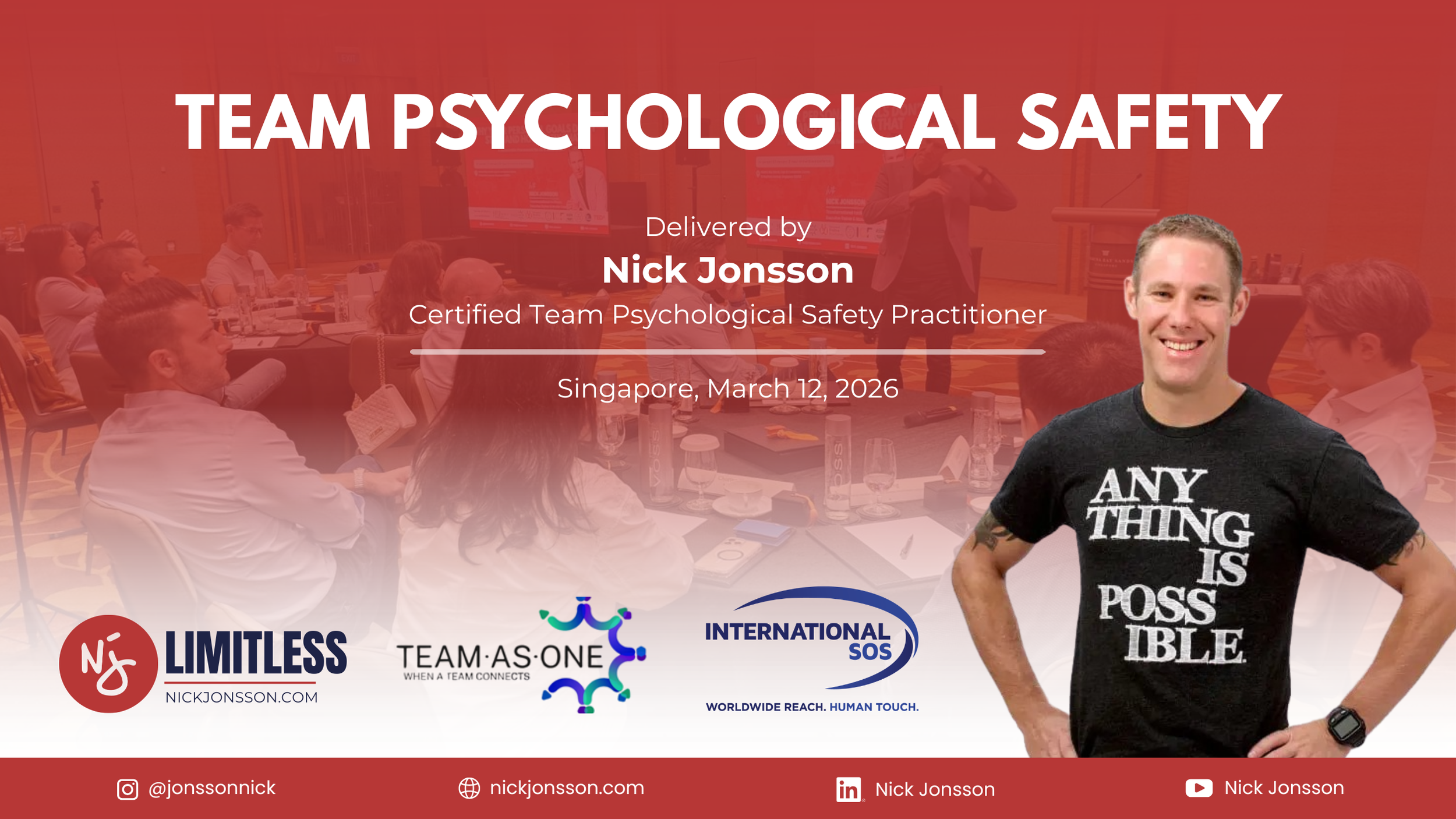
Nick Jonsson Delivers Team Psychological Safety Training in Singapore
On March 12, 2026, Singapore-based keynote speaker and leadership facilitator Nick Jonsson delivered an interactive team psychological safety training programme for corporate leaders in Singapore.
The 90-minute session explored one of the most important questions facing modern organisations: Do employees feel safe enough to speak honestly, admit mistakes, ask for help and raise concerns before small problems become serious ones?
Psychological safety has become an increasingly important leadership priority. Organisations depend on people sharing accurate information, contributing different perspectives and speaking up when something does not feel right. Yet even capable and committed employees may remain silent if they believe questioning a decision, acknowledging uncertainty or reporting a mistake could damage their reputation or career.
Nick’s training helped participants move beyond a general discussion of trust. It presented team psychological safety as something leaders can observe, assess and strengthen through practical behaviours.
As a Certified Team Psychological Safety Practitioner, experienced senior executive and author, Nick combined research, personal storytelling, team reflection and actionable leadership tools. His aim was not only to explain psychological safety, but also to help leaders recognise where silence appears and decide what they can do differently.
What Is Team Psychological Safety?
Team psychological safety is commonly described as a shared belief that a team is safe for interpersonal risk-taking.
In practical terms, it means people believe they can:
Ask questions without being made to feel incompetent
Acknowledge mistakes without being humiliated
Request help when they need it
Offer a different point of view
Challenge an assumption or decision respectfully
Raise concerns before a problem escalates
Discuss difficult issues honestly
Contribute ideas without fear of ridicule
Be open about uncertainty
Learn together when something goes wrong
Nick emphasised that psychological safety is not the same as comfort, constant agreement or an absence of accountability.
It does not mean being nice all the time. It does not mean avoiding difficult conversations, accepting poor performance or lowering professional standards.
Psychological safety means creating an environment in which people feel able to speak the truth—even when the truth is uncomfortable.
A psychologically safe team can still have demanding goals, candid feedback and robust debate. In fact, psychological safety can make these things more productive because people are better able to discuss performance and problems without becoming defensive or withdrawing from the conversation.
The Organisational Cost of Silence
Silence is rarely proof that everything is going well.
Employees may stay quiet because of hierarchy, previous negative experiences, fear of embarrassment or a belief that their contribution will not make a difference. Junior colleagues may see something important but hesitate to challenge a more senior person. Experienced team members may notice a risk but decide it is safer not to raise it.
In these environments, leaders can mistakenly interpret silence as agreement.
Nick’s session examined what can happen when concerns are ignored or people do not feel able to challenge authority. Historical examples demonstrated how technical knowledge and professional competence are not always enough to prevent failure. When hierarchy discourages people from speaking, crucial information may never reach those making the decisions.
The lesson for organisations is not that every concern will prove correct. It is that teams need a reliable way to surface and examine concerns before deciding what action to take.
Speaking up early gives an organisation more options. Problems can be investigated while they are still manageable. Assumptions can be tested. Decisions can be improved. Employees can learn from mistakes rather than concealing them.
When people remain silent, the organisation loses access to information it may urgently need.
Where Does Silence Appear in a Team?
During the training, participants were invited to reflect on situations in which silence might appear in their own teams.
These situations can include:
Employees hesitating to challenge a decision
Team members hiding or minimising mistakes
People waiting too long before asking for help
Junior employees remaining quiet in meetings
Concerns being raised privately but not discussed openly
Difficult issues being repeatedly postponed
Alternative viewpoints disappearing too quickly
Employees agreeing publicly while disagreeing privately
Warning signs being noticed but not escalated
Leaders receiving less candid information as they become more senior
This reflection matters because silence is not always obvious. A team may appear harmonious while important conversations are taking place only outside the meeting room—or not taking place at all.
Leaders therefore need to look beyond whether employees are friendly or cooperative. They need to consider whether people are genuinely able to ask, admit and raise: ask for support, admit uncertainty or mistakes, and raise concerns when something needs attention.
The Error-Reporting Paradox
One of the concepts explored during the session was the error-reporting paradox.
A team that reports more mistakes may initially appear to be performing worse than a team that reports very few. However, the number of reported mistakes does not necessarily show how many mistakes are actually occurring. It may reveal how safe people feel discussing them.
High-performing teams can sometimes report more mistakes because their members are willing to acknowledge problems. These teams make errors visible, allowing the organisation to investigate causes, share lessons and improve systems.
A team reporting no mistakes may be operating perfectly—but it may also be hiding them.
This changes the questions leaders need to ask. Rather than focusing only on the number of reported problems, leaders should consider:
How easy is it for an employee to report a mistake?
What happens immediately after someone speaks up?
Does the response encourage future honesty?
Is the discussion focused on learning or blame?
Are recurring patterns identified and addressed?
Do employees believe reporting an issue will lead to constructive action?
A leader’s reaction in these moments sends a powerful message. One dismissive or punitive response can discourage future openness far beyond the individual involved. A thoughtful, curious response can demonstrate that speaking up is both safe and valuable.
Team Psychological Safety Can Be Measured
A central message from Nick’s training was that psychological safety is not simply a vague feeling or abstract cultural ambition.
It can be assessed through the behaviours that employees experience in their daily work.
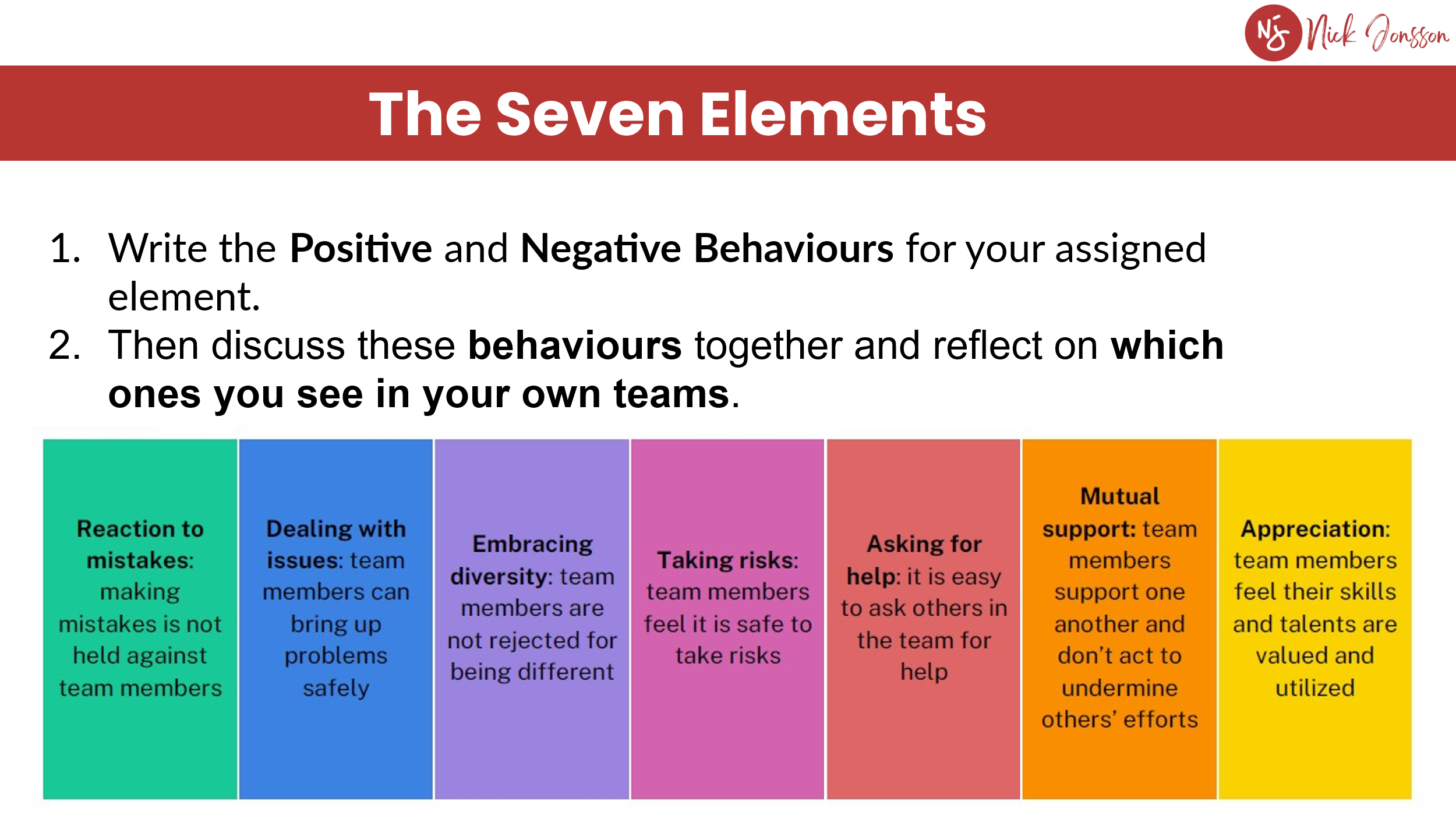
The session introduced seven elements of team psychological safety:
1. Reactions to mistakes
How does the team respond when something goes wrong?
If mistakes are immediately met with embarrassment, blame or punishment, people are more likely to hide them. Constructive responses do not remove accountability. They allow the team to understand what happened, address the consequences and reduce the likelihood of repetition.
2. Dealing with issues
Can the team openly discuss difficult matters, or do problems remain unresolved?
Psychological safety is stronger when teams can address tension, uncertainty and disagreement directly. Avoiding an issue may preserve short-term comfort, but it often creates larger problems later.
3. Embracing diversity
Are different perspectives genuinely welcomed?
Diversity creates value only when people feel able to contribute their distinct experiences and opinions. If team members expect rejection or judgement, the organisation may appear diverse while continuing to hear only a narrow range of views.
4. Taking risks
Can people experiment, suggest new approaches and question established methods?
Innovation involves uncertainty. Teams need appropriate freedom to test ideas and learn from outcomes without treating every unsuccessful attempt as a personal failure.
5. Appreciation
Do employees feel that their effort and contribution are recognised?
Appreciation helps people understand that their work matters. It can also encourage continued participation by showing that thoughtful contributions and honest communication are valued.
6. Asking for help
Can team members admit that they need support?
In an unsafe environment, asking for help may be interpreted as weakness or incompetence. In a healthier team, it is recognised as a responsible step that helps protect quality, performance and wellbeing.
7. Mutual support
Do team members actively help one another succeed?
Psychological safety becomes stronger when support is part of the team’s normal way of working. Employees are more likely to communicate openly when they trust that colleagues will respond with fairness, respect and constructive assistance.
Together, these seven elements give organisations a structured way to examine psychological safety. A Team Psychological Safety Report can help teams identify strengths, recognise gaps and create a clearer baseline for improvement.
Measurement is not intended to label a team as simply “safe” or “unsafe.” It provides a starting point for better conversations. Different teams may have different experiences, and individual members may not experience the same environment in the same way.
The value lies in making the invisible more visible—and turning broad cultural ambitions into specific behaviours that leaders and teams can address.
Small Leadership Behaviours Have a Significant Impact
Psychological safety is influenced by formal policies, but it is experienced through everyday interactions.
Employees watch what leaders do when someone disagrees, delivers bad news, admits a mistake or asks for assistance. These moments communicate what the organisation truly values.
Nick introduced several leadership behaviours that can help strengthen psychological safety:
Respond constructively when mistakes are disclosed
Invite input before making important decisions
Ask open and thoughtful questions
Recognise employees who raise concerns
Listen without immediately becoming defensive
Show appropriate vulnerability
Acknowledge when the leader does not have every answer
Make it clear that different perspectives are welcome
Follow up when concerns are raised
Explain decisions, particularly when suggestions are not adopted
Ensure junior colleagues have opportunities to contribute
Treat requests for help as responsible leadership behaviour
These actions may appear small, but their repetition shapes team culture.
When leaders consistently respond with curiosity, employees learn that honest communication is worthwhile. When leaders react with irritation, judgement or dismissal, people learn to protect themselves by remaining silent.
Psychological safety is therefore not created through a single presentation or policy announcement. It develops through patterns of behaviour that are reinforced over time.
Turning Insight into an Action Plan
Awareness is important, but the goal of leadership training is meaningful action.
Participants were encouraged to reflect on one idea that stood out during the session and identify something they would do differently as leaders.
The programme used a practical “Continue, Stop, Start” framework:
Continue
What existing behaviour supports psychological safety and should be maintained?
This could include inviting questions, checking in with quieter colleagues, responding calmly to bad news or recognising people who contribute different perspectives.
Stop
What behaviour may be discouraging openness and needs to end?
Examples could include interrupting, dismissing concerns too quickly, reacting defensively, assigning blame before understanding the situation or allowing only the most senior voices to dominate discussions.
Start
What new behaviour could make it easier for employees to speak honestly?
A leader might begin asking for concerns before closing a meeting, actively inviting alternative viewpoints, sharing lessons from personal mistakes or holding regular conversations about team dynamics.
The action-planning process also encouraged ownership and accountability. A positive intention becomes more powerful when someone is responsible for it and a review date is established.
This approach moves psychological safety from theory into everyday leadership practice.
Bringing Personal Experience into the Conversation
Nick’s work on psychological safety is informed not only by leadership research and professional training, but also by his own personal journey.
During the session, he reflected on how someone can have strong relationships at work while still not feeling able to speak honestly about personal struggles.
Friendship, familiarity and collegiality do not automatically create psychological safety.
People may be surrounded by colleagues they like and respect but still worry that vulnerability will change how others see them. They may continue performing, leading and supporting others while privately struggling.
Genuine psychological safety requires courage from the person speaking and care from the person listening. It requires the ability to ask for help, admit difficulty and raise concerns—and an environment that responds constructively when someone does.
Nick’s willingness to connect leadership principles with lived experience gives the subject a human dimension. Psychological safety is not merely an organisational initiative. It shapes whether people feel able to be honest at moments when honesty matters most.

A Meaningful Connection with International SOS
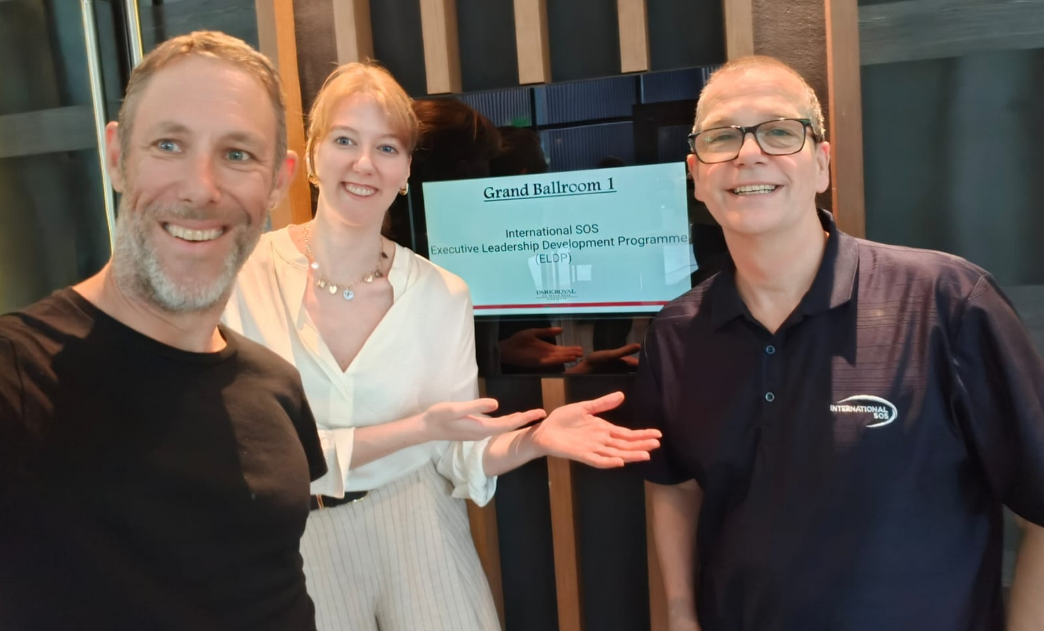
The March 12 session was delivered for leaders from International SOS, an organisation with which Nick has a longstanding professional connection.
Earlier in his corporate career, he served as General Manager of Medical Services in Indonesia from 2014 to 2015 and as Business Development Manager in Vietnam from 2009 to 2010.
Returning to work with leaders from the organisation allowed him to bring together his executive background, subsequent leadership journey and specialist work in team psychological safety.
The session was designed to create space for reflection while giving participants a practical framework they could take back to their teams.
A Team Psychological Safety Speaker in Singapore
Based in Singapore and working with organisations across Asia and internationally, Nick Jonsson delivers keynote speeches, leadership workshops and team psychological safety training for companies seeking stronger communication, healthier leadership and more effective teamwork.
His programmes can support organisations that want to:
Understand what psychological safety means in practice
Assess psychological safety across teams
Identify where hierarchy or silence may be creating risk
Strengthen speaking-up and feedback cultures
Improve the way teams respond to mistakes
Encourage earlier requests for help
Build more inclusive leadership practices
Support honest conversations about difficult issues
Increase mutual support and appreciation
Develop practical leadership action plans
Turn cultural insights into measurable improvements
Nick’s approach combines senior corporate experience, practitioner training, personal storytelling and practical team exercises. This makes his sessions relevant to leaders who need more than a theoretical introduction.
For organisations looking for a team psychological safety speaker in Singapore, Nick offers an engaging and grounded perspective on how leaders can create environments in which people feel able to contribute, challenge, learn and speak the truth.
The central message of the March 12 training was simple but significant:
Psychological safety is not built by policies alone. It is built through everyday leadership behaviours.
For enquiries about booking Nick Jonsson for a keynote, leadership workshop, team psychological safety assessment or corporate training programme in Singapore or elsewhere in Asia, get in touch to discuss your organisation’s goals.
Or follow Nick on LinkedIn for weekly insights on coaching, leadership, wellbeing, and performance.