Team Psychological Safety Masterclass for Leaders at Marina Bay Sands by Nick Jonsson

Building Psychological Safety & Care for People to Drive Results
Team Psychological Safety Masterclass for Marina Bay Sands Leaders
Event: Marina Bay Sands Learning Festival - Leadership Edition 2026
Location: Marina Bay Sands, Singapore
Date: 4 August 2026
Facilitator: Nick Jonsson
What does it really take for people to speak up at work?
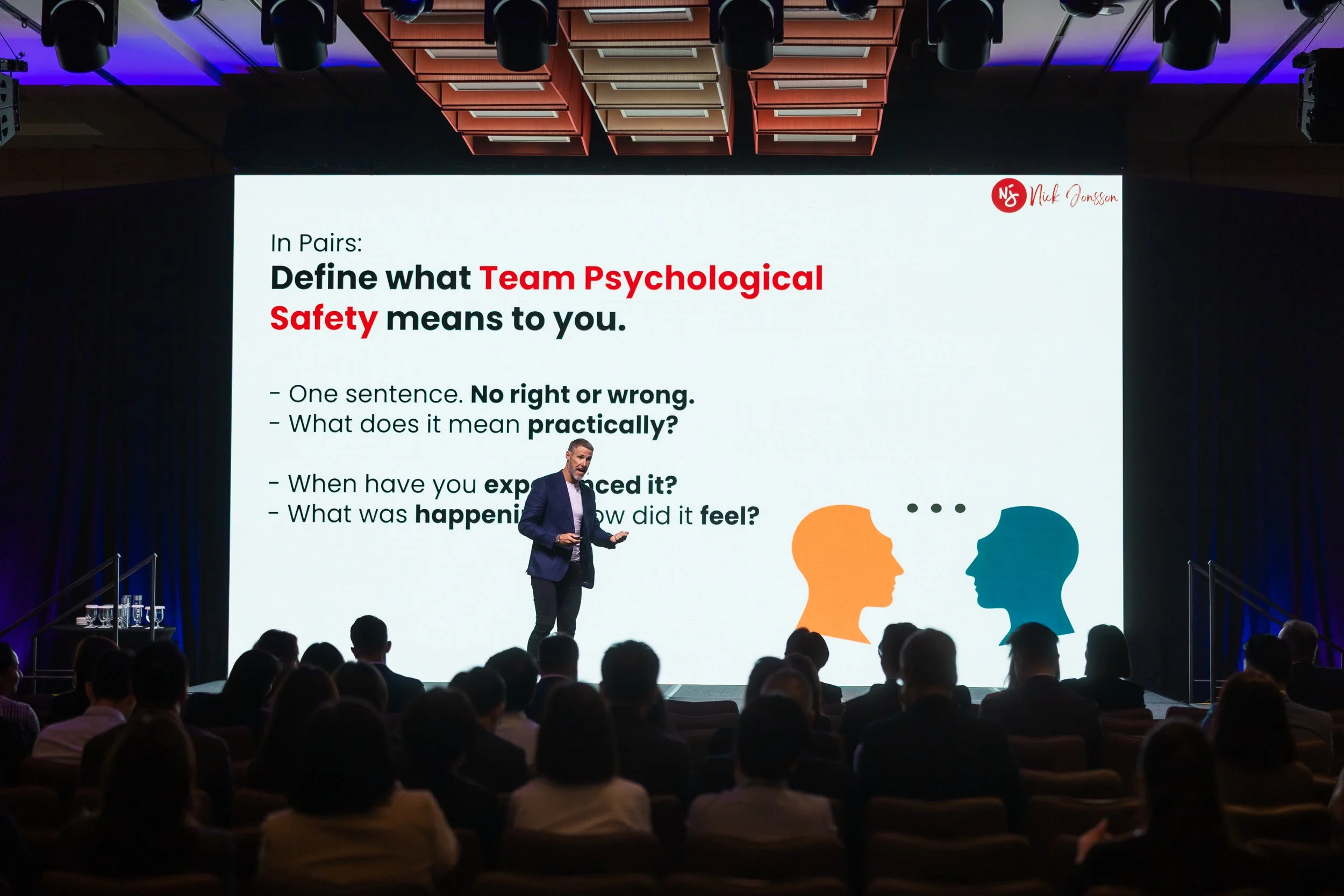
It was a privilege to facilitate a masterclass for @Marina Bay Sands leaders as part of the Marina Bay Sands Learning Festival - Leadership Edition 2026.
My session focused on a subject I care deeply about:
🎯 Building Psychological Safety & Care for People to Drive Results
We explored a simple but important question:
What happens when people don't feel safe to speak up?
When people stay silent about mistakes, concerns, ideas or challenges, the consequences can be significant.
Psychological safety isn't about being nice all the time, avoiding difficult conversations or lowering standards.
It's about creating a culture where people feel safe to:
🔹 Speak up
🔹 Challenge ideas
🔹 Admit mistakes
🔹 Ask for help
🔹 Raise concerns early
🔹 Learn and grow together
Together with the MBS leaders, we explored the cost impact of silence and where silence can show up in teams - from challenging decisions and admitting mistakes to speaking up across hierarchy.
We then focused on four practical leadership behaviours that help build psychological safety:
🔍 Be Curious - Ask more than tell.
🙏 Be Humble - Admit your own mistakes.
👏 Recognize Recognise Courage - Thank people for speaking up.
🤝 Create Inclusion - Invite quieter and junior voices.
We finished with a simple challenge:
What is ONE leadership behaviour you will intentionally practise over the next 30 days to strengthen psychological safety within your team?
Because culture isn't created by what we say we value.
💡 It's created by what leaders repeatedly do.
And high-performing organisations are built by teams where people feel safe to speak up.
🙏 A big thank you to Marina Bay Sands, the Talent Development & Management team, and all the MBS leaders who participated so openly in the conversations, reflections and exercises.
It was a privilege to contribute to this year's Leadership Learning Festival.
#PsychologicalSafety #Leadership #LeadershipDevelopment #MarinaBaySands #TeamCulture #HighPerformingTeams #LimitlessLeadership
Team Psychological Safety in Leadership
The Marina Bay Sands masterclass went beyond discussing psychological safety as a leadership concept. It explored what psychological safety looks like in everyday leadership behaviour, team conversations and organisational culture.
At the heart of the session was a practical question:
Do people feel safe enough to say what needs to be said?
In high-performing environments, employees need to be able to raise concerns, question assumptions, acknowledge mistakes, offer different perspectives and ask for help without fearing embarrassment, rejection or negative consequences.
This is particularly important in complex, fast-moving organisations where leadership decisions, collaboration, guest experience, safety, innovation and operational performance are closely connected.
What Is Team Psychological Safety?
Team psychological safety is not about removing accountability or making work comfortable all the time.
It is not about:
· Being nice all the time
· Avoiding difficult conversations
· Lowering standards
It is about creating a team culture where people feel able to speak up, challenge ideas and learn from mistakes.
One of the foundations explored during the Marina Bay Sands masterclass was Amy Edmondson's definition of psychological safety as:
“A shared belief that the team is safe for interpersonal risk taking.”
The practical implication is significant. A psychologically safe team is not necessarily a team with fewer disagreements or fewer mistakes. It is a team where important information reaches the surface earlier.
Why Psychological Safety Matters for High-Performing Teams
One of the counterintuitive ideas explored in the masterclass was why high-performing teams can sometimes appear to report more mistakes.
The reason is not necessarily that they are making more mistakes. It can be because people feel safer reporting them.
When people feel able to speak openly:
· Problems can be identified earlier
· Mistakes can become learning opportunities
· Leaders receive information they might otherwise miss
· Different ideas can be challenged constructively
· Employees are more willing to ask for help
· Risks can be raised before they become larger problems
Psychological safety therefore supports both people and performance.
The Cost of Silence
A major theme of the Marina Bay Sands session was the cost of silence.
Silence can appear harmless. But when people repeatedly choose not to raise an issue, question a decision or share what they know, the accumulated organisational cost can become significant.
During the masterclass, leaders reflected on areas where silence can affect:
1. Guest Experience
2. Safety
3. Innovation
4. Teamwork
5. Trust
6. Employee Engagement
7. Reputation
8. Performance
This shifted the conversation from psychological safety as simply a people topic to psychological safety as a leadership and business issue.
Where Does Silence Show Up in Teams?
Leaders were invited to consider where silence might already exist inside their own teams. Examples included:
· Challenging decisions
· Admitting mistakes
· Asking for help
· Speaking up across hierarchy
· Raising concerns early
These moments matter because culture is often revealed not when everything is going well, but when someone needs to say something difficult. A leader's response in that moment can determine whether the person speaks up again.
Psychological Safety and Hierarchy
Hierarchy plays an important role in organisations, but it can also unintentionally discourage employees from challenging more senior colleagues.
The question is therefore not whether hierarchy exists. The leadership question is:
Can people still speak honestly across that hierarchy?
Creating psychological safety requires leaders to actively reduce the interpersonal risk associated with speaking up. That means making it clear, through repeated behaviour, that respectful challenge, questions, concerns and alternative perspectives are welcome.
The Seven Elements That Build Team Psychological Safety
1. Reaction to Mistakes
Team members should know that making an honest mistake will not automatically be held against them. How leaders respond to mistakes can either create learning or create silence.
2. Dealing With Issues
People need to feel able to raise problems safely. When issues can be discussed early, teams have a better opportunity to address them before they grow.
3. Embracing Diversity
Team members should not feel rejected for being different. Different experiences, perspectives and ways of thinking can strengthen team decision-making when people feel safe enough to contribute them.
4. Taking Risks
People need to feel that thoughtful interpersonal and professional risk-taking is possible. Innovation rarely happens when everyone is afraid of getting something wrong.
5. Asking for Help
People should be able to ask teammates for support without believing that doing so will make them appear weak or incapable.
6. Mutual Support
Strong teams support one another and avoid behaviours that undermine colleagues' efforts.
7. Appreciation
People need to know that their skills, talents and contributions are recognised, valued and utilised.
Together, these elements help move psychological safety from an abstract leadership concept into observable team behaviour.
Four Leadership Behaviours That Build Psychological Safety
A central message from the Marina Bay Sands masterclass was:
The leadership behaviours you model every day become the culture of your team.
Be Curious
Ask more than tell. Leaders do not need to have every answer. Questions such as “What are we missing?”, “What do you see differently?” and “What concerns do you have?” can create space for perspectives that might otherwise remain unheard.
Be Humble
Admit your own mistakes. When leaders acknowledge that they can be wrong, they reduce some of the interpersonal risk experienced by everyone else. Leadership humility signals that learning matters more than protecting an image of perfection.
Recognise Courage
Thank people for speaking up. Someone who raises a concern is taking an interpersonal risk. How a leader responds to that moment matters. Recognising the courage required to speak up can reinforce the behaviour and make future honesty more likely.
Create Inclusion
Invite quieter and junior voices. Not everyone will compete for airtime. Inclusive leaders deliberately create opportunities for people who might otherwise remain silent to contribute their ideas and perspectives.
From Employee Experience to Guest Experience
For an organisation such as Marina Bay Sands, team culture has implications beyond the internal employee experience.
The session closed around a simple leadership principle:
Exceptional guest experiences begin with exceptional team experiences.
Employees who feel listened to, respected and safe to contribute are better positioned to collaborate, solve problems and deliver consistently strong experiences. Psychological safety therefore connects leadership culture with employee experience and, ultimately, the experience delivered to customers and guests.
Creating a Culture Where People Speak Up
Psychological safety is not created by a single workshop, policy or statement of organisational values.
It is created through repeated interactions.
It is built when leaders respond constructively to bad news.
It is built when someone challenges an idea and remains respected.
It is built when a junior employee is invited into the conversation.
It is built when mistakes are examined for learning rather than simply blame.
And it is built when asking for help is treated as responsible rather than weak.
Over time, these everyday moments become culture.
Turning Learning Into Leadership Action
The Marina Bay Sands masterclass concluded by asking every participant to identify one practical behaviour they would intentionally practise over the following 30 days.
The question was:
What is ONE leadership behaviour that you will intentionally practise over the next 30 days to strengthen Team Psychological Safety within your team?
This emphasis on action is central to Nick Jonsson's approach to leadership development. Insight matters. But sustainable culture change happens when leaders translate insight into consistent behaviour.
Team Psychological Safety Keynotes, Masterclasses and Leadership Workshops
Nick Jonsson works with leadership teams and organisations in Singapore, Southeast Asia and internationally to strengthen psychological safety, leadership effectiveness, team culture and sustainable high performance.
Team Psychological Safety programmes can be delivered as:
· Leadership keynotes
· Interactive masterclasses
· Leadership development workshops
· Executive team sessions
· Team coaching programmes
· Culture and psychological safety interventions
Sessions can be customised around the organisation's leadership environment, challenges and business priorities.
Topics can include:
· Team Psychological Safety
· Speaking-up cultures
· Leadership behaviours that create trust
· The cost of organisational silence
· High-performing team culture
· Vulnerability and authentic leadership
· Employee experience and customer experience
· Difficult conversations
· Learning from mistakes
· Inclusive leadership
· Team connection
· Leadership accountability

About Nick Jonsson
Nick Jonsson is a professional speaker, executive coach, counsellor, psychotherapist and Certified Team Psychological Safety Practitioner.
He is the author of the international bestselling book Executive Loneliness and was recognised as a Global Gurus Top 30 Coach 2026.
His work focuses on helping leaders and organisations strengthen leadership, psychological safety, vulnerability, connection, wellbeing and sustainable high performance.
His broader leadership philosophy is grounded in the belief that exceptional performance and human wellbeing do not need to compete with one another.
His mission is:
Empowering people to build a Limitless Life through Vulnerability & Holistic Wellbeing.
Bring Team Psychological Safety to Your Organisation
If your organisation wants people to speak up earlier, collaborate more openly, challenge ideas constructively and learn faster from mistakes, strengthening Team Psychological Safety is an important place to start.
Nick Jonsson delivers customised Team Psychological Safety keynotes, masterclasses, workshops and leadership programmes for organisations in Singapore, Asia and internationally.
Enquire about a Team Psychological Safety keynote, masterclass or leadership workshop with Nick Jonsson.
What is Team Psychological Safety?
Team Psychological Safety describes an environment where team members feel safe taking interpersonal risks, including speaking up, asking questions, admitting mistakes, challenging ideas and asking for help.
Why is psychological safety important for leadership teams?
Leadership teams operate in complex environments where important information can easily remain unspoken. Psychological safety helps leaders surface concerns, encourage constructive challenge, identify problems earlier and learn from mistakes.
Is psychological safety about being nice?
No. Psychological safety is not about being nice all the time, avoiding difficult conversations or lowering standards. It enables people to address difficult issues more openly and constructively.
How can leaders build psychological safety?
Practical leadership behaviours include asking rather than only telling, admitting personal mistakes, thanking people who speak up and intentionally inviting quieter or more junior voices into conversations.
Can Nick Jonsson deliver Team Psychological Safety workshops in Singapore?
Yes. Nick Jonsson delivers leadership keynotes, workshops, masterclasses and team development programmes in Singapore and internationally, including customised Team Psychological Safety sessions for leadership teams and organisations.
Can a Team Psychological Safety programme be customised?
Yes. Sessions can be adapted to an organisation's business context, leadership challenges, team environment, desired outcomes and level of seniority.
Or follow Nick on LinkedIn for weekly insights on coaching, leadership, wellbeing, and performance.