Resilience, Grit & the Courage to Keep Going: Nick Jonsson on Connection, Purpose and Gratitude
RESILIENCE, GRIT & THE COURAGE TO KEEP GOING
An Entertaining and Inspiring Keynote by Nick Jonsson
How do we keep going when life does not go according to plan?
We often think resilience means being tougher, pushing harder and refusing to give up.
Nick Jonsson discovered something very different.
After years of chasing success, working longer hours and presenting an image of having everything under control, he reached a point where achievement was no longer enough. Behind the successful executive people saw was a very different reality: loneliness, anxiety, unhealthy coping mechanisms and eventually burnout.
In Resilience, Grit & the Courage to Keep Going, Nick combines personal storytelling, humour, audience interaction and practical life lessons to explore what actually helps people through difficult periods.
His answer is surprisingly human:
Connection. Purpose. Gratitude.
Three simple truths that helped Nick rebuild his own life — and that audiences can begin practising immediately.
ABOUT THE TALK
We all experience setbacks.
A career changes. A relationship ends. Health suffers. Plans fall apart. Someone disappoints us. We disappoint ourselves.
And sometimes everything looks perfectly fine from the outside while internally we are struggling.
Nick knows that experience personally.
Growing up in working-class Sweden, he learned early that when life became difficult, the answer was to work harder. After an accident meant he could no longer continue his original career as a construction painter, he changed direction, moved to Australia and eventually built a successful corporate career in Southeast Asia.
The same philosophy followed him:
Work harder.
Push through.
Don't show weakness.
For a while, it worked.
There were positions, money, business travel and recognition. But underneath the visible success, Nick was increasingly struggling.
As Nick describes it in the talk:
“I knew how to achieve. Not how to cope.”
Eventually, unhealthy coping mechanisms, isolation and emotional pressure contributed to burnout. Nick describes reaching a point where he could no longer simply work his way through the problem. Transcript Talk 2
That experience eventually changed his understanding of resilience.
Resilience was not about pretending everything was okay.
It was about learning how to respond when it wasn't.

THE THREE TRUTHS OF RESILIENCE
At the heart of the keynote are three lessons Nick discovered through his own recovery and subsequent work with people around the world.
1. CONNECTION
We don't have to face hard times alone.
2. PURPOSE
We need a reason to keep going.
3. GRATITUDE
Even during difficult periods, there can still be something good worth noticing.
And underneath all three sits another idea:
Presence.
Because connection requires presence.
Purpose requires presence.
Gratitude requires presence.
TRUTH 1: CONNECTION
We Don't Have to Face Hard Times Alone
One of the most personal moments in the keynote is Nick's story about walking into his first recovery meeting.
He was uncomfortable.
He worried about being recognised.
He wasn't even convinced he belonged there.
But inside that room he discovered something he had been missing for years: people who could speak honestly about what was really happening in their lives without pretending everything was fine.
The presentation captures the progression simply:
Honesty.
No judgment.
Relief.
“When we tell the truth, others can show up for us.”
It became an important lesson in resilience.
Sometimes courage isn't pushing forward alone.
Sometimes courage is saying:
“I need help.”
Nick explores why asking for help can feel particularly difficult for successful people who have spent years being the person everyone else depends upon.
The very qualities that help someone become successful — independence, determination, responsibility and the ability to solve problems — can sometimes make it difficult to admit when they cannot solve something alone.
Connection changes that.
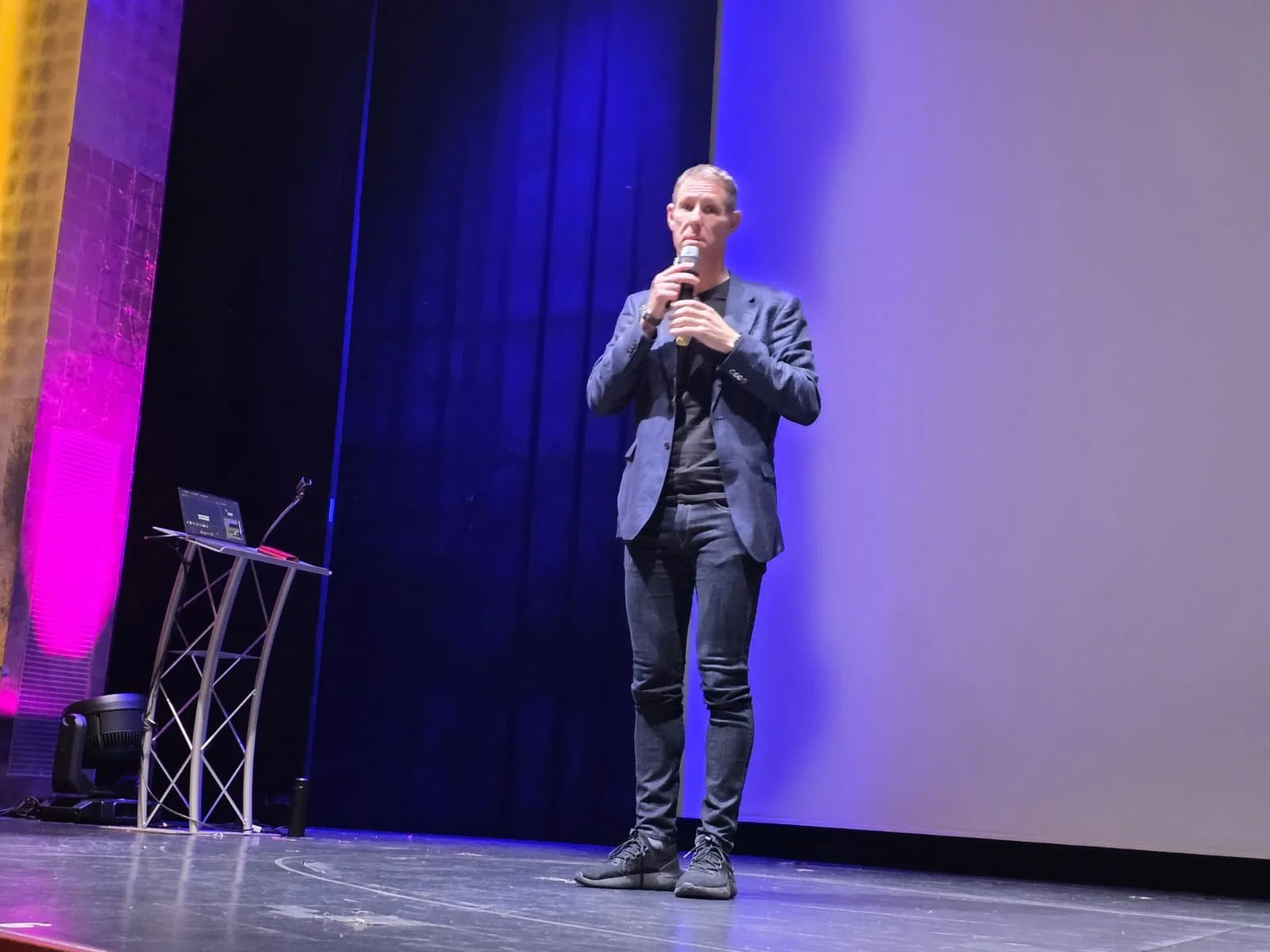
COMMUNICATION IS NOT THE SAME AS CONNECTION
We live in one of the most connected periods in human history.
We have phones.
Messages.
Email.
Social media.
Video calls.
And yet being in constant communication doesn't necessarily mean we feel connected.
One of the keynote's simplest messages is:
COMMUNICATION ≠ CONNECTION
Nick challenges audiences to consider:
Are we actually listening?
Are we present with the people sitting across from us?
Or are we physically present while mentally somewhere else?
This becomes particularly relevant in families, friendships, workplaces and leadership.
Because sometimes the person who helps us keep going isn't someone who fixes our problem.
It is simply someone who is genuinely there.
RELATIONSHIPS HELP US KEEP GOING
Nick's journey eventually led him to place far greater importance on relationships.
He speaks about repairing relationships, finding safe spaces to be vulnerable and discovering communities where people could speak openly without shame.
His message is not that everyone should tell everyone everything.
Quite the opposite.
Nick emphasises the importance of choosing appropriate people and safe spaces in which to be vulnerable.
That may be a partner.
A friend.
A coach.
A therapist.
A support group.
A colleague.
A community.
Sometimes resilience begins with finding one person with whom we don't need to pretend.
TRUTH 2: PURPOSE
A Reason to Keep Going
Purpose does not always mean changing the world.
It can be much quieter than that.
It can mean being there for someone.
Helping another person.
Supporting a family member.
Mentoring somebody.
Volunteering.
Listening.
Sharing something you have learned.
Nick describes an important shift in his own life:
FROM ACHIEVEMENT
“What can I achieve?”
TO CONTRIBUTION
“What can I contribute?”
For much of his earlier life, success was measured through achievement.
The next position.
The next goal.
The next recognition.
The next milestone.
But during his recovery, Nick began discovering purpose through helping others.

“THIS GROUP SAVED ME.”
One of the stories Nick shares concerns the men's community that developed from people supporting one another.
It became a place where men could speak honestly, share challenges and support each other.
And then one member said something Nick never forgot:
“This group saved me.”
That sentence helped Nick see purpose differently.
Something that may seem relatively small to us can be enormously important to somebody else.
You don't necessarily need a grand mission.
Purpose can simply mean:
BE THERE FOR SOMEONE.
Instead of continually asking:
“What can I get from life?”
Nick invites audiences to occasionally ask:
“What can I give?”
TRUTH 3: GRATITUDE
Notice What Is Still Good
Nick begins the keynote with something he now regularly practises himself:
A Gratitude Moment.
He asks the audience:
What are you grateful for today?
It could be a person.
A moment.
Or something small.
Nick began deliberately practising gratitude in January 2024.
What started as a 30-day challenge became part of his life.
He began noticing things he previously might have taken for granted:
Family.
Health.
Sleep.
Sobriety.
Service.
And the ordinary moments of everyday life.
The lesson became:
GRATITUDE CHANGES WHAT WE NOTICE.
YESTERDAY'S DREAM. TODAY'S EXPECTATION.
The keynote also explores something many of us experience without noticing.
We dream about something for years.
Then we finally get it.
And surprisingly quickly, it becomes normal.
The dream becomes an expectation.
Nick brings humour into this idea through everyday situations — including being on a beautiful cruise and suddenly becoming annoyed because somebody has taken the sunbed we wanted.
Yesterday we might have dreamed about being there.
Today we're frustrated about the sunbed.
The presentation captures the idea in five words:
YESTERDAY'S DREAM.
TODAY'S EXPECTATION.
Gratitude helps interrupt that process.
It reminds us to notice what we already have before immediately moving on to what is missing.
THE “I'LL BE HAPPY WHEN…” TRAP
There is another pattern Nick asks audiences to recognise:
I'll be happy when…
I get promoted.
I earn enough money.
I find the perfect partner.
My children become successful.
I retire.
I finally take that dream holiday.
The problem isn't having goals.
The problem is continually postponing life until the next goal is achieved.
Nick describes the mindset as:
SUCCESS FIRST. HAPPINESS LATER.
And eventually:
WE MAKE HAPPINESS WAIT.
The talk encourages audiences to pursue meaningful goals without missing the life happening around them while they pursue them.
PRESENCE: WHERE THE THREE TRUTHS MEET
Connection.
Purpose.
Gratitude.
They appear different.
But Nick argues that they all require the same thing:
Being fully present.
You cannot deeply connect with somebody while constantly distracted.
You cannot notice where you can contribute if you aren't paying attention.
And you cannot appreciate what is good if your mind is always somewhere else.
Nick describes the modern contradiction perfectly:
PRESENT IN BODY.
ABSENT IN MIND.
We can be sitting at dinner with somebody we love while looking at our phone.
We can be travelling somewhere beautiful while answering emails.
We can be with our children while mentally replaying tomorrow's meeting.
Life is happening around us.
The question is whether we are actually there for it.
THREE QUESTIONS TO TAKE HOME
Nick leaves audiences with three simple questions:
WHO CAN I CONNECT WITH?
Who could I call, message, meet or listen to more carefully?
HOW CAN I CONTRIBUTE?
Who could I help today?
WHAT AM I GRATEFUL FOR NOW?
What is already good in my life that I may have stopped noticing?
These become three practical actions:
CONNECT — Reach out to someone.
CONTRIBUTE — Offer help.
APPRECIATE — Notice one good thing.

THE COURAGE TO KEEP GOING
Resilience does not mean life stops being difficult.
It doesn't mean we never struggle.
And it doesn't mean doing everything alone.
Sometimes resilience means connecting.
Sometimes it means rediscovering purpose.
Sometimes it means noticing something good in the middle of something difficult.
And sometimes the bravest thing we can do is ask another person to walk the next part of the journey with us.
THE COURAGE TO KEEP GOING STARTS HERE.
We can ask someone to take the next step with us.
KEY AUDIENCE TAKEAWAYS
After Resilience, Grit & the Courage to Keep Going, audiences will leave with a simple and memorable framework for thinking about resilience:
Connection — We don't have to face difficult periods alone.
Purpose — Having something or someone worth showing up for can give us a reason to keep moving.
Gratitude — Paying attention to what remains good can change what we notice.
Presence — Connection, purpose and gratitude become much harder when we're physically present but mentally somewhere else.
Most importantly, the keynote makes resilience feel human and practical, rather than another demand to simply “be stronger.”
WHO IS THIS KEYNOTE FOR?
Resilience, Grit & the Courage to Keep Going can work particularly well for:
Corporate conferences and leadership events; employee wellbeing and engagement programmes; company retreats and offsites; association conferences; cruise and enrichment programmes; universities and educational institutions; community events; men's wellbeing events; and audiences navigating change, pressure or transition.
The talk can be positioned as an inspirational keynote, motivational keynote, resilience keynote, wellbeing keynote or entertainment/enrichment talk, depending on the audience and event.
WHY NICK JONSSON?
Nick Jonsson brings lived experience to a subject that can otherwise become theoretical.
He has experienced professional success and burnout, isolation and connection, unhealthy coping mechanisms and recovery, setbacks and reinvention.
Today, Nick works as a speaker, coach, counsellor and psychotherapist and speaks openly about the lessons he has learned along the way. His presentations combine personal experience with practical questions audiences can apply to their own lives. His live talk explicitly connects his professional work with burnout, counselling, psychotherapy and addiction recovery. Transcript Talk 2
His storytelling also comes from experience outside the boardroom — including recovery, relationships, community, returning to study and endurance sport.
That combination gives Nick a distinctive perspective on resilience:
You don't always become stronger by pushing harder. Sometimes you become stronger by connecting, contributing, appreciating and allowing somebody else to help.

FREQUENTLY ASKED QUESTIONS
What is Nick Jonsson's resilience keynote about?
Nick Jonsson's Resilience, Grit & the Courage to Keep Going keynote explores how people can navigate difficult periods through three central practices: connection, purpose and gratitude. The keynote combines Nick's personal experiences with audience interaction and practical reflection.
What are Nick Jonsson's Three Truths of Resilience?
They are Connection, Purpose and Gratitude. Connection means not having to face difficult periods alone. Purpose provides a reason to keep going. Gratitude helps us notice what remains good.
What role does presence play in resilience?
In Nick's keynote, presence connects all three truths. Connection requires being present with others, purpose requires noticing where we can contribute, and gratitude requires noticing what is happening now. Is this a motivational keynote?
Yes. The talk is designed as an inspirational and motivational keynote, but it also contains practical reflections audiences can use after the event.
Is this keynote suitable for corporate audiences?
Yes. The themes of pressure, achievement, burnout, relationships, purpose, gratitude and resilience are directly relevant to executives, leaders and employees. Nick's own story includes many years in the corporate world before his later work as a speaker, coach, counsellor and psychotherapist.
Does Nick Jonsson talk about burnout?
Yes. Nick shares his own experience of burnout and describes how continually working harder while hiding his struggles contributed to unhealthy coping mechanisms and eventually serious difficulties.
Does the keynote discuss addiction and recovery?
Yes. Nick shares aspects of his recovery journey, including attending his first recovery meeting and learning the importance of honesty, asking for help and connecting with people who understood what he was experiencing.
Is the keynote only for people experiencing major adversity?
No. The framework is deliberately applicable to everyday life. Audiences are encouraged to think about relationships, contribution, gratitude, presence and which areas of life currently need attention.
Is this a heavy talk?
The subject matter includes serious experiences, but the presentation itself mixes vulnerable storytelling with humour, relatable situations, audience participation and positive, practical messages.
What practical actions can audiences take after the keynote?
Nick reduces the framework to three immediate actions: Connect — reach out to someone; Contribute — offer help; Appreciate — notice one good thing.
Can this keynote be adapted for different audiences?
The core themes are broad enough to work across corporate conferences, leadership events, wellbeing programmes, retreats, community audiences and entertainment or enrichment programmes.

CALL TO ACTION
BRING RESILIENCE, GRIT & THE COURAGE TO KEEP GOING TO YOUR NEXT EVENT
Looking for a resilience keynote that is personal, engaging, thought-provoking and practical?
Nick Jonsson brings audiences into a deeply human conversation about what happens when life becomes difficult — and why the answer isn't always to push harder.
Through storytelling, humour and audience participation, Nick introduces three ideas audiences can remember long after the event:
CONNECT.
CONTRIBUTE.
APPRECIATE.
Enquire about Nick Jonsson speaking at your conference, corporate event, leadership retreat, wellbeing programme or special event.
BOOK NICK JONSSON TO SPEAK
Or follow Nick on LinkedIn for weekly insights on coaching, leadership, wellbeing, and performance.