

Creating Daily Wins for Health, Happiness & Meaning: Nick Jonsson on Why Communication Is Not Connection

How Human Connection Can Transform the Way We Live, Lead and Relate
A motivational keynote by Nick Jonsson
Creating Daily Wins Through Connection
We often think about health, happiness and meaning as separate parts of life.
But there is something that connects all three:
Our relationships with other people.
We can be surrounded by colleagues, friends, family members and thousands of social-media connections and still experience loneliness.
We can communicate constantly without truly connecting.
And we can become successful professionally while gradually becoming disconnected personally.
In Creating Daily Wins for Health, Happiness & Meaning, speaker, coach, author, psychotherapist and counsellor Nick Jonsson explores why meaningful human connection is an essential part of holistic wellbeing—and what we can do every day to strengthen it.
Drawing on his own journey through corporate success, loneliness, burnout and recovery, together with his work with executives and communities around the world, Nick challenges audiences to think differently about what it means to live a successful life.
The message is simple:
One of our most powerful daily wins is connection.
What Is the Keynote About?
Nick Jonsson’s keynote Creating Daily Wins for Health, Happiness & Meaning explores the role human connection plays in our physical, social and emotional wellbeing.
At the heart of the presentation is an important distinction:
Communication is not always connection.
We have never had more ways to communicate. Yet simply exchanging messages, attending meetings, networking or being surrounded by people does not necessarily mean that we feel genuinely known, supported or understood.
Nick uses his own experience to illustrate this paradox.
As his corporate career progressed, his external success increased—but his sense of belonging declined.
Each promotion seemed to give him more space, greater responsibility and greater professional recognition. At the same time, he found himself increasingly disconnected from the people around him.
Eventually, Nick realised that the problem wasn’t simply that he needed more people around him.
He needed deeper and more authentic relationships.
Connection: The Third Step in Holistic Leadership
The keynote forms part of Nick Jonsson’s broader Five Steps to Holistic Leadership framework:
Surrender
Purpose
Connection
Goals
Discipline
Nick describes Holistic Leadership primarily as self-leadership: learning to lead ourselves socially, physically and mentally rather than measuring life only through professional performance.
This keynote focuses particularly on Step 3: Connection.
Connection means moving beyond performance and allowing ourselves to be known as human beings.
It requires curiosity.
It requires listening.
It sometimes requires vulnerability.
And occasionally it requires three words that many successful people find surprisingly difficult to say:
“I need help.”
That became a turning point in Nick’s own story.
When Success Becomes Lonely
Professional success and personal connection do not automatically grow together.
Nick experienced this firsthand during his corporate career.
People knew successful Nick.
Far fewer people knew what was actually happening underneath.
As his responsibilities grew, his relationships with colleagues changed. He found himself increasingly isolated, eating lunch alone and missing something that he initially struggled to identify.
Eventually, he understood what it was:
Belonging.
His career was climbing while his wellbeing was moving in the opposite direction.
This experience eventually led Nick to research loneliness among senior executives for his book, Executive Loneliness.
His research found that:
33% experienced executive loneliness.
80% would not speak to HR or colleagues about it.
75% would not seek professional help.
For organisations, this raises an important leadership question:
Who supports the people who are expected to support everyone else?

You Can Be Surrounded by People and Still Feel Lonely
Loneliness is not necessarily the absence of people.
Someone can be surrounded by colleagues at work, attend social functions, have a family, travel with others or be among thousands of people and still feel invisible and lonely.
That is why Nick distinguishes between contact, communication and genuine connection.
One of the simplest examples is a question we ask almost automatically:
“How are you?”
And the equally automatic answer:
“I’m fine.”
But what happens when someone isn’t fine?
Do they have a person with whom they can answer honestly?
Nick encourages audiences to consider:
Who really knows how you are?
Taking Off the Mask
One of the central themes of the keynote is what Nick calls “taking off the mask.”
For years, professional achievement allowed him to hide what was happening internally.
He could perform.
He could achieve.
He could appear confident.
He could tell people everything was fine.
But performance eventually became a barrier to authentic connection.
Nick’s experience led him to a principle that now shapes his work:
Real connection begins when the performance ends.
When we allow trusted people to see more of who we really are—including uncertainty, difficulty and imperfection—we create the possibility of a different kind of relationship.
This does not mean sharing everything with everyone.
Nick advocates selective vulnerability: understanding who has earned our trust, identifying confidential and psychologically safe relationships and communities, and choosing appropriately where to open up.
Asking for Help Is a Strength
Another barrier to connection is the belief that asking for help demonstrates weakness.
Nick once held that belief himself.
Today, he teaches the opposite:
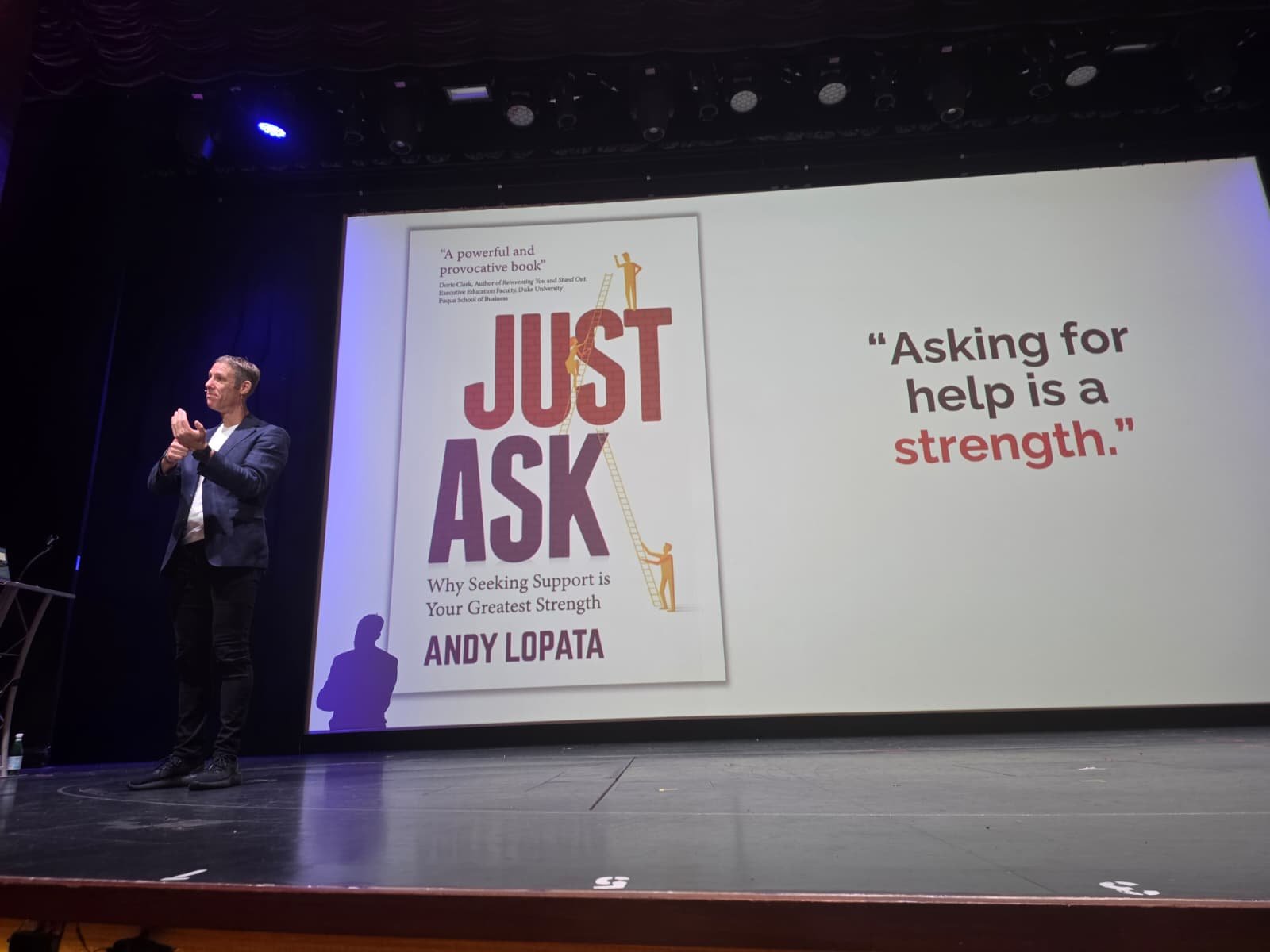
Asking for help is a strength.
The ability to recognise when we don’t have all the answers—and then identify someone who may be able to support us—is part of healthy leadership and healthy relationships.
Being capable does not require doing everything alone.
And strength does not require pretending that everything is always fine.
What Is Social Health?
We talk regularly about physical health and mental health.
Nick encourages audiences to think about a third dimension:
Social health.
Social health relates to the quality of our relationships, communities, sense of belonging and ability to give and receive meaningful support.
Nick illustrates this through sport.
Someone looking at his participation in triathlon might see physical fitness.
Nick sees something else as well:
Community.
He once trained and competed predominantly alone. Today, he deliberately builds friendships and communities around swimming, cycling and running wherever he travels.
The exercise still matters.
But so do the conversations, friendships and sense of belonging surrounding it.
Social Fitness: Relationships Need Exercise Too
Physical fitness requires regular attention.
Relationships do too.
Nick introduces audiences to the idea of social fitness: intentionally maintaining and strengthening our relationships rather than assuming they will take care of themselves.
That can involve very small actions:
Calling someone.
Checking in with a friend who is going through a difficult period.
Having coffee together.
Walking together.
Sharing a meal.
Remembering an important event in someone’s life.
Starting a conversation with someone new.
Or asking one question deeper.
These actions may appear insignificant.
Over time, however, they can create stronger relationships and a greater sense of belonging.
Building Personal and Professional Safe Spaces
Deep connection becomes easier when people have environments in which they feel able to be themselves.
Nick therefore encourages people to intentionally build personal safe spaces and professional safe spaces.
Personal safe spaces might include trusted friends, family relationships, sporting communities, peer groups or other communities where honest conversations can take place.
Professional safe spaces might include trusted peer groups, mentors, coaches, leadership communities or confidential networks of people who understand the pressures associated with a particular role.
Nick has seen this particularly through the men’s community he facilitates, where members can check in, express gratitude, acknowledge challenges and support one another.
One lesson has become especially clear:
When one person tells the truth, it gives someone else permission to do the same.
Connection, Vulnerability and Leadership
Connection also matters inside organisations.
Senior leaders frequently operate in environments where they are expected to appear decisive, confident and in control.
That can make honest conversations more difficult.
Nick’s work around executive loneliness, psychological safety, vulnerability and holistic leadership explores what happens when leaders lack appropriate spaces to discuss the pressures they carry.
The answer isn’t indiscriminate vulnerability.
It is creating appropriate relationships in which leaders can be honest, ask for support, challenge their assumptions and be known as people rather than simply by their titles.
This makes connection relevant not only to individual wellbeing but also to leadership development, organisational culture and sustainable performance.
Why Connection Matters for Health, Happiness and Meaning
Nick brings the keynote back to three dimensions of a fulfilling life.
Health
We benefit from having people who support us, check in with us and notice when something may not be right.
Happiness
Many of life’s happiest moments become more meaningful because they are shared.
A meal.
A holiday.
A laugh.
A walk.
A conversation.
Sometimes nothing extraordinary is happening at all—the value comes from who is beside us.
Meaning
Meaning can emerge when our experiences help another person.
Our own difficult chapters may eventually allow us to make someone else feel understood, seen or less alone.
That is why Nick summarises the idea simply:
One daily win: connection.
Health — we feel supported.
Happiness — we share joyful moments.
Meaning — we help someone feel seen.
Your Story Can Help Someone Else Feel Less Alone
Nick’s own experience taught him another lesson.
The experiences we are most tempted to hide can sometimes become the experiences that allow us to help another person.
Sharing appropriately about adversity can communicate:
“You are not the only one.”
It can reduce shame.
It can start an honest conversation.
And an honest conversation can sometimes become the beginning of meaningful change.
Nick therefore asks audiences two questions:
What story are you carrying?
How could it help someone else?

A Simple Connection Challenge
The keynote doesn’t end with a complicated framework or another long to-do list.
It ends with something people can actually do.
Think about someone in your life—or perhaps someone you have only recently met.
Next time you speak:
Go one question deeper.
Listen rather than preparing your response.
Be curious.
And, where appropriate, allow yourself to be a little more honest too.
The challenge is simple:
Have one deeper conversation that matters.
Because sometimes the most important thing we can do for another human being is remarkably simple:
Make someone feel seen.
Presented to an International Audience
A version of Creating Daily Wins for Health, Happiness & Meaning was delivered by Nick Jonsson as part of the Royal Caribbean Enrichment Program during an international voyage.
It formed part of a seven-talk series exploring themes including resilience, purpose, wellbeing, human connection and meaningful living.
The presentation was adapted for an international leisure audience while drawing on the same personal stories, leadership insights and practical frameworks Nick brings to corporate conferences, leadership events and international stages.
Key Audience Takeaways
After this keynote, audiences are encouraged to:
Recognise the difference between communication and genuine connection
Understand why loneliness can exist even when surrounded by people
Consider social health alongside physical and mental health
Identify relationships in which they can safely be honest
Understand the role of appropriate vulnerability in building trust
Become more comfortable asking for help
Build personal and professional safe spaces
Treat relationships as something requiring regular social fitness
Practise curiosity and learn to go one question deeper
Create small daily connection habits
Consider how their own experiences could help another person feel less alone
Make people feel seen, heard and valued
Who Is This Keynote For?
Creating Daily Wins for Health, Happiness & Meaning can be adapted for:
Corporate conferences and leadership events
Executive retreats and offsites
Wellbeing and mental health programs
HR and people-leadership conferences
Association events
Sales conferences and kick-offs
Professional-services firms
Entrepreneur and founder communities
Hospitality and travel audiences
Universities and educational organisations
International conferences
The presentation can be adapted according to the audience, with greater emphasis on leadership, executive loneliness, psychological safety, resilience, wellbeing, relationships, social health or personal transformation.
Book Nick Jonsson for a Keynote or Motivational Talk
Looking for a speaker on connection, wellbeing, resilience or leadership?
Nick Jonsson is an international keynote speaker, executive coach, bestselling author, psychotherapist and counsellor whose work focuses on the human challenges that often sit underneath professional success.
Through personal storytelling, research, humour and practical frameworks, Nick speaks openly about subjects many high-performing people experience but rarely discuss—including executive loneliness, burnout, vulnerability, belonging, resilience, asking for help and meaningful human connection.
His presentations are designed not simply to inspire audiences for an hour, but to create conversations that continue after people leave the room.
Speaking Topics Include
Creating Daily Wins for Health, Happiness & Meaning
Human connection, social health and meaningful relationships.
Executive Loneliness
The hidden isolation that can accompany leadership and success.
Psychological Safety
Creating environments where people feel safe to speak honestly, contribute and ask for support.
Resilience & Burnout
Moving through adversity and rebuilding sustainably.
Purpose & Meaning
Looking beyond achievement to create a life and career that matter.
Holistic Leadership
Nick’s Five Steps to Holistic Leadership: Surrender, Purpose, Connection, Goals and Discipline.
Enquire About Booking Nick Jonsson
Nick’s keynotes and motivational talks can be adapted for corporate events, leadership conferences, executive retreats, associations, international conferences and private organisational events.
What is Nick Jonsson’s Creating Daily Wins keynote about?
Creating Daily Wins for Health, Happiness & Meaning is a motivational keynote about human connection and its relationship with wellbeing, happiness, belonging and meaning. Nick Jonsson combines personal experience, leadership insights and practical ideas to show audiences how small daily acts of connection can strengthen relationships and help people feel seen and supported.
Why is human connection important for wellbeing?
Human connection can provide support, belonging, companionship and opportunities to share both positive and difficult experiences. Nick Jonsson encourages audiences to consider social health alongside physical and mental health and to intentionally invest in meaningful relationships.
Can someone be lonely even when surrounded by people?
Yes. Nick Jonsson’s work distinguishes physical proximity and communication from meaningful connection. Someone can have colleagues, family, friends and a large professional network while still feeling that nobody truly knows what they are experiencing.
What is executive loneliness?
Executive loneliness describes the isolation that leaders and senior professionals can experience as responsibility, expectations and perceived pressure to appear strong increase. Nick Jonsson explores executive loneliness through his own corporate experience, his research and his work with leaders.
What does Nick Jonsson mean by “taking off the mask”?
Taking off the mask means reducing the gap between the image we present and what we are actually experiencing. Nick does not advocate telling everybody everything. Instead, he encourages appropriate vulnerability with people and communities where trust and confidentiality have been established.
Why does Nick Jonsson say communication is not always connection?
People can exchange messages, attend meetings and speak every day without discussing anything meaningful. Nick distinguishes frequent communication from the experience of being genuinely known, heard and understood. His keynote encourages people to move some conversations beyond automatic exchanges and go one question deeper.
How can leaders build deeper relationships?
Nick encourages leaders to practise curiosity, listen more closely, create trusted peer relationships, identify safe spaces, ask for help when appropriate and allow trusted people to see the human being behind the professional role.
What prevents people from developing deep relationships?
Common barriers discussed in the keynote include being too busy, fear of vulnerability and reluctance to ask for help.
Is vulnerability appropriate in the workplace?
Nick advocates selective vulnerability rather than indiscriminate disclosure. The objective is not to share every private difficulty with colleagues. It is to develop trusted relationships and psychologically safe environments where appropriate honesty, questions and requests for support are possible.
Why is asking for help important?
Nick’s personal experience taught him that attempting to handle everything alone can deepen isolation. Asking an appropriate person for support can open possibilities that are difficult to see alone. He therefore reframes asking for help as a potential strength rather than automatically interpreting it as weakness.
How can I improve my social health?
Nick encourages people to start small: reconnect with someone, schedule time with people who matter, participate in communities around shared interests, check in with someone experiencing difficulty, speak to someone new, exercise with others and occasionally take a conversation one question deeper.
How can sport help with social connection?
Nick uses swimming, cycling, running and triathlon not only for physical fitness but also for social health. He deliberately connects with sporting communities when travelling and uses shared activity as a natural environment for friendship and conversation.
What are personal and professional safe spaces?
Personal safe spaces are trusted relationships or communities where people can speak openly without feeling they must constantly perform. Professional safe spaces can include trusted peer groups, mentors, coaches and confidential leadership networks where people can discuss challenges with others who understand their environment.

What are Nick Jonsson’s Five Steps to Holistic Leadership?
Nick Jonsson’s Five Steps to Holistic Leadership are:
Surrender → Purpose → Connection → Goals → Discipline
The framework provides a roadmap for leading oneself more holistically across different dimensions of life rather than defining success exclusively through professional achievement.
Who is Nick Jonsson?
Nick Jonsson is a speaker, coach, author, psychotherapist and counsellor whose work focuses on executive loneliness, resilience, connection, holistic wellbeing and leadership. His personal journey from corporate success through isolation and recovery informs much of his speaking and leadership work.
Does Nick Jonsson speak about executive loneliness?
Yes. Executive loneliness is one of Nick Jonsson’s central areas of work and the subject of his book Executive Loneliness. His speaking explores why leaders can become isolated, why asking for support can feel difficult and how meaningful relationships and appropriate vulnerability can help counter isolation.
Does Nick Jonsson deliver motivational keynotes?
Yes. Nick delivers motivational and leadership keynotes combining personal storytelling with practical ideas around connection, resilience, purpose, wellbeing, psychological safety and holistic leadership.
Can Nick Jonsson speak at corporate events?
Yes. Nick’s presentations can be adapted for corporate conferences, leadership meetings, executive retreats, employee wellbeing programs, associations and international business events.
Can this keynote be customised for leadership teams?
Yes. For a leadership audience, Creating Daily Wins for Health, Happiness & Meaning can place greater emphasis on executive loneliness, leadership vulnerability, psychological safety, social health, trusted peer relationships and sustainable performance.
What is the main message of Creating Daily Wins for Health, Happiness & Meaning?
The central message is that connection is one of the most valuable daily wins we can create.
Meaningful relationships can support health, allow us to share happiness and create meaning when we help another person feel seen, heard or less alone.
BOOK NICK JONSSON FOR YOUR EVENT
Or follow Nick on LinkedIn for weekly insights on coaching, leadership, wellbeing, and performance.